If you run a property, you've probably wondered: 'Is my booking slump just me, or is everyone seeing this?' Reservation systems give you your own metrics — but what about the bigger picture?
Hello from ONDA — your digital hospitality infrastructure partner.
"Bookings were slow last month… is it just us?
Is the market like this for everyone right now? I'm thinking of opening a second property — which neighborhoods are already saturated?"
If you run a property, you've definitely asked yourself these questions.
Reservation systems give you your own metrics — revenue, booking trends, occupancy — but you want the full story.
And it's not just property owners. Anyone starting something new or trying to level up does research first.
What's happening in the industry? What's trending? Are there new tools I should adopt — and do they actually work?
Before launching Trend ON, we at ONDA looked into what kind of travel and hospitality content is out there — and what's actually useful.
Turns out, industry forums and communities aren't that active. You can get a sense of macro trends, but not the granular intel you really need.
We figured there was demand for this kind of data — so we created a Big Data section on Trend ON.
Going forward, we'll publish weekly or monthly insights for property owners, travel professionals, and anyone who needs a pulse on the accommodation market.
And here's our first piece: Seoul & Incheon occupancy rankings by neighborhood — November edition.
*All charts and data are sourced from ONDA's internal reservation platform.
Seoul Occupancy by Neighborhood
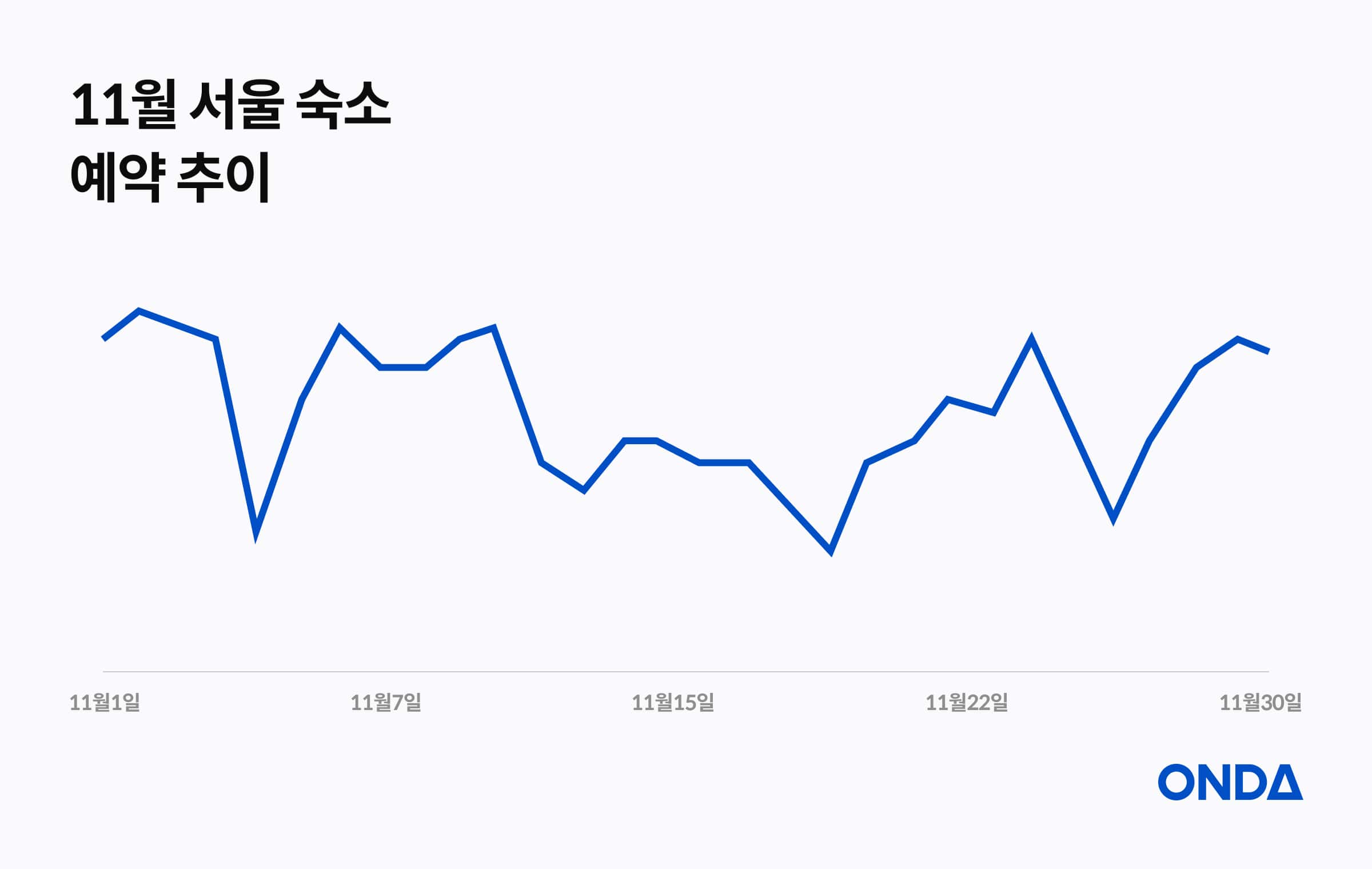
Before we dive into the rankings, let's look at Seoul's overall reservation trend for November.
Bookings in Seoul were generally strongest on Tuesdays and Wednesdays. Peak day: Wednesday, November 2.
The slowest day? Saturday, November 19.
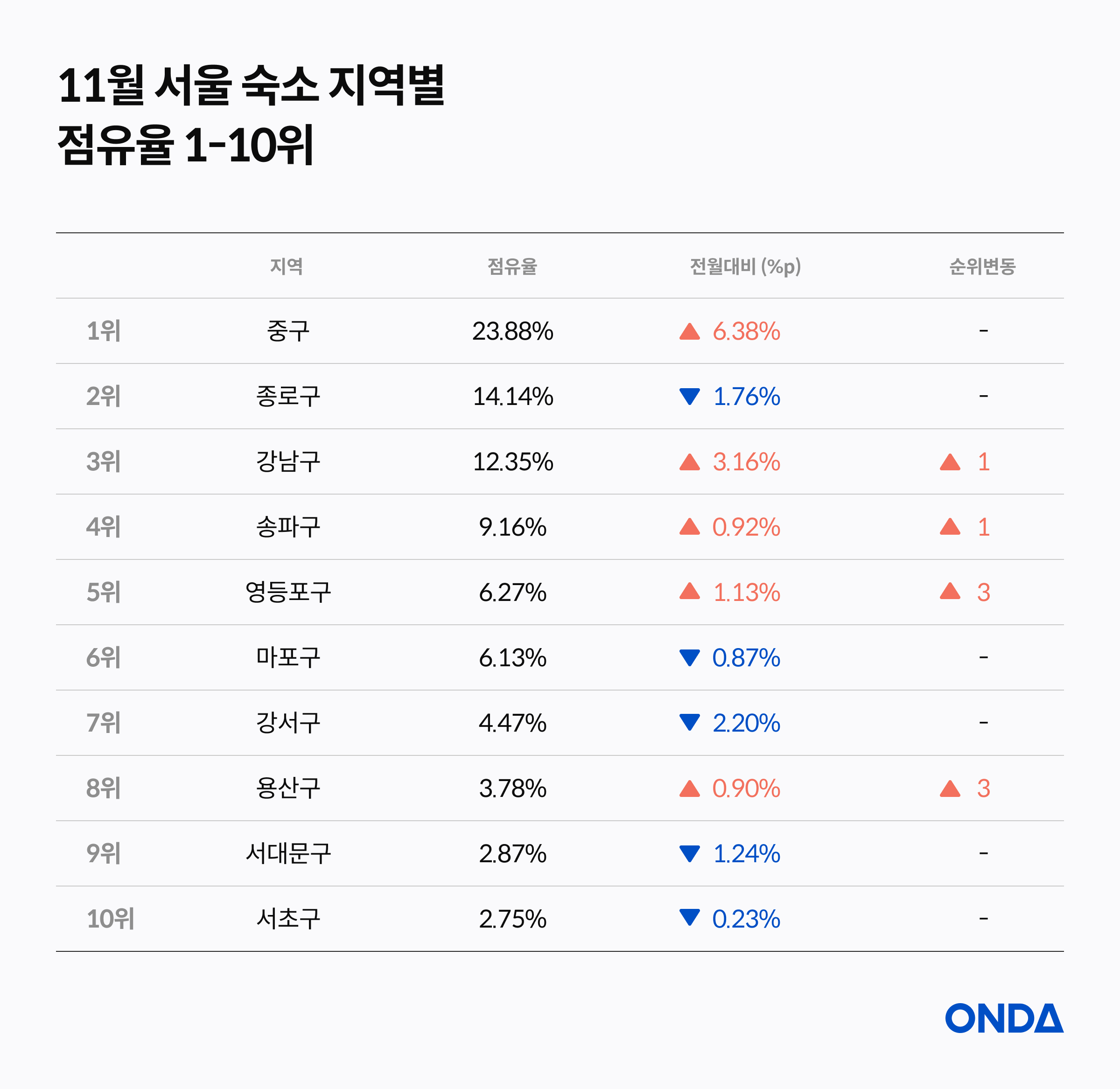
Now, the rankings.
Jung-gu (home to Myeongdong) claimed #1 with a 23.88% occupancy rate — up 6.8 percentage points month-over-month.
Jung-gu was the only district to break into the 20% range, likely driven by the return of international tourists to Myeongdong as Korea enters the endemic era.
According to the Korea Tourism Organization, 476,097 foreign tourists visited Korea in October — a 415% increase over the same month last year (92,416).
The takeaway? Activating global sales channels is no longer optional for accommodation operators.
Jongno-gu held onto #2 with a 14.14% occupancy rate, though it dipped 1.76 percentage points from October.
Most mid-tier neighborhoods kept their rankings. Notable movers: Yeongdeungpo-gu (up 3 spots to #5) and Yongsan-gu (up 3 spots to #8).
Incheon Occupancy by Neighborhood
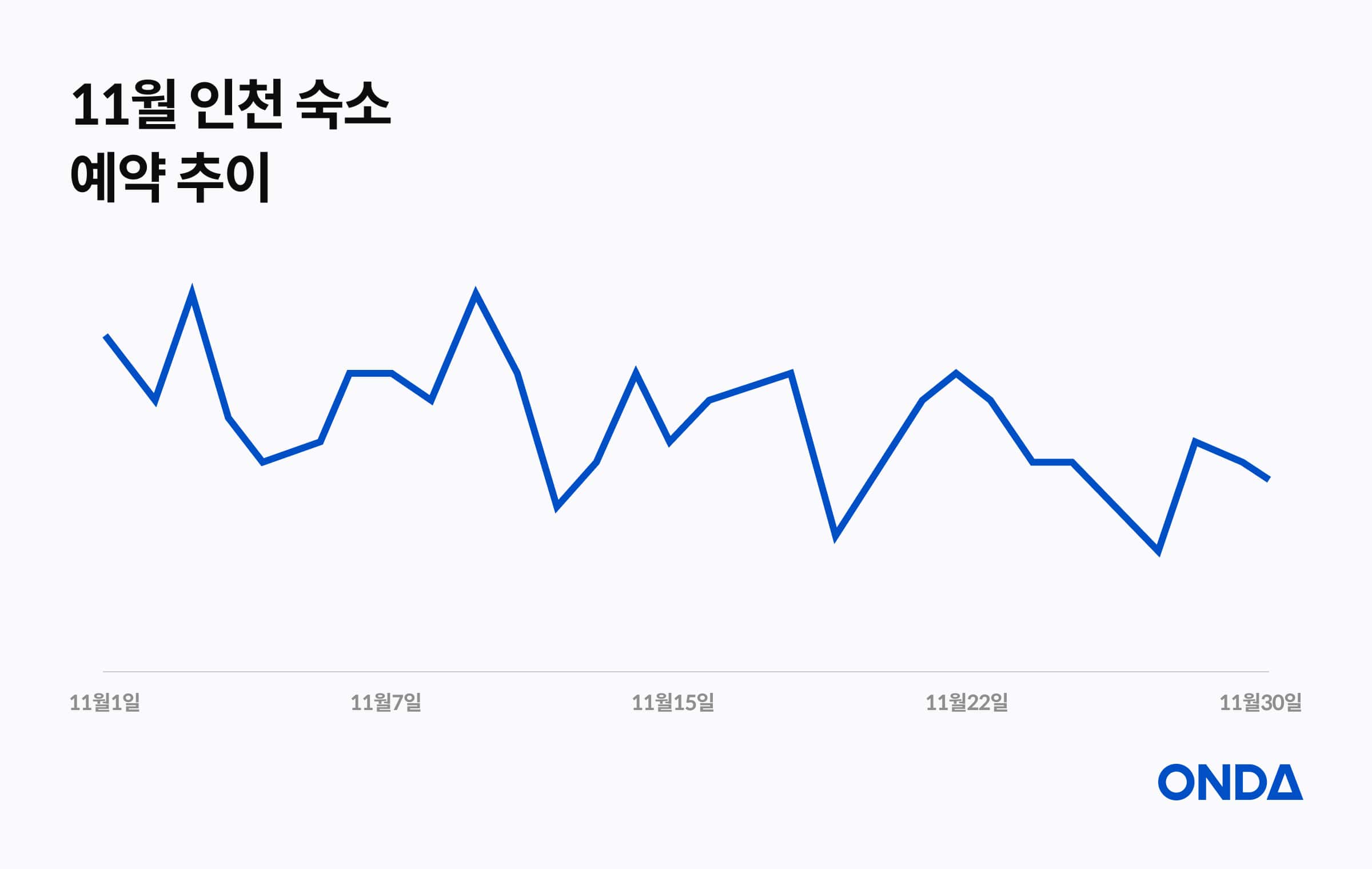
In Incheon, peak booking day was Thursday, November 3. Slowest: Sunday, November 27.
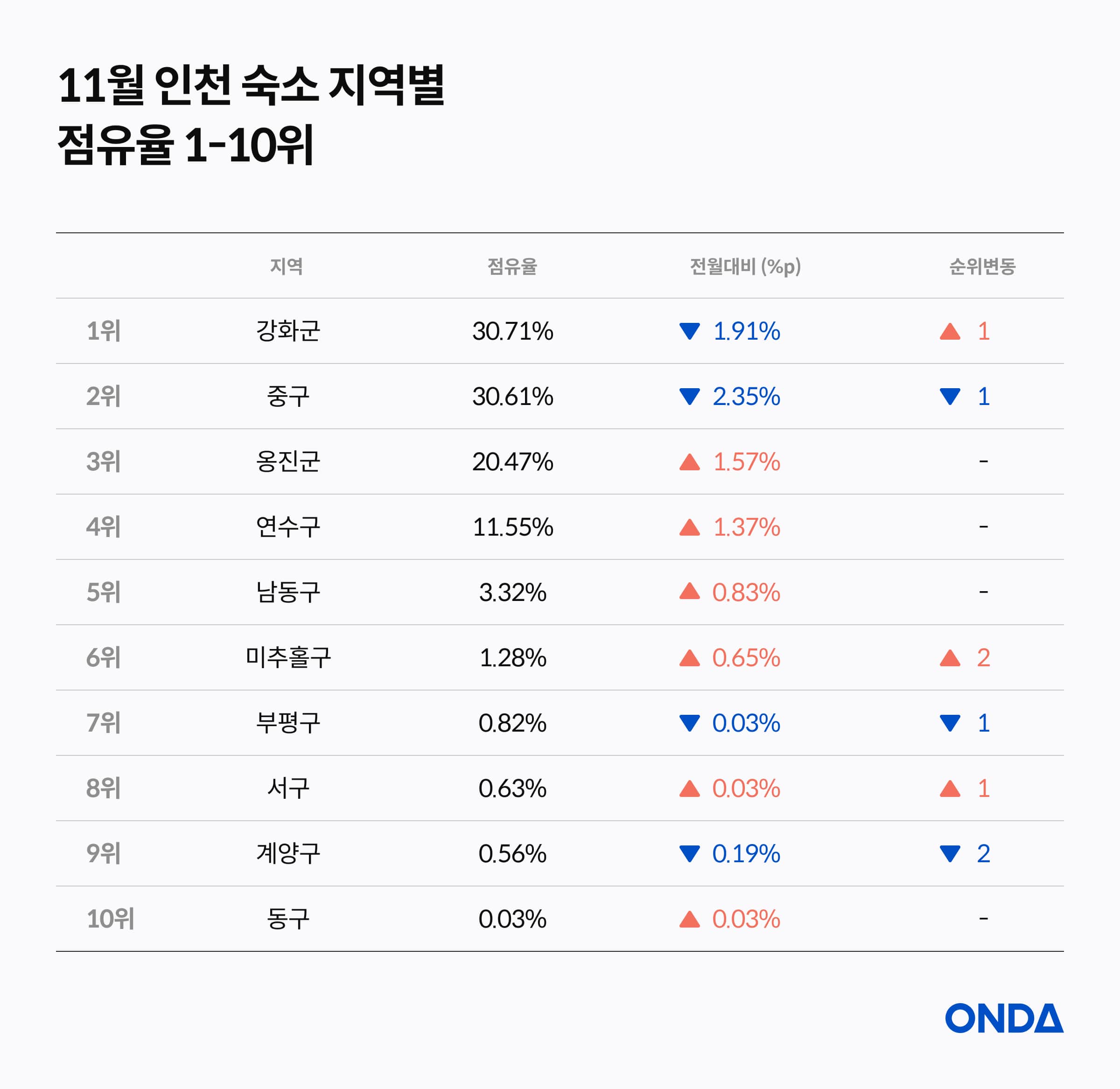
Ganghwa-gun took the top spot in November — moving up from #2 in October — despite a 1.91 percentage point dip in occupancy.
Jung-gu came in at #2 with a razor-thin 0.1 percentage point gap behind Ganghwa-gun.
While the top two neighborhoods saw slight declines, districts ranked 3–5 saw an average 1.25 percentage point increase month-over-month.
Unlike Seoul (where top neighborhoods shuffled), Incheon's volatility was in the 6–10 range.
That's a wrap on our first Big Data piece: November Seoul & Incheon occupancy by neighborhood.
The big story? Foreign tourists are coming back.
And that means one thing for the accommodation market: you need to be selling on global channels.
ONDA customers who've activated international distribution have seen over 50% revenue uplift and an average 95% increase in room utilization.