2023 brings big changes to Korea. Starting June, everyone counts their age the same way (international system), expiration dates become 'use-by dates,' and Gangwon-do becomes 'Gangwon Special Self-Governing Province' — Korea's second special autonomous province after Jeju, 16 years later.
Hello from ONDA — the digital leader in Korea's hospitality ecosystem.
2023 is shaping up to be a year of change.
Starting June, Korea standardizes age counting (international system), switches from expiration to use-by dates, and more.
One regional change: Gangwon-do becomes 'Gangwon Special Self-Governing Province' in June 2023.
It's Korea's second special autonomous province after Jeju — the first in 16 years.
With heightened autonomy, Gangwon can loosen regulations and chart its own development path based on local needs.
Hoping this autonomy creates fresh momentum for the region's lodging market, let's dive into regional occupancy rankings for Gangwon-do and Gyeonggi-do.
Gangwon-do Regional Occupancy Rankings
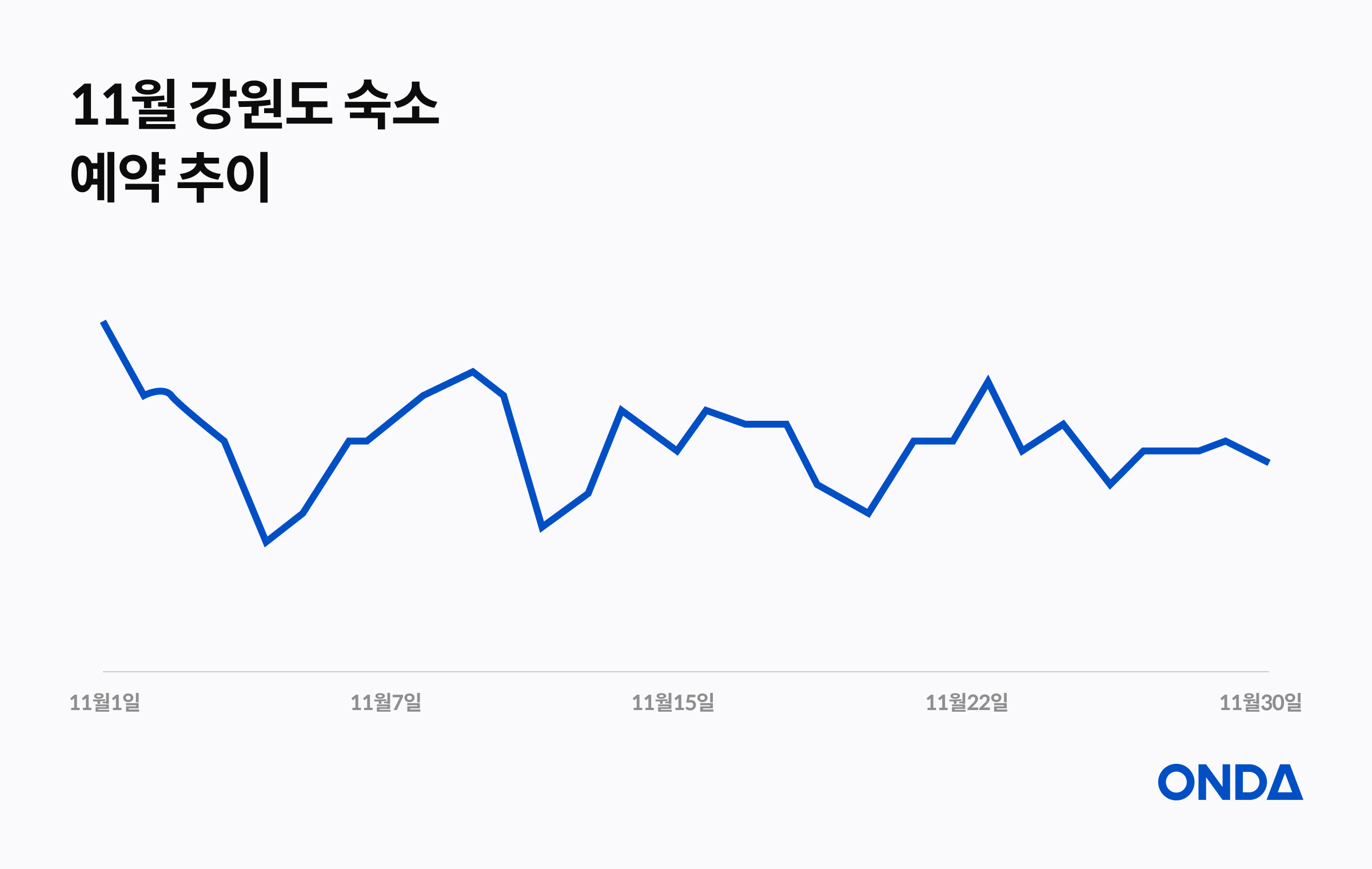
Gangwon-do bookings rose ~4% month-over-month in November.
The real story: December check-in reservations.
Christmas, ski season, year-end holidays — Gangwon saw a 641% jump in December check-ins compared to October.
Compare that to Jeju's 357% — Gangwon's surge is explosive.
The November booking curve shows Wednesday bookings peaked while Saturday hit the low, with a ~7.8% gap between the two.
Top booking day: Tuesday, November 1. Slowest: Saturday, November 5.
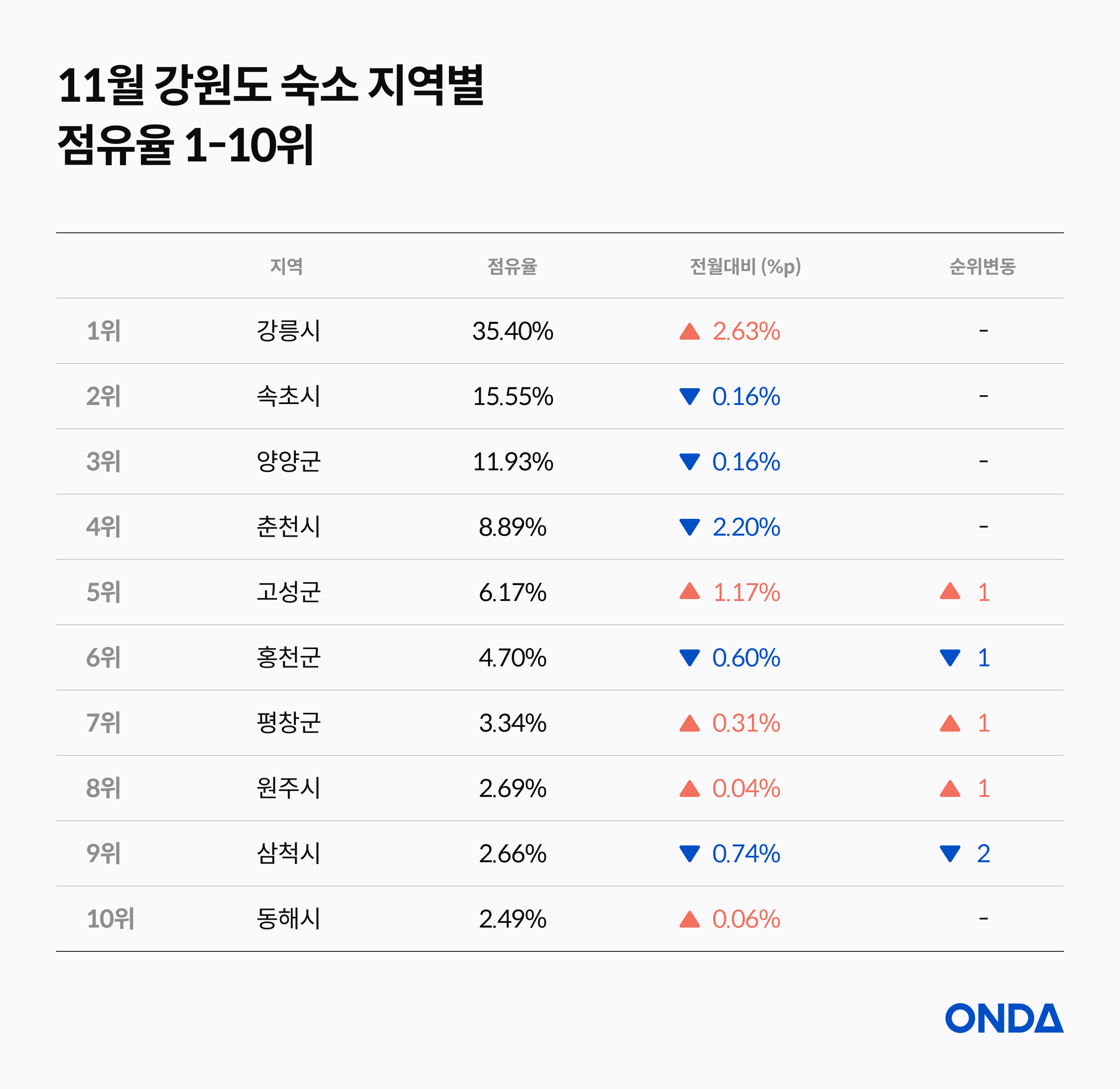
Top Gangwon cities held steady from October.
But ranks 2–4 (Sokcho, Yangyang, Chuncheon) dipped an average 0.84pp month-over-month, while Gangneung alone climbed 2.63pp.
Mid-tier cities saw little change, though slight shifts shuffled the rankings.
Hongcheon slid to 6th (down 0.6pp), while Pyeongchang and Wonju each rose one spot.
Gyeonggi-do Regional Occupancy Rankings
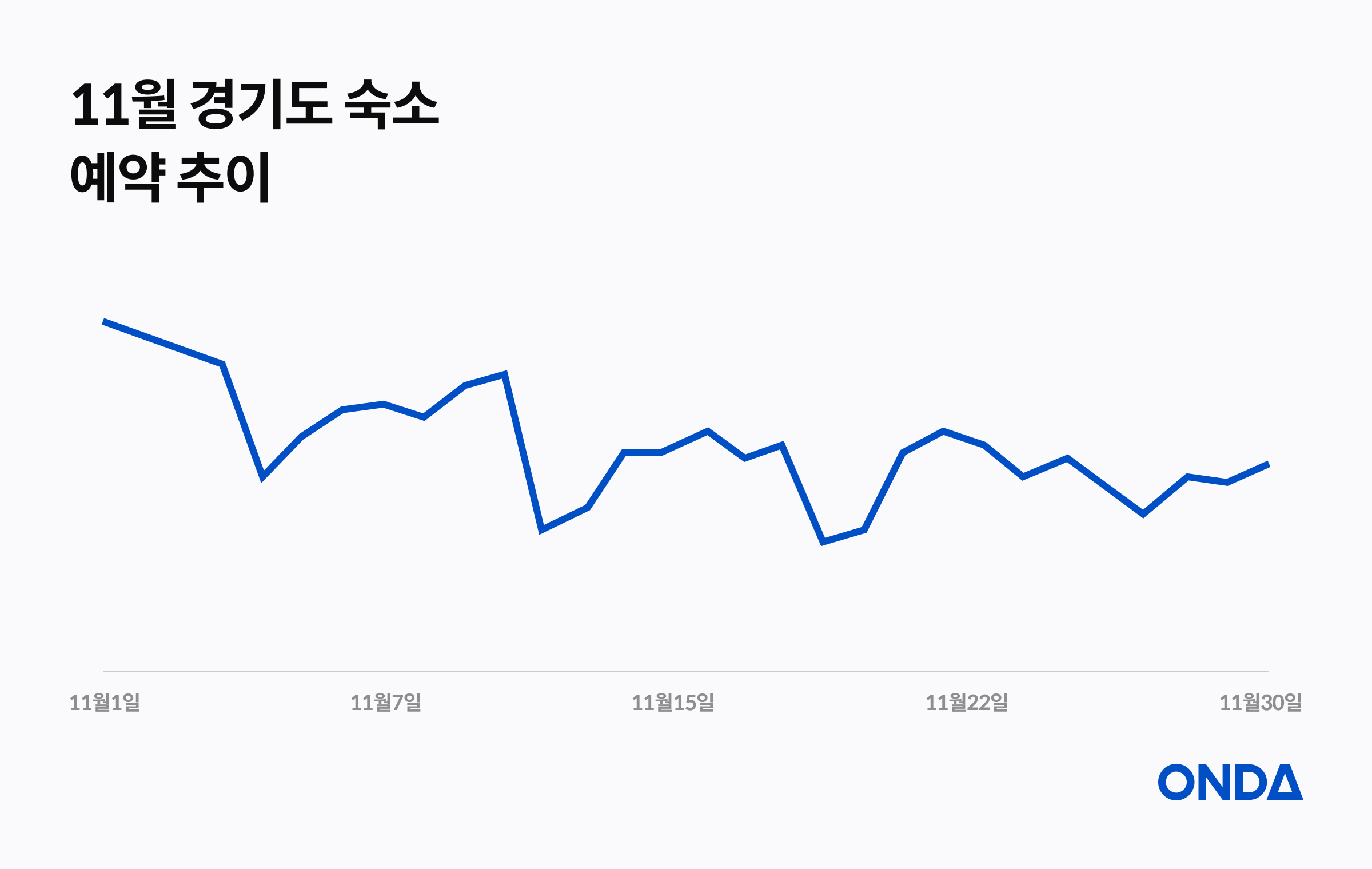
Next up: Gyeonggi-do booking trends.
Peak booking day: Thursday, November 3. Slowest: Sunday, November 27.
For the full month, Wednesday led at 18.18%, while Saturday lagged at 10.36%.
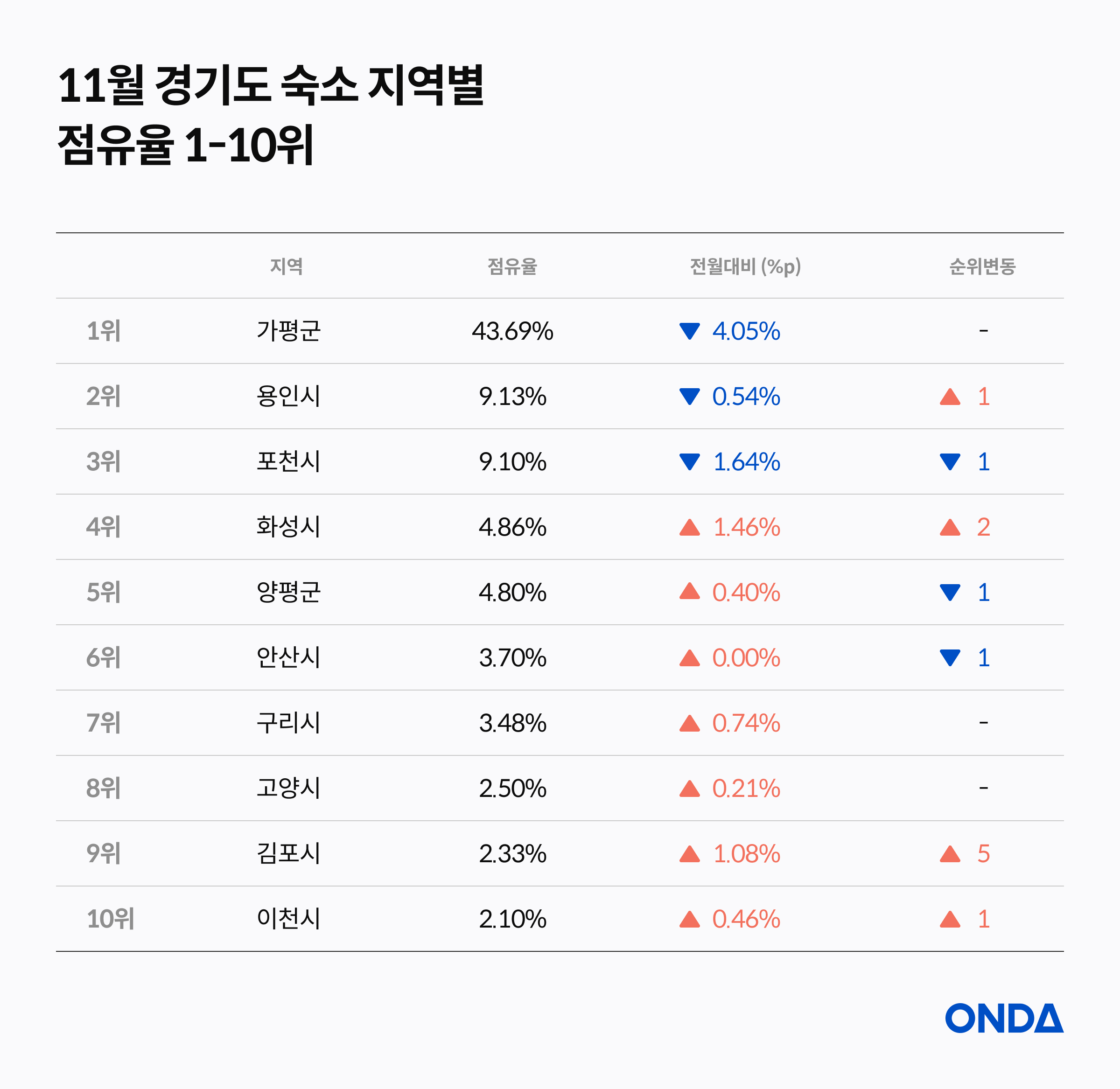
Gyeonggi's occupancy rankings have one standout feature: the #1 city dominates.
Gapyeong dropped 4.05pp month-over-month but still held first place at 43.69% — same as October.
That's ~7x the average occupancy of ranks 2–5 (6.97%).
Ranks 6–10 saw occupancy rise across the board except Ansan (6th).
And now, the answer to this post's title:
The Gyeonggi city that jumped 5 spots in occupancy: Gimpo.
Gimpo bookings surged 86% from October to November.
Result: occupancy up 1.08pp, rank up 5 spots to 9th place in November.
Analyzing ONDA bookings, we saw a spike in properties near Gimpo Airport.
Likely driver: rising outbound travel among Koreans.
In fact, per Korea Credit Finance Association, November personal credit card spending abroad hit ₩1.09 trillion — the second-highest monthly figure in 2022 after August's record.
January–November 2022 cumulative overseas card spend: ₩10.02 trillion, up ~50% year-over-year.
For properties near airports, the takeaway is clear: expand your sales channels to capture more travelers.
Properties using ONDA Pension Plus that connected to 31+ channels saw transaction volume rise 14% and bookings rise 16%.
For small properties outside the pension category, those gains were 38% and 50%, respectively.