Abstract strategy games are pure calculation—no luck, no bluffing, just two minds locked in spatial combat. Here's why these beautifully minimal titles work in hospitality spaces, and which ones guests actually finish.
02. Two Players: Abstract Strategy
By Ahn Min-woo, CEO, Agar Games


Hello, I'm Ahn Min-woo, CEO of Agar Games. Did you kick off January with energy? The board game market is buzzing too—everyone's scrambling to prep new releases for the world expo this October.
Starting this installment, I'm going to recommend board games that fit beautifully into your space. Today: abstract strategy games—the crown jewel of two-player gaming.
What Are Abstract Strategy Board Games?
You've probably heard the term "abstract strategy" thrown around, but what does it actually mean? Simple: these are games where the rules are dead simple to learn, but the strategy is devastatingly hard to master. More specifically, in abstract strategy games, all information is visible to both players, and luck plays zero role (unless your opponent messes up). Think Go, chess, or janggi—those are textbook abstract strategy.
This definition gives you a feel for how you win these games. No luck, no bluffing—just pure calculation. That's why abstract strategy thrives in two-player formats over three- or four-player. The reason? Add more players and politics dilutes the head-to-head calculation that makes these games sing. Most legendary abstract games are built for two.
This creates a useful shortcut for couples or pairs at board game cafés: the phrase "abstract strategy" alone helps you filter games. Two-player gaming cuts out auction mechanics and party chaos, leaving abstract strategy as the dominant genre. Walk into a café with a friend, ask for abstract strategy (or ask for anything but abstract strategy), and you'll land on the vibe you want.
Recommended 2-Player Abstract Strategy Games
Today I'm covering three abstract strategy games that are both wildly popular and perfect for hospitality spaces. These work whether you're chatting casually or locked in deep concentration. Let's go.
I'll introduce them in the order I usually recommend to guests at our game space.
1. Quoridor
Quoridor is structurally simpler than the games that follow, but its win condition is brilliantly strange. The goal: advance your pawn to the opposite side of the board while blocking your opponent from reaching yours. First to the other side wins.
Quoridor supports up to four players, but the real game shines at two. The simplicity of play amplifies the importance of reading ahead and executing stealth tactics. How far can you see? How well can you hide your strategy?
On your turn, you can move your pawn one space in any cardinal direction, or place a wall to block your opponent (each player gets 10 walls). You can only do one action per turn. If your opponent's pawn is directly in front of you, you can jump over it.
The critical rule: you can never completely block your opponent's path. This one constraint explodes the strategic space. With a finite board and 20 walls total between both players, you must carefully decide when and where to commit your barriers. Early and mid-game play is deliberate; by late game, you can often see who's winning.
The delicious dilemma: burn walls too freely and you'll run dry at the critical moment. Hoard them and you'll miss your window. Classic risk management baked into the genre.
My personal strategy tip: when moving, aim for odd-numbered lanes—your opponent will need more walls to block you. I also play conservatively with walls. Fewer walls used = psychological edge + more options. But that dilemma? It never stops knocking.
Visually, Quoridor is gorgeous. It's made of natural wood, which doubles as décor. You can see the European wood grain peeking through the stain—classy, weighty. The photo shows wear from our café's heavy use, and even that patina looks refined. The publisher Gigamic's entire wooden abstract line (Quixo, Quarto, etc.) shares this unified design language. They look stunning displayed together. (The price tag, less so.)
I think Quoridor's biggest draw is its short play time and the fact that it's a race game—counting moves to the finish is way easier than Go-style territory control. It's the perfect abstract strategy gateway game.
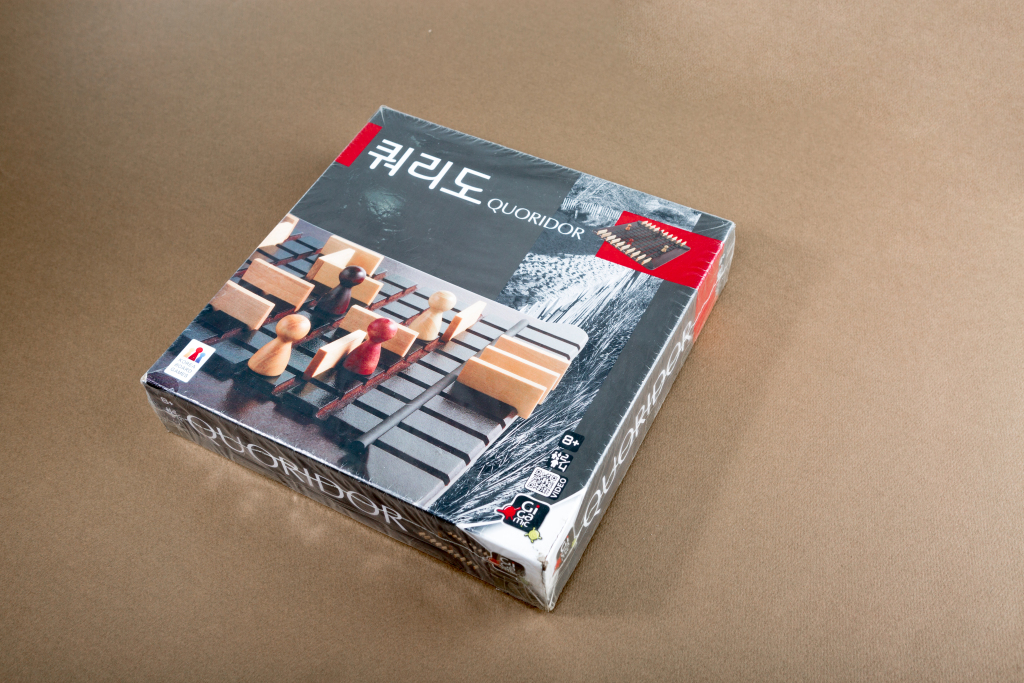
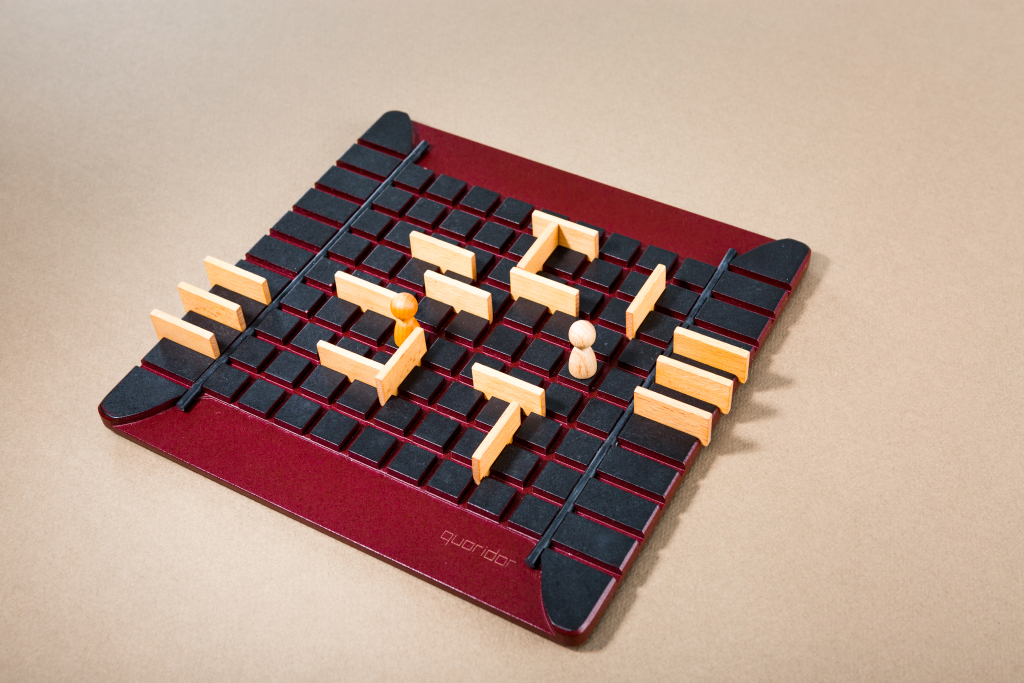
Gateway abstract strategy game: Quoridor
2. Abalone
Abalone isn't terribly complex either, but I list it after Quoridor because of snowballing—once you gain an advantage, it's easier to keep pressing. In Quoridor, your wall supply runs out, giving your opponent comeback potential. In Abalone, there's no such relief valve.
Each player picks white or black marbles. Set them up as shown in the photo, then push or pull to shove six of your opponent's marbles off the board first. You win.
On your turn, you can move your marbles in any of six directions. You can move up to three marbles per turn (e.g., one marble three times, or three marbles once). If marbles are adjacent, they move together. When pushing in a straight line, if your marbles outnumber your opponent's marbles and they're in a contiguous line, you can push the opponent's marbles one space in the same direction. Equal or fewer marbles? No push. Shove enemy marbles to the edge, then off the board—six marbles eliminated wins.
The fun lies in using a single move to control six directions of movement, the balance of your forces, and leverage points. You can dodge attacks, cut off attack lanes, or flip leverage to steal control. This is where difficulty spikes—I expected hesitation when explaining Abalone to newcomers.
But Abalone surprised me. Despite its difficulty, reactions were overwhelmingly positive. Repeat customers too. I watched play sessions and asked around. The verdict: Abalone's tactile joy. The marbles are smooth and addictive to handle, but the real magic is the thunk when you push a marble into position. That impact feel is ridiculously satisfying—it drives "one more game." Visually, the black-and-white palette is clean and elegant.
As you can see in the photo, Abalone's popularity has worn down the box. If you stock Abalone in your space, keep an eye on those smooth, round marbles—they're easy to lose. And if one falls from height onto a hard surface like tile or stone, it might shatter.
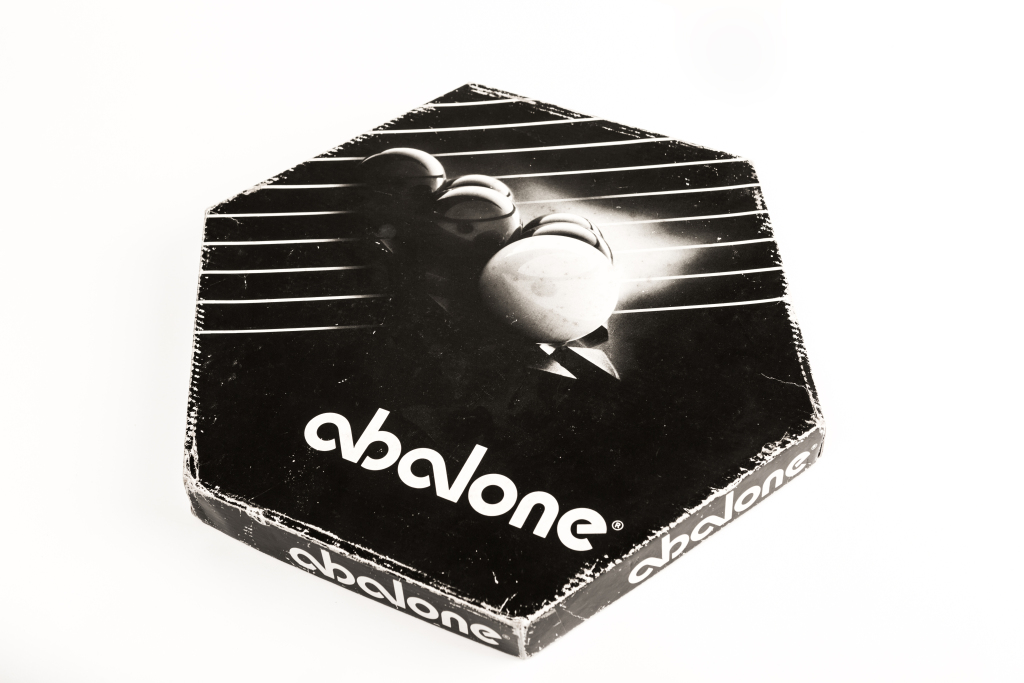
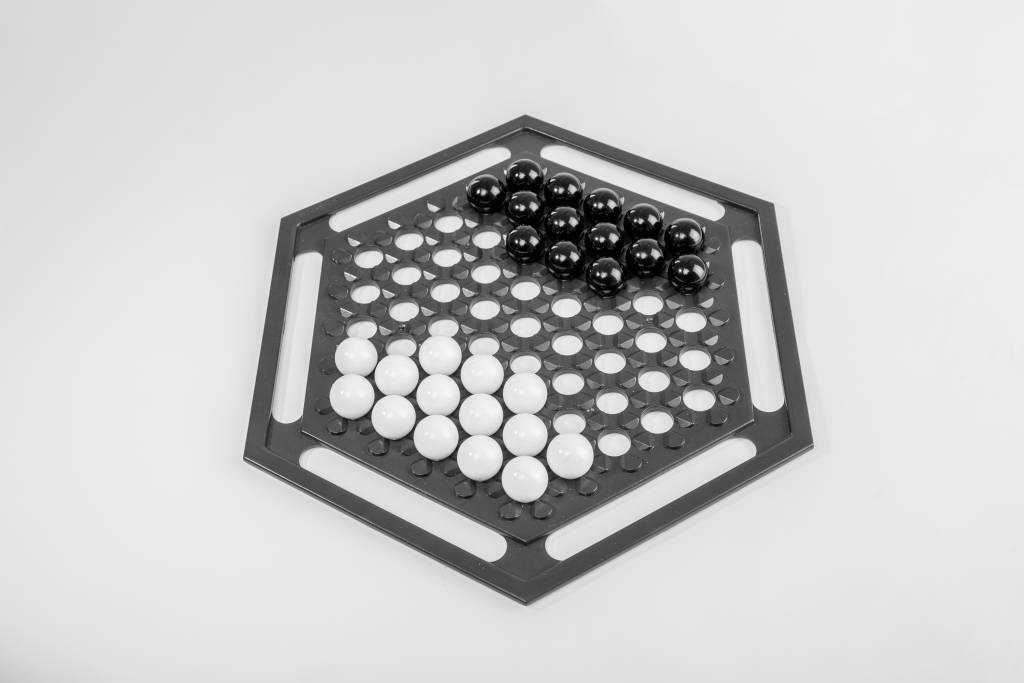
The tactile joy that made Abalone a hit
3. Dvonn
The final game I'm covering today is Dvonn. I save it for last after Quoridor and Abalone because the rules are trickier. When neither player can move any more pieces, the game ends—whoever controls more pieces wins.
Dvonn belongs to the GIPF Project series (like Gigamic's line). It's my favorite from that series, and it pairs beautifully with Quoridor and Abalone. The GIPF Project's strength: thematic coherence. I value games where theme and mechanics align. Most abstract games are, well, abstract—themeless. But GIPF games draw on natural phenomena. I was especially taken by YINSH, themed around a tornado.
Dvonn is volcanic. The box art says it all. Stacks and fire. Place it next to the board during play and the premium aesthetic shines through. Like other two-player abstracts, player pieces are black and white. But Dvonn adds red pieces—representing volcanic heat or the molten core itself.
Here's the twist: to survive, your pieces must stay connected to at least one red piece. Lose that connection and your pieces crumble off the board instantly—brutal.
Think of the board as a vertical cross-section of Earth—the planet sliced lengthwise. This helps make sense of the rules: you can only move pieces on the perimeter, and fully surrounded pieces can't move.
Setup: players alternate placing the three red pieces, then alternate placing their own pieces. On your turn, you move one of your pieces in any of six directions, one space. When you land, you stack your piece on top of whatever's there. The top piece controls the stack. If your opponent's piece was underneath, you just seized it.
The height of a stack determines how far it must move—a stack of five pieces must move exactly five spaces in a straight line. No changing direction mid-move. No stopping short.
For first-timers, I recommend shuffling all pieces and randomly placing them on the board for Game 1. Starting Game 2, the loser places the two red pieces, then players alternate placing pieces one by one, Go-style.
Dvonn's "capture by covering" rule creates wild variance. Control pressure is intense. You can even cover and move the red pieces. Since you can't move onto empty spaces and must move the full stack height, range calculation is critical. Tall stacks become hard to move and easy to attack. At game end, total up the height of all stacks you control—tallest wins (a quick scoring shortcut).
There's no passing—if you can move, you must. This forced-move rule keeps tension high until the final turn. Dvonn makes calculation a delight.
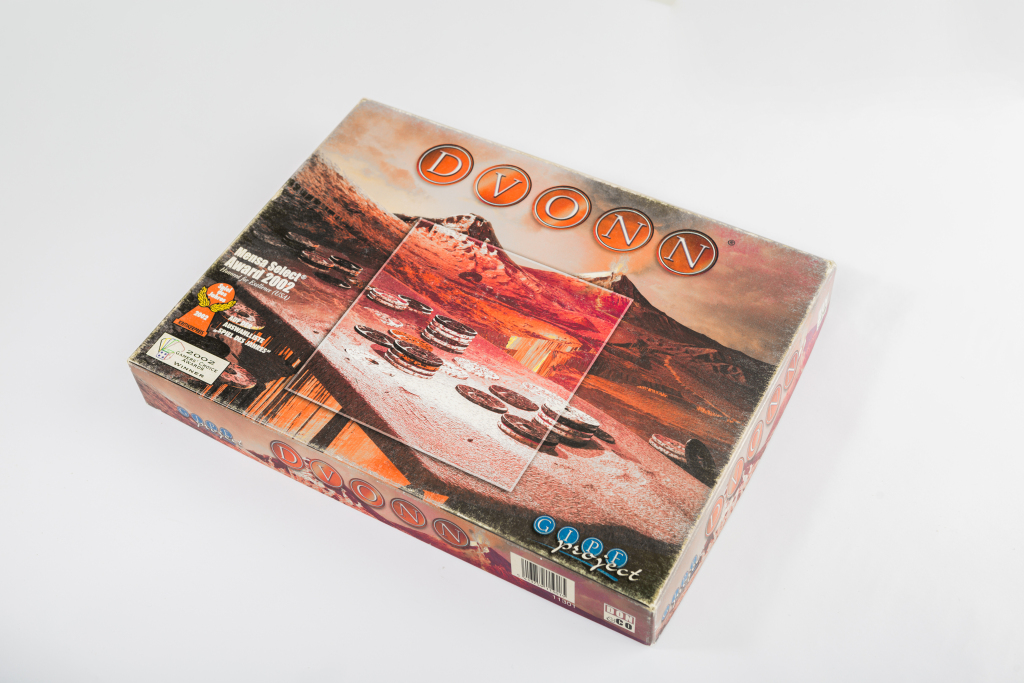
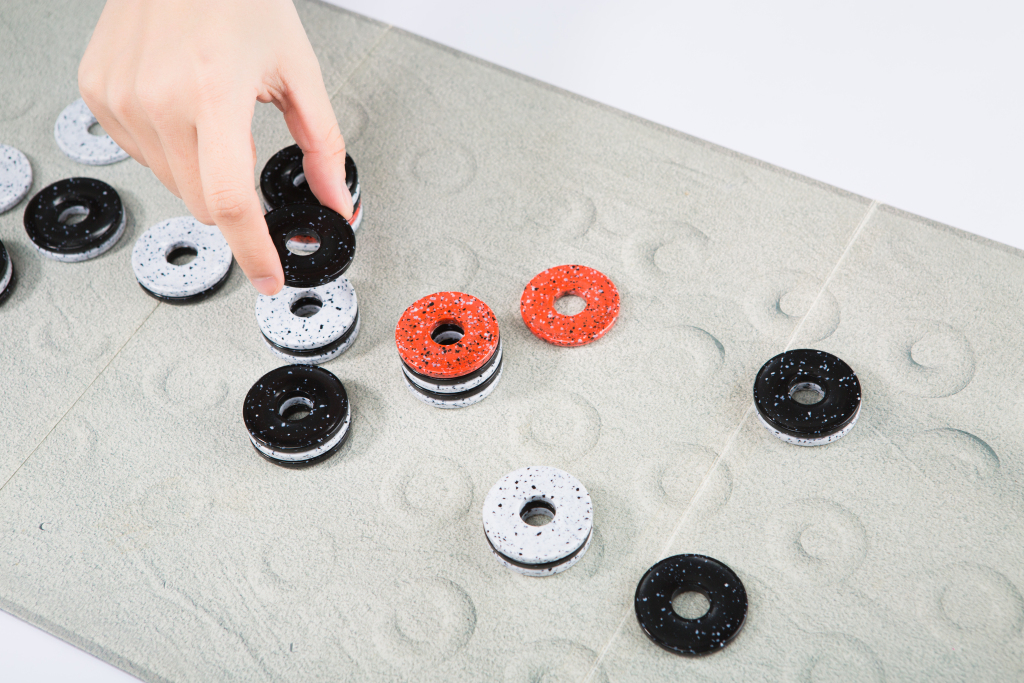
Dvonn: the calculation is the joy
Wrap-Up
That's my curriculum—Quoridor, Abalone, Dvonn—the three two-player abstract strategy games with the best reception over five years and thousands of guests. All three have been Mensa Select winners, so they're great for cognitive development too.

If these descriptions didn't click or you want full rules, visit the publisher websites or board game communities (BoardLive, BoardGameGeek) for official rulebooks.
Next installment: lighter two-player games focused on psychological warfare. Happy Lunar New Year, and happy February!
[Series Index]
2019.01 Introduction 紹介 2019.02 Two Players: Abstract Strategy 2019.03 Two Players: Psychological Warfare 2019.04 Two Players: Card Games 2019.05 Special: Big Games 2019.06 Three to Four: Placement 2019.07 Three to Four: Deduction 2019.08 Three to Four: Card Games 2019.09 Many Players: Bluffing 2019.10 Many Players: Negotiation 2019.11 Many Players: Mafia 2019.12 Reflections 所懷
View full magazine >>
⚠️ All rights reserved. Cite this piece as 'ONDA (온다)' when quoting.