Discover three beautiful tile-placement board games perfect for hospitality spaces — Marrakech, Reef, and Ticket to Ride.
06. Three or Four Players: Placement <Splendor></Splendor>
Writer: Ahn Min-woo, CEO, Ahgoh Games
Editor: Somora Manager, ONDA
Photo: Yuhwa Garang & Studio Sio


Hello, I'm Ahn Min-woo, CEO of Ahgoh Games. Summer's here in earnest — you can feel the energy surging on the streets. Just the other day I spotted people playing board games by the Han River, cold beers in hand, looking so happy I decided to do the same with friends this summer.
So from this installment onward, I'm stepping beyond two-player games to introduce titles that shine with three or four people. Today's focus: games built on 'placement' — perfect for your hospitality space.
Feature: Placement
The placement genre is usually labeled "Tile Placement" in the hobby, but since today's picks don't always involve literal tiles, I'm just calling it placement. The core mechanic is simple: place game components on a board according to certain rules, form specific patterns, and score points.
To win at placement games, you need to understand not just how the scoring works, but also how to chain combos as the game progresses — synergy matters. And you want to pursue scoring paths that don't overlap with opponents, minimizing competition and maximizing efficiency.
Now, let's explore three games, ordered from easiest to deepest.
1. Marrakech
01_About the game
Our first pick is Marrakech, named after the Moroccan city. Here, you play a rug salesman. Sell more than your rivals, and you win. When I first saw this game, I was drawn to the colorful fabric pieces inside — totally unique. It's easy to learn and not overly strategic, so it's a light go-to in our space, and guests love it.
02_How to play Marrakech
Spread out the board. Inside the little paper box you'll find four colors of rug fabric — each player picks one. You'll also see a wooden die and a wooden pawn that looks like a little man. His name is Assam. Place Assam in the center of the board. Distribute 30 dirhams (money tokens) to each player.
Marrakech has a quirky rule: players are distinguished by rug color, but only Assam moves when you roll the die. He's the hero.
On your turn, roll the die and move Assam. You can move him straight ahead, or rotate him 90° left or right first, then move. (Fun detail: if he hits a wall, he follows the wavy pattern drawn there.) He can't turn 180°. If you land on an empty space or your own rug, you pay nothing. But if you land on an opponent's rug, you pay them dirhams equal to the contiguous squares of that rug color touching Assam's space. Then you place one of your rugs adjacent (orthogonally) to Assam.
Rugs can overlap others or span empty squares, but you can't place a rug in the exact same shape over an existing one. Everyone starts with the same number of rugs. When someone runs out, the game ends. Each visible rug square = 1 point, each dirham = 1 point. Highest score wins.
03_Strategy
This game is mechanically simple, but you need to grasp the economics to enjoy the push-and-pull of stepping on each other's rugs. That's why I don't usually lead with this for total newbies. You score dirhams when opponents land on your rugs during the game, but at the end you score for territory controlled — so you need a long game. If you run out of money mid-game, you're immediately eliminated (even though you start with 30 dirhams, don't get complacent).
Also, when an opponent lands on your rug, they may cover it with their own — so watch out when someone's trajectory aims for the center of your biggest rug cluster. Do you redirect them to protect your turf, or let them land to milk a big payout? This is a light strategy game that thrives on table talk and politics. Flip side: if players don't actively check the leader, one person can snowball to an easy win. Beginners need a gentle hand. There's definitely some snowballing here.
For more fun, use the variant rule. I learned the variant first and thought it was the default. Once I saw the base rule, I preferred the variant even more. The twist: you don't choose Assam's direction — the previous player does. After you roll, move, pay (or not), and place your rug, then you set Assam's direction for the next player. More interaction, more chaos.
04_Visuals
Despite the cutthroat gameplay, the finished board looks like the box art — rugs beautifully arrayed. Hard to believe that pretty mosaic came from ruthless carpet warfare. The art style matches the theme perfectly. Mustachioed wooden Assam, sandal-decorated die, lightweight dirham coins — they all scream Morocco. The money is called dirhams, and the visual identity backs it up.
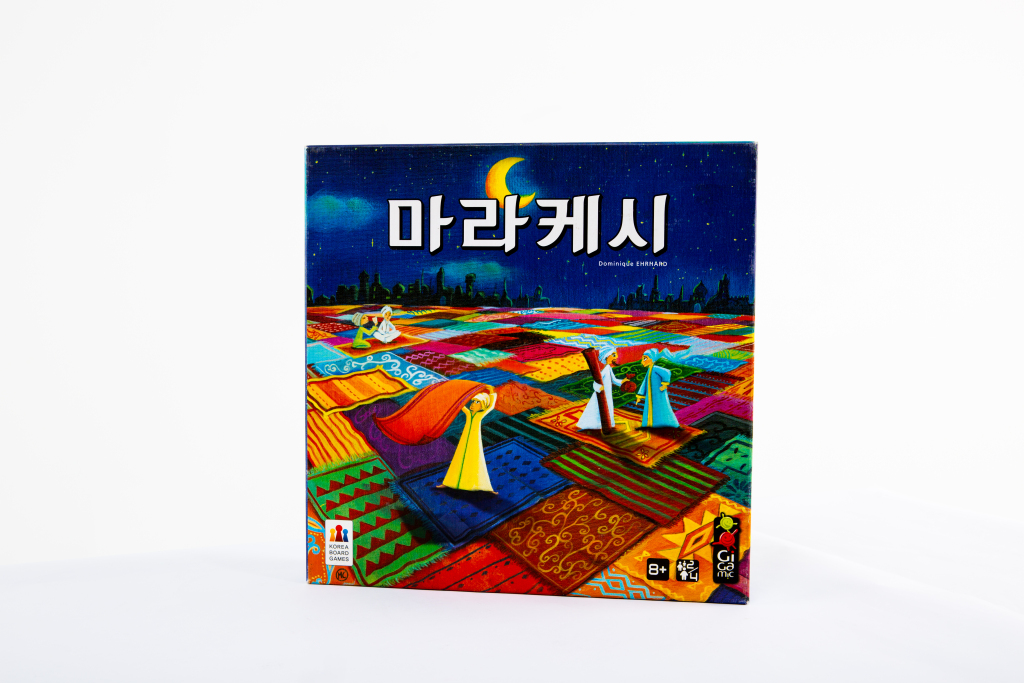
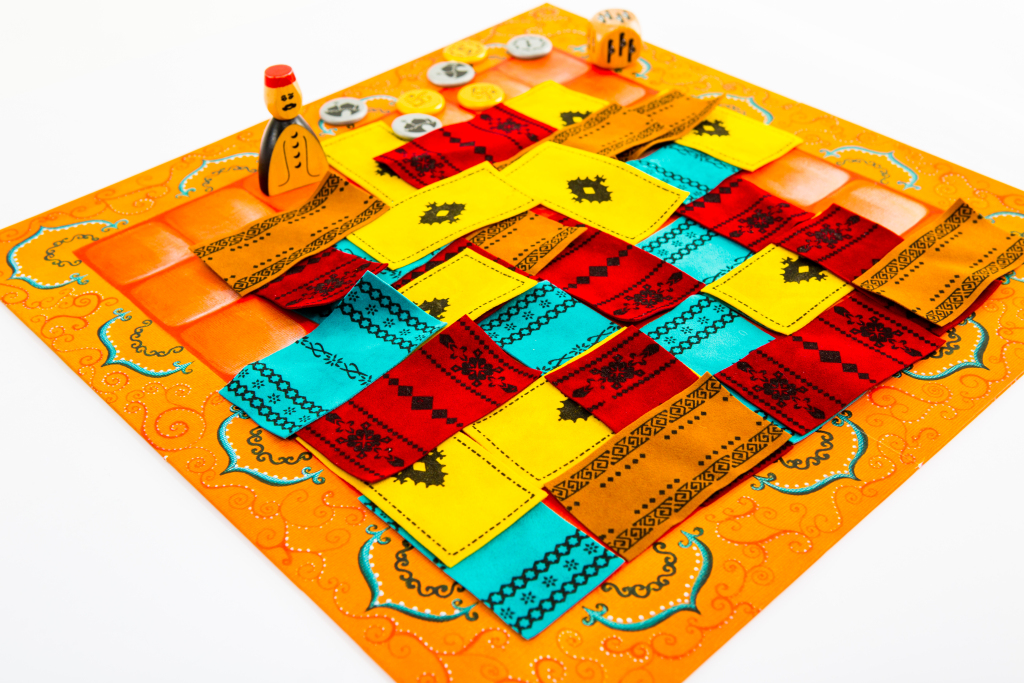
Sell more colorful rugs than your rivals in 'Marrakech'
2. Reef
01_About the game
After Marrakech, you're ready to become a coral reef. In Reef, you build a stunning coral structure on your personal board to score points. The box is noticeably bigger, and the components make a satisfying clatter when you pour them out — guests' faces light up every time. The core mechanic is pattern building, but since you need smart placement to complete those patterns, it belongs in this essay.
02_How to play Reef
Unlike Marrakech, Reef involves hand management. On your turn, you either play a card from your hand, or draw a card from the center. The center has a facedown deck plus three faceup cards. You can only do one action per turn, and your hand limit is four cards. So timing matters.
What makes Reef unique: each card has two uses — top and bottom. The top half tells you which coral pieces to take and place on your reef. The bottom half shows a pattern — a scoring condition. If your reef matches that pattern, you score the points shown on the bottom. (You can score multiple times if the pattern appears multiple instances.) The game ends when one coral color is exhausted or the deck runs dry. Highest score wins.
Pattern scoring checks the top-most coral color in each stack, so colors mix within a single column as the game progresses. You only score when you play the card and trigger its pattern — building coral alone doesn't score unless you cash in a matching pattern card.
There's an elegant twist borrowed from games like Puerto Rico: if you don't like the three faceup cards and want to draw blind from the deck, you must place 1 point from your score onto one of the faceup cards to sweeten the pot for someone else.
03_Strategy
Because cards have dual uses, you can run out of pattern cards even if you haven't gathered enough coral. Minimize wasted scoring opportunities by carefully sequencing your plays and collecting small wins. Since you're drafting coral from a shared pool, you must watch your opponents closely. What cards do they hold? Which colors are they collecting? Infer their strategy.
Patterns repeat across colors — if pink has pattern A, so does yellow. Harder patterns score more, so if you want big points, specialize in one or two colors. Competing for the same color as an opponent is a losing proposition. Also, try not to finish the game holding too many cards — you can still cash in patterns with the bottom half, but each pattern can only score once, so don't hoard them. Better to trigger your big setups early. Reef demands more strategic foresight and active blocking than Marrakech.
04_Visuals
The colors are vivid and vibrant, right? The coral theme is nailed. A 4×4 grid covered in multicolored coral looks gorgeous. I suspect the designers intentionally made scoring depend on the top coral so that mixed-color stacks still look appealing. Normally I'm not a fan of plastic components in board games, but Reef needs plastic to achieve this brightness — it works. The shapes are smooth and streamlined, too. Kids love them.
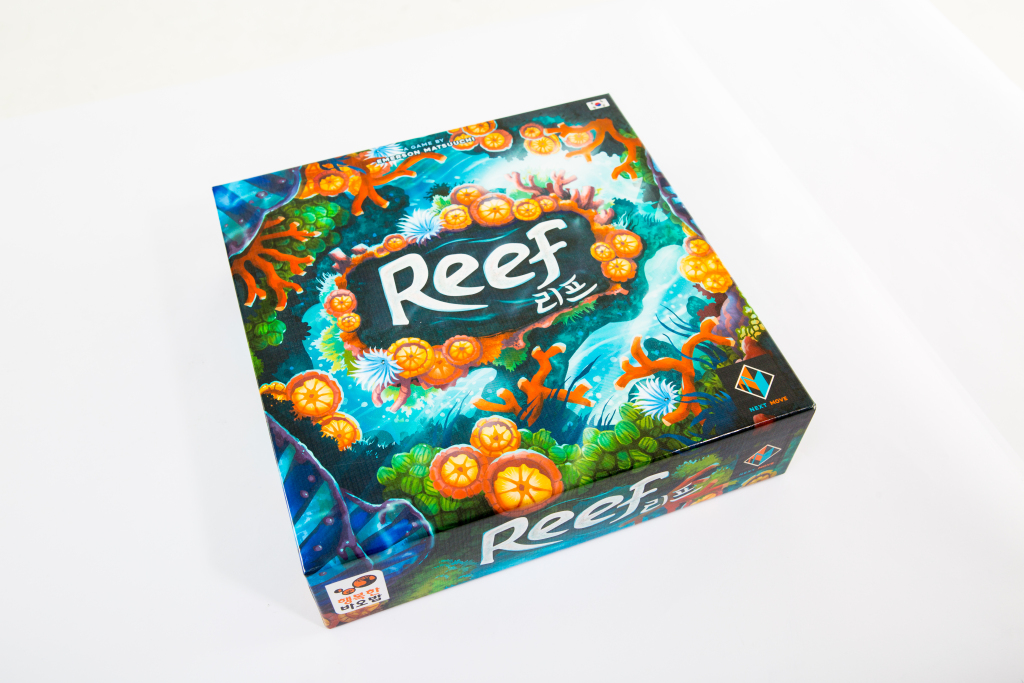
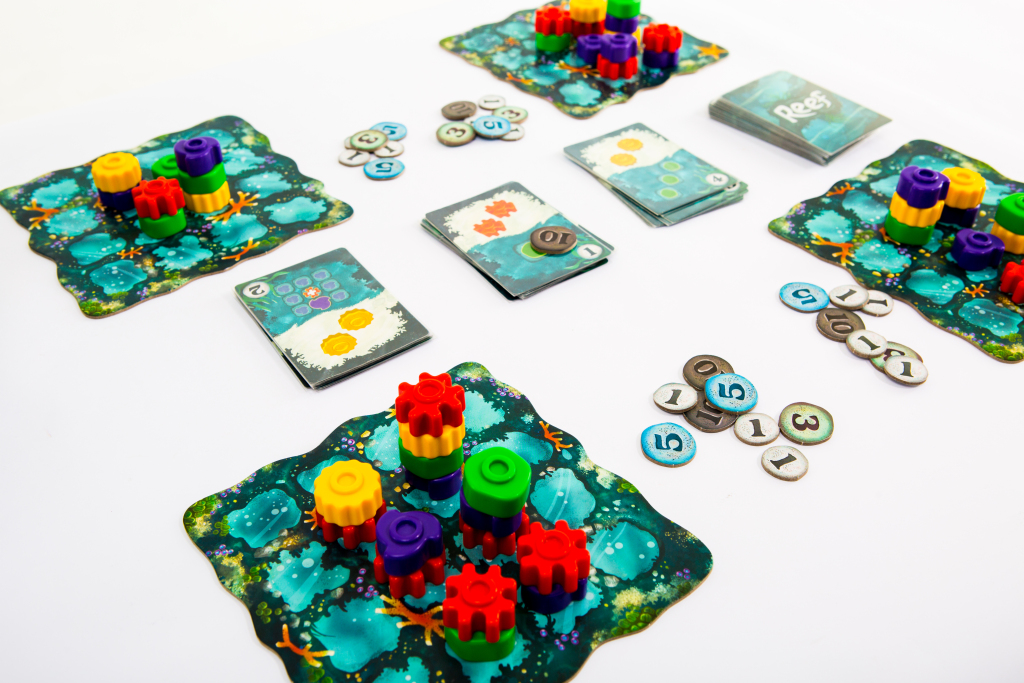
Play cards to build a dazzling coral reef in 'Reef'
3. Ticket to Ride
01_About the game
Ticket to Ride is all about connecting train stations. See that tagline at the bottom of the box? 3 million copies sold. That's staggering. These days, if a new game sells 10,000 copies it's a hit — shelf life is short. But 3 million? That's the power of a 15-year-old classic. Rules-wise, Reef is actually a bit more complex, but Ticket to Ride takes longer to play and has a much bigger footprint — hence why I saved it for last. (Visual scale is a barrier to entry, too.)
02_How to play Ticket to Ride
Ticket to Ride plays similarly to Reef. Well, Ticket to Ride came first — Reef borrowed from it. Choose your train color, draw four train cards. The rest of the deck stays facedown; flip five cards faceup. On your turn, you can play train cards to claim a route, or draw new train cards. Just like Reef: use or draw. The big difference: no hand limit, and when you claim a route, you can play as many matching cards as you want (up to the route's length).
Train cards are used to claim routes between adjacent cities. You must match the route's color, play all required cards at once (no partial claims), and you can only claim one route per turn. When drawing, you get two cards — either blind from the deck, or one faceup card (but only one if faceup). There's also a rainbow locomotive wild card that can substitute for any color.
Scoring works two ways. First, every time you claim a route, you score points based on its length. Second, you start the game with three destination ticket cards showing long-distance connections (e.g., New York to Los Angeles). Building the required path earns big bonus points at the end. But if you fail, you lose those points. So choose your tickets carefully. (You must keep at least one.)
There's also a shared objective: the player with the longest continuous route gets a bonus. The game ends when any player has two or fewer trains left. Add up route points, longest-route bonus, and destination tickets (positive or negative). Highest total wins.
03_Strategy
Timing card use mirrors Reef. But unlike Reef's personal boards, Ticket to Ride uses a shared map — so you can directly interfere with opponents' plans by claiming routes they need. Choose destination tickets that overlap geographically — better efficiency. Remember: failed tickets hurt you, and harder tickets pay more. Balance risk and reward.
Don't hoard cards just because there's no hand limit. Claim key routes early to block opponents and secure your own paths. You can take one extra action mid-game to skip your turn and refresh destination tickets (draw three, keep at least one) — use this wisely.
Pro tip: don't score routes as you claim them. Wait until the end and tally all at once per player. It saves time. You can eyeball opponents' progress by how many trains they've placed.
04_Visuals
Bright and colorful, yes — but the art and fonts skew vintage to match the old-timey train theme. Personally, I think wood components would've felt more authentic than plastic here. Reef's plastic works; Ticket to Ride's feels less charming. That said, the 10th Anniversary Edition with upgraded components? Chef's kiss. Ticket to Ride has so many country-specific versions (Europe, Asia, etc.) with different maps and art — find one you love.
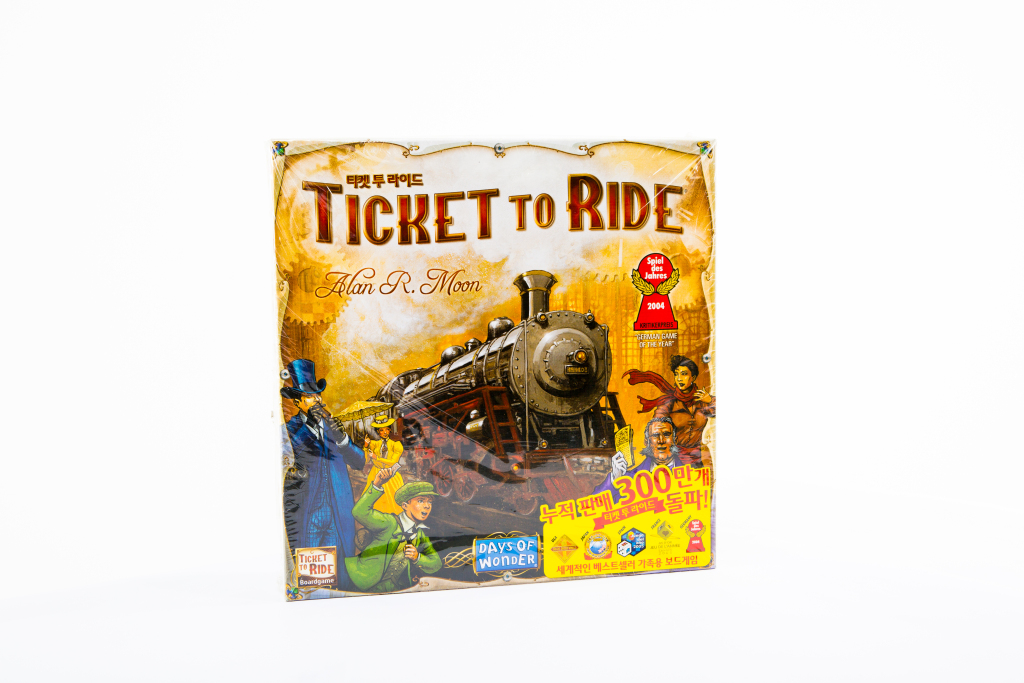
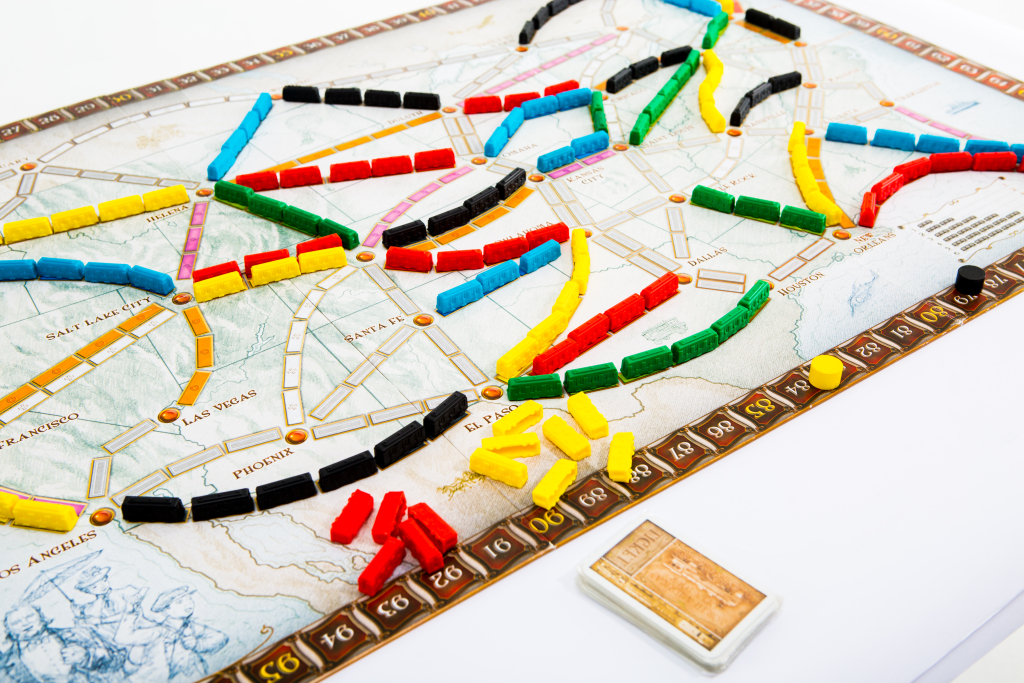
The classic route-building game 'Ticket to Ride'
Fine.
From Marrakech to Ticket to Ride. These are the three or four-player placement games that, over five years and thousands of guests, consistently earned the best reactions. You might wonder why I didn't mention Carcassonne — a genre staple. True, it's iconic, but its scoring isn't intuitive for beginners, so I don't lead with it. Once you've played today's three, though, Carcassonne will feel much more accessible and enjoyable.
For detailed rules, check each publisher's official rulebook or community sites like Boardgamegeek or 보드라이브 (Board Dive).
Next time, I'll introduce games for three or four players that lean heavier into deduction and tension. Have a wonderful day!
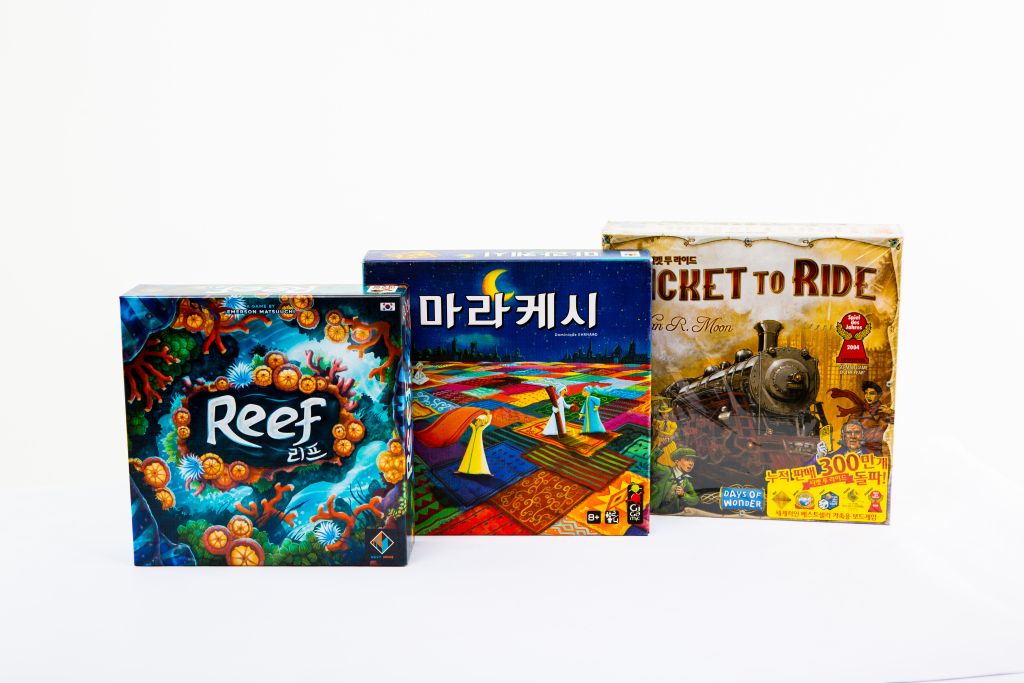
Huge thanks to the photographer for these beautiful shots
@siostudio, http://studiosio.co.kr
[Series Index]
2019.01 Introduction 紹介 2019.02 Two Players: Abstract Strategy 2019.03 Two Players: Psychological Warfare 2019.04 Two Players: Cards 2019.05 Special: Big Games 2019.06 Three or Four Players: Placement 2019.07 Three or Four Players: Deduction 2019.08 Three or Four Players: Cards 2019.09 Many Players: Bluffing 2019.10 Many Players: Negotiation 2019.11 Many Players: Mafia 2019.12 Reflections 所懷
View full magazine <<
Subscribe to the magazine <<
⚠️ All rights reserved. Cite this piece as 'ONDA (온다)' when quoting.