An ex-corporate worker trades job security for a guesthouse in Seoul. This is part two of his firsthand account—how he stopped waiting for his company to define his future.
Written by Jung Seung-ho, operator of Seoul Dalbit Guesthouse
Seoul Dalbit Guesthouse Dongdaemun Branch (Main) Address: 329-18 Changsin-dong, Jongno-gu, Seoul Room types: Small twin room, small double room, standard twin room Facilities: Communal living room and kitchen, rooftop garden Nearby attractions: Naksan Park, Heunginjimun Gate, DDP, Changsin-dong Stationery & Toy Market, Dongmyo Flea Market
Seoul Dalbit Guesthouse DDP Branch Address: 74 Jangchung-dong 2-ga, Jung-gu, Seoul Room types: Double room, family rooms (3-, 4-, 6-person) Facilities: Communal living room and kitchen, rooftop garden Nearby attractions: Jangchung Gymnasium, Namsan, Gwanghuimun Gate, Cheonggyecheon Stream
Seoul Dalbit Guesthouse SNS Website: http://seouldalbit.com Instagram: @seoul_dalbit
02. Waking Up
– Realizing my company won't decide my fate

Photo by Júnior Ferreira on Unsplash
I used to love my company.
A stable business with solid pay and benefits. Great corporate culture on top of that.
Every job seeker dreams of it. I dreamed of it while preparing for employment. I really wanted to get in. When I got the acceptance call, it felt like the greatest achievement of my life. In the early days, I was thrilled by the joy of earning my own money and the sense of belonging to a solid company.
Looking back now, those three years as an employee were genuinely useful for my internal and external growth. Seeing the countless departments in the company taught me what functions are needed to run a business—from R&D, production, and quality control to marketing, sales, and back-office functions like HR, accounting, tax, and general affairs. On a smaller scale, I learned how to use MS Office and documentation tools, how to collaborate with people of different personalities and capabilities, how to communicate with clients, and yes—even Korea's drinking culture!
But that joy was short-lived. The company, which had been posting strong results right up until I joined, suddenly began to wobble the summer after my arrival. The external environment deteriorated rapidly, and various indicators looked grim. People in the company reassured each other that the core business wasn't shaken, but the numbers told a brutal story.
And sure enough, at the end of 2014—my first year—the company recorded its worst performance ever. Then in the spring of May 2015, the company launched voluntary retirement.
The company did what companies do. "Stable for years" is another way of saying "stagnant." Like pruning dead branches and shaking off old dust, the company began restructuring. From a business perspective, the decision made sense.
Except that both the people doing the cutting and the people being cut were colleagues who worked in the same office. That was the real tragedy.
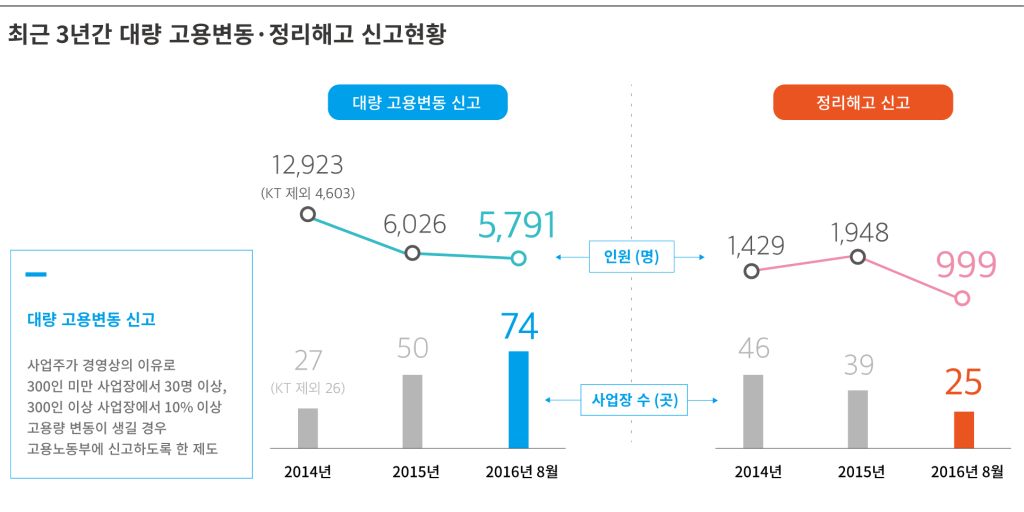
Layoffs disguised as voluntary retirement (Source: Hankyoreh)
Voluntary retirement. The name makes it sound like people who want to leave are departing for new opportunities. In reality, 'some' people did time their exit during this period to switch jobs or start something new. But for most employees, reality wasn't so friendly.
It wasn't publicly announced, but internally, targets for voluntary retirement were identified and quietly notified. Watching people get called in for exit interviews one by one, a silent pandemonium gripped the office. No one made a sound on the outside, but everyone was screaming inside: 'Am I next?'
Within a month, one in ten people was gone. From department heads in their 50s to managers in their early 30s—everyone cleared their desks. As we watched them pack, as we said goodbye, those of us left behind raised our glasses.
A toast to you and me, the survivors. Or rather, to the company that spared us. Cheers.

In the end, I was lucky enough to survive. I earned the right to sit in that office.
Were the people who got let go bad at their jobs? Did they cause major losses? Or did they not work hard enough?
Sure, some cases fit that description. But most were targeted due to forces beyond their control.
Because of the department or role they didn't choose. Because of evaluations shaped more by relationships with superiors than results. Because limited promotion slots meant they didn't move up. Because they got unlucky. For those reasons, they had to wrap up their careers.
I survived because I was still a junior. Because I hadn't yet experienced bad luck.
Not because I did something right, but because I couldn't do anything at all—and yet I might still lose my livelihood. That thought crossed my mind.
I used to believe (or wanted to believe) that my fate was something I chose and shaped through my decisions. But after going through all this, I felt a sense of powerlessness—I couldn't choose or decide anything about my own fate.
"I need to create something—some way—to decide my own destiny."
That's when this lowly office worker began dreaming of escaping the company.
Switching jobs wasn't the answer. No matter where I went, my position as an employee wouldn't change. Which means my survival being decided by others wouldn't change either.
Civil service exams or certification tests didn't suit me. Sitting at a desk for 1–2 years minimum—maybe several—sacrificing daily life to prepare for a single test day? That didn't align with my temperament, and I had zero interest in academics.
I wanted to run my own business.
Not to fulfill some lifelong dream, not to change the world, not because of some grand ambition. I simply wanted to be responsible for my own survival with my own hands. I didn't want to entrust my fate to a giant corporation—I wanted to survive or fail based on my own thoughts and actions.
But once I reached that conclusion, the biggest problem emerged. What business should I start? Actually, where and how does one even start a business?
Since childhood, I'd lived by conforming to society's massive systems. During school, I studied the set curriculum. I worked hard, got good grades, got into a decent university. In college, I stacked up activities and specs. Then I entered a respectable company and started my career. If I'd kept going like that, I'd probably have gotten married at the right time, started a family, taken out a mortgage, bought a house. That kind of life.
But once I decided to start a business, I realized this was completely different from everything I'd experienced before. In business, you decide where to start, which path to take, and how to get there. Conceiving a business is like creating 1 from 0, as someone once said.
I had to move away from the academic, theory-based writing habits I developed as a student—and from the corporate habits of picking topics, combining facts and data, and running them by superiors for approval, reports, and sign-offs.
I was dropped onto an open field with no trail, not even knowing which direction to go, yet I had to start walking. The sense of being lost and afraid was overwhelming. Ironically, I'd confidently declared I'd take responsibility for my own survival and downfall—but I had no clue how to actually survive. My business started right in the middle of that ambiguity and fear.
What will I sell? To whom?
Where, how? Price, value, differentiation, brand?
How do I draw up a business model?
Actually, let's set all that aside.
Let me start with the simplest question.
"What do I like,
and what am I good at?"
[Series Index]
2019.01 Prologue 2019.02 Waking Up 2019.03 Daydreaming 2019.04 Observing 2019.05 Conceiving 2019.06 Meeting 2019.07 Excitement 2019.08 Catching My Breath 2019.09 Calculating 2019.10 Wandering 2019.11 Breaking Ground 2019.12 Taking Shape 2020.01 Grand Opening 2020.02 Epilogue – Resignation Process Summary