Jung Seung-ho opens his calculator to see if a 3,000-square-foot Dongdaemun building can become Seoul Dalbit Guesthouse. Three hospitality rookies, zero construction experience, one question: how many rooms actually fit?
09. The Calculation
— Breaking out the calculator to see if this thing can actually work.
Writer Jung Seung-ho, Seoul Dalbit Guesthouse
Editor Somora Manager, ONDA
Seoul Dalbit Guesthouse Dongdaemun (Main Location) Address: 329-18 Changsin-dong, Jongno-gu, Seoul Room Types: Small twin, small double, standard twin Facilities: Shared living room & kitchen, rooftop garden Nearby: Naksan Park, Heunginjimun Gate, DDP, Changsin-dong stationery & toy market, Dongmyo flea market
Seoul Dalbit Guesthouse DDP (Branch) Address: 74 Jangchung-dong 2-ga, Jung-gu, Seoul Room Types: Double, family rooms (3-, 4-, 6-person) Facilities: Shared living room & kitchen, rooftop garden Nearby: Jangchung Gymnasium, Namsan, Gwanghuimun Gate, Cheonggyecheon Stream
Seoul Dalbit Guesthouse SNS Website: http://seouldalbit.com Instagram: @seoul_dalbit
We found a place we liked. A commercial building tucked in a Dongdaemun market alley — two floors we could use together. Over 3,000 square feet of open space. A blank canvas where we could actually build the kind of rooms we'd imagined.
The broker had already given us deposit and rent terms. Now, before signing anything, we needed to figure out one thing: how many rooms could we actually fit in this space?
The three of us on the guesthouse team — all hospitality newbies. None of us knew the first thing about hotels, tourism, or construction. I studied materials engineering. P studied business and was heading into a corporate job. H ran an Airbnb and had done some DIY renovations, but designing a space from scratch? That was new territory.
Still, we couldn't just sign a lease on a hunch. So we rolled up our sleeves and got to work.
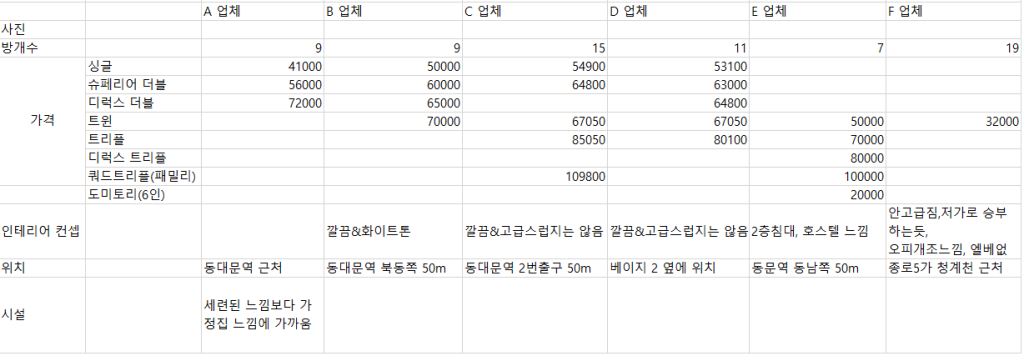
Room types and pricing from competitors, circa 2015. Four years later, with the market where it is now, these numbers feel like ancient history.
What's the concept?
Our research showed Dongdaemun draws heavy tourist traffic — mostly from Asia. To understand what these travelers actually wanted, we hit cafes in Sinchon and Insadong, struck up conversations with Asian tourists, bought them drinks, and asked questions. We talked to people from Singapore, Malaysia, Hong Kong. Small sample size, sure — but a clear pattern emerged: they valued a comfortable bed, private space, and a good location. Shopping trips were common, meaning they'd leave with more luggage than they came with. (We hadn't thought of that.)
So: private rooms over dorms. Quiet and cozy over party hostel. Storage space included. (This made sense for Dongdaemun's shopping-focused crowd — it wouldn't apply everywhere.)
What kind of rooms?
Asian travelers tend to avoid dorms. Solo travelers exist, but small groups (2–4 people) are more common. Two-person rooms seemed like the sweet spot — efficient use of space, high demand. We'd sprinkle in some 4-person family rooms for tour groups.
Room mix sorted.
How big should the rooms be?
H's Airbnb experience suggested rooms didn't need to be huge, but we wanted to confirm. So we revisited four or five guesthouses near Dongdaemun — this time not just to look around, but to actually sleep there. We booked a Friday night (everyone's schedules lined up) and stayed in a small 3-person room, maybe 160–200 square feet with a private bathroom.
Three guys in their late twenties huddled in one room, measuring every corner with a tape measure. We must have looked ridiculous.
Width, length, bathroom size (about 30 sq ft). If a 3-person room was this size, a 2-person room could work at 100–130 sq ft. Sounds cramped on paper, but with two beds and luggage for a 3–4 night stay? Felt fine.

Reckless? Maybe a little sad? Either way, this was the depth of our early planning.
What's the price?
This is the internet age — no need to call around. We checked booking sites for hostels and guesthouses nearby, looked at reviews, ratings, pricing. We'd match their rates or go slightly lower.
Concept, check. Room types, check. Sizing, check. Now for the real calculation: profitability. How do we actually configure this Dongdaemun space?
The building was old — nearly 30 years. No floor plan. So we grabbed a tape measure and mapped it ourselves. Luckily, the layout was a simple rectangle.
100–130 sq ft per room including bathroom — call it 13 feet by 13 feet.
We started playing mental Tetris: rooms here, bathrooms there, common areas over there.
If we divide the whole space like this, we get XX rooms. Set weekday and weekend pricing at X0,000 won. Subtract rent, rough labor costs, utilities, breakfast, and supplies…
The numbers looked great. If we ran it halfway decently, all three of us could make good money.
Looking back now, it was a wildly rough model. Our guesthouse doesn't hit those early revenue projections. But here's the funny part: our cost estimates were almost perfect. Where we missed? Room count and pricing. We didn't account for building codes (wall thickness, hallway width). And we underestimated how cutthroat the market was — our naive pricing assumptions didn't survive contact with reality.
These days, with years of data, we can build much tighter models. But the structure? Same spreadsheet. Just different numbers.
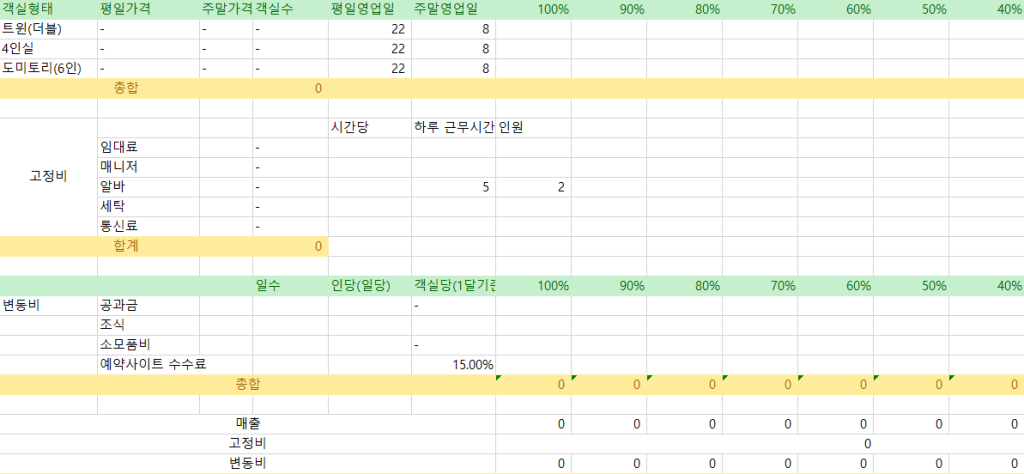
The Excel sheet we used to forecast revenue and profitability.
The numbers said go. We chose the Dongdaemun building.
The contract signing happened at a run-down real estate office in the Dongdaemun market. That's when we learned who the landlord was — and we were all a little shocked. Turns out, the owner of the building was a wholesale stationery and toy dealer we'd passed in the market alleys. I'd felt sympathy for these small business owners grinding it out. Turns out, this one owned multiple buildings.
It was a scorching August day in 2015. Big money on the table, so we read every line of the lease slowly, carefully.
What if this happens? What if that? How long until we're ready to open?
Looking back, I wish we'd added more safety clauses. But honestly, if I time-traveled back to that moment knowing what I know now, I'd probably sign the same deal. We didn't know any better.
If you're reading this and about to sign a lease: ask for what you need. Negotiate. Put everything in writing. A lease is an agreement between equals — landlord and tenant. Don't roll over because the broker says, "That's just how it works, we're all friends here."
The world is big. There are plenty of buildings.
We wired the deposit. Signed the lease.
Done! Now we just renovate and open, right?
That naive assumption was the start of a slow-motion disaster.
We'd never done a project this big. We had no idea what came next.
[Series Index]
2019.01 Prologue 2019.02 Waking Up 2019.03 Daydreaming 2019.04 Observing 2019.05 Conceiving 2019.06 The Meeting 2019.07 Excitement 2019.08 Catching Our Breath 2019.09 The Calculation 2019.10 Lost 2019.11 Breaking Ground 2019.12 Taking Shape 2020.01 Grand Opening 2020.02 Epilogue — The Resignation Process