A former office worker trades spreadsheets for guesthouse construction in Seoul's Dongdaemun. First-time renovator navigates contractor delays, plumbing mishaps, and the gap between blueprints and reality.
12. Coming Together
– The property takes shape, piece by piece. But there's still plenty to figure out.
Writer Jung Seung-ho, Seoul Dalbit Guesthouse
Editor ONDA Manager Somora

Seoul Dalbit Guesthouse Dongdaemun (Main Branch) Address: 329-18 Changsin-dong, Jongno-gu, Seoul Room Types: Small twin, small double, standard twin Amenities: Shared lounge & kitchen, rooftop garden Nearby: Naksan Park, Heunginjimun Gate, DDP, Changsin-dong stationery & toy market, Dongmyo flea market
Seoul Dalbit Guesthouse DDP Branch Address: 74 Jangchung-dong 2-ga, Jung-gu, Seoul Room Types: Double, family rooms (3-person, 4-person, 6-person) Amenities: Shared lounge & kitchen, rooftop garden Nearby: Jangchung Gymnasium, Namsan, Gwanghuimun Gate, Cheonggyecheon Stream
Seoul Dalbit Guesthouse SNS Website: http://seouldalbit.com Instagram: @seoul_dalbit
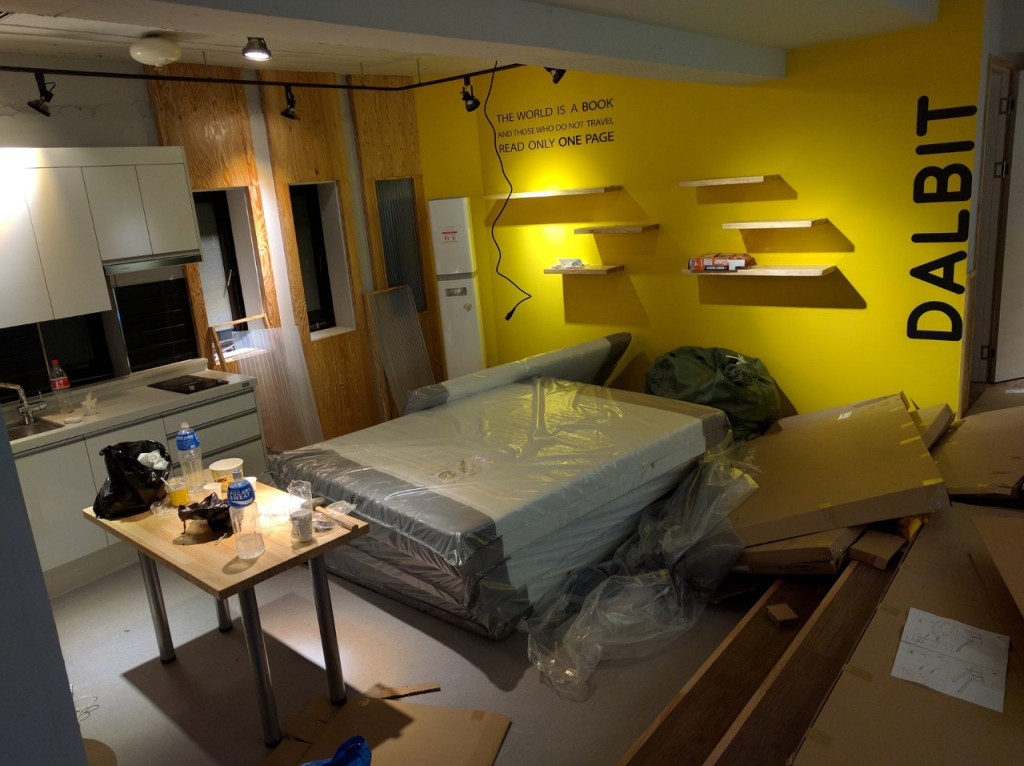
We broke ground. Our guesthouse construction finally kicked off. Six months had passed since my partners and I shook hands and said, "Let's do this." Four months since we signed the lease on that perfect Dongdaemun building.
Up until then, the biggest "renovation" I'd ever managed was calling a neighborhood contractor to swap out wallpaper or fix a faucet. This was my first large-scale build — so yeah, I was excited. Especially after all the drama around design and contractor selection (covered in previous chapters).
The pre-construction phase dragged. But once we broke ground, things moved fast. Walls went up according to plan. Plumbing defined the bathrooms. Framing gave us floors, walls, ceilings. Finishing touches and furniture weren't in yet, but seeing rooms materialize — rooms that had only existed on paper — felt surreal.
To be honest, I couldn't be on-site much during construction. I was still employed full-time. I'd swing by late evenings after work, once the crew had left. My co-founders picked up the slack — clearing their daytime schedules to monitor progress on-site. I'm grateful for that.
Why You Should Monitor Construction
As the client commissioning the work, staying on top of construction is critical. You need to verify that facilities are being installed where you intended. And — this might sound cold — you also need to keep an eye on whether the crew is actually working.
As I mentioned last time, labor and materials dominate construction costs. Labor especially is elastic: it stretches or shrinks based on how many workers show up for how many days. So if you're the client, you should track how many people are on-site, whether progress is being made day-to-day, and whether materials are going into the right places.
Yes, the site manager is primarily responsible for monitoring progress. But the client should still show up regularly — bring coffee, ask questions, see what's being built and with what materials. Small gestures like this foster goodwill and create a foundation of trust that makes invoicing and final payment much smoother.
Monitoring matters throughout the build — framing, plumbing, electrical. But it's especially important during finishing work (wallpaper, paint, tiling) because that's what defines your space's look and feel. Are the right colors and materials going in? Is the wallpaper glue applied generously? (We missed this — wallpaper peeled off later.) Is the bathroom floor sloped correctly for drainage? Details matter.
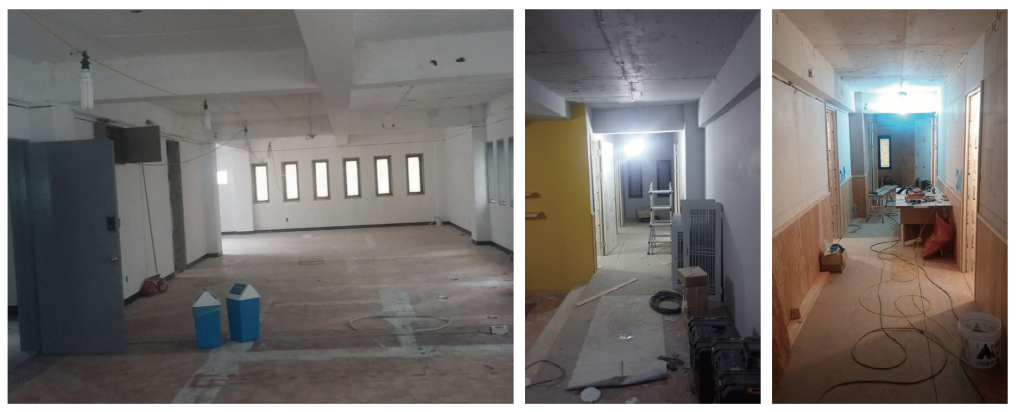
Empty space (left) transformed into hallways and rooms (right) after framing and masonry work.
Figuring Out Everything Else
While construction progressed, we still had a ton of non-construction decisions to make. Our team stayed connected via group chat and committed to meeting in person at least once a month to decide on major items — no matter how busy we were.
– Design
Beyond interior build-out, we needed a logo and website — foundational marketing assets. None of us had design chops, so we outsourced from the start. One partner knew a talented freelance designer, so we hired him for a package deal: logo, website mockup, and post-construction photography + retouching. The rate was steep, but the work turned out great. Looking back, it was money well spent.
These days, platforms like Soomgo and Kmong make it easy to find freelancers even if your personal network doesn't include designers. Worth exploring.
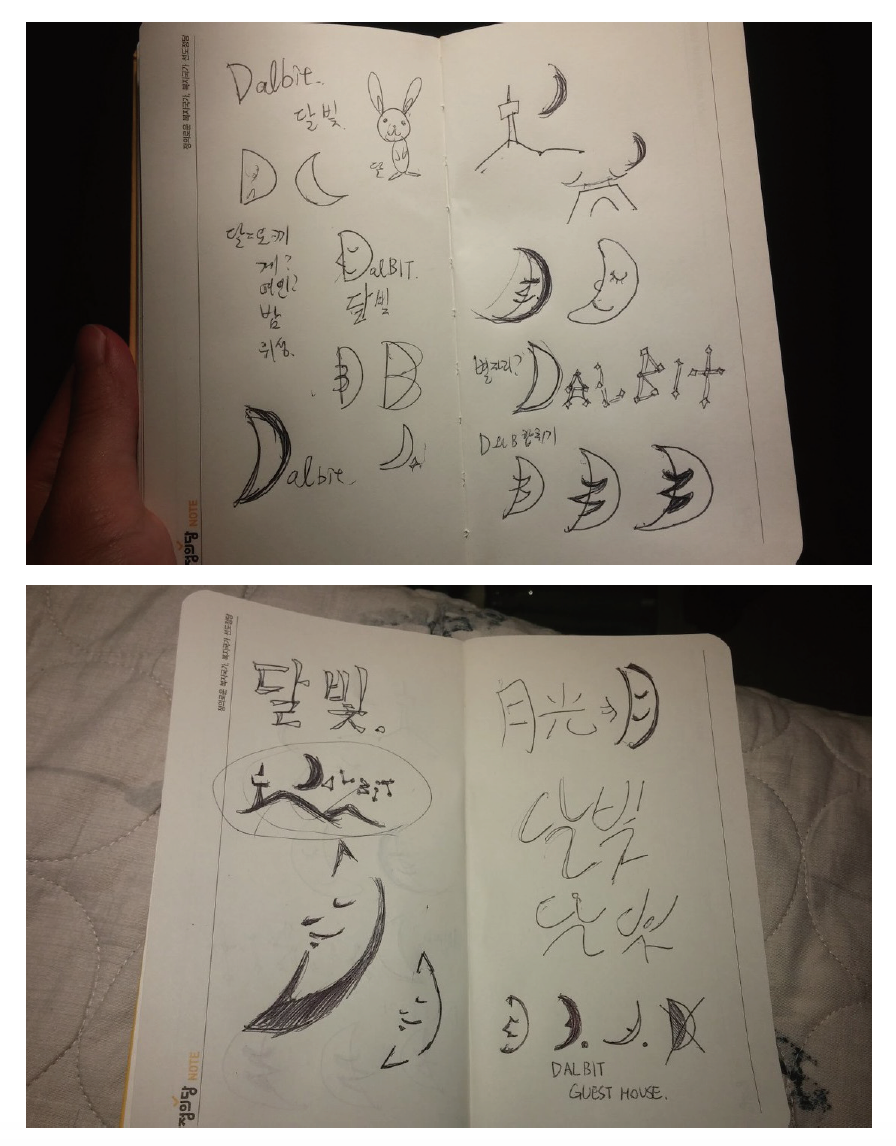
Early logo sketches I sent the designer — brainstorming around the "moonlight" theme.

The final logo — clean and elegant.
– Nailing Down the Details
Construction gave us the big picture: room layouts, hallways, common areas. But we still had to decide on furniture, decor, pricing strategy, and brand positioning.
Our team met repeatedly to hash out these details. What's interesting — and still feels smart in hindsight — is that we actually rented dorm rooms at several notable Seoul guesthouses and stayed overnight as a team to observe operations firsthand and learn from their details. During our prep period, we visited 4–5 properties, analyzing each one's strengths and weaknesses, then adapting what we learned for our own space.
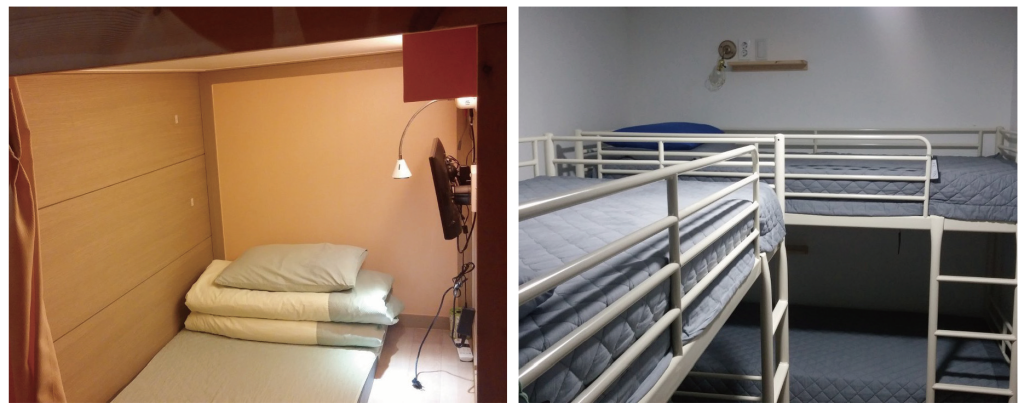
Other Seoul properties we stayed at to learn operations and details.
Through this process, we figured out: How should we position ourselves? What vibe should guests feel? How should we split our rooms between doubles (one large bed — couples) and twins (two singles — friend groups)? What electronics, supplies, and decor should we stock in common areas?
We also finalized the most important piece: staffing and operations. We set check-in/check-out hours, then designed a 3-shift rotation (weekday mornings, weekday nights, weekends).
Every step benefited from our field visits. We had zero prior experience, so staying at operating guesthouses helped us spot things we hadn't thought of — breakfast prep, laundry machines, cleaning supplies — and build them into our plan.
When opening a property, the more details you think through upfront, the less you'll panic when real situations arise — and the faster you'll solve them. This goes double if you're working with partners. Without structured communication, it's easy for everyone to assume "someone else will handle it." So meet often. Put issues on the table. Drill into the details. Make decisions together.
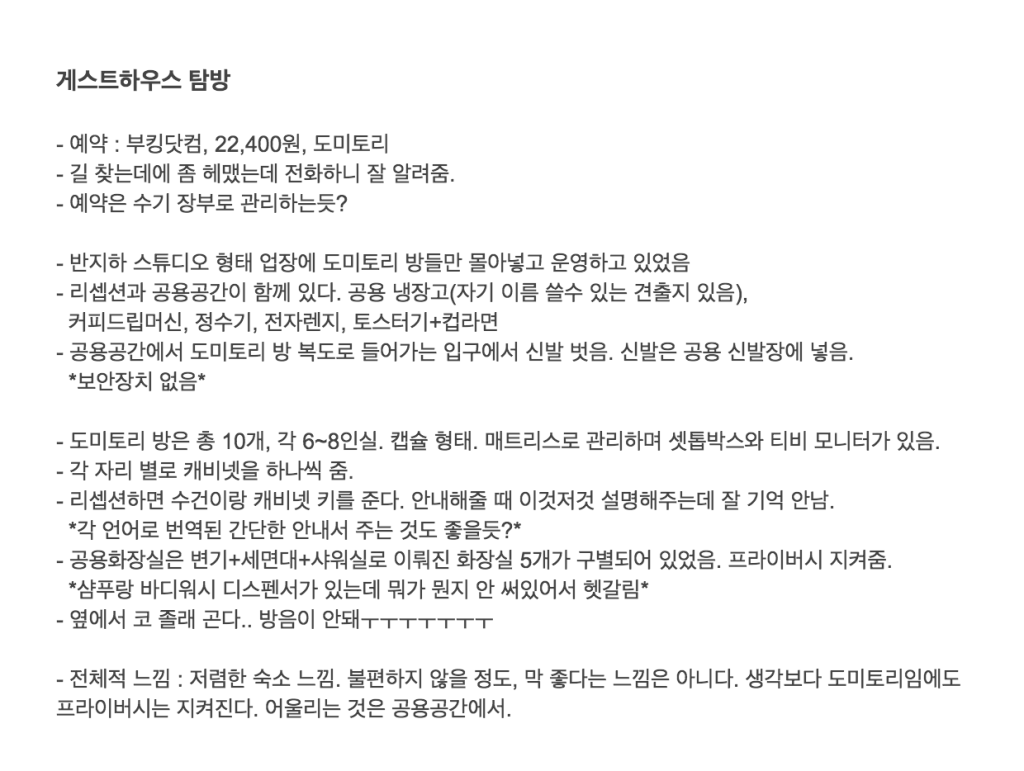
Observation notes from visiting other guesthouses.
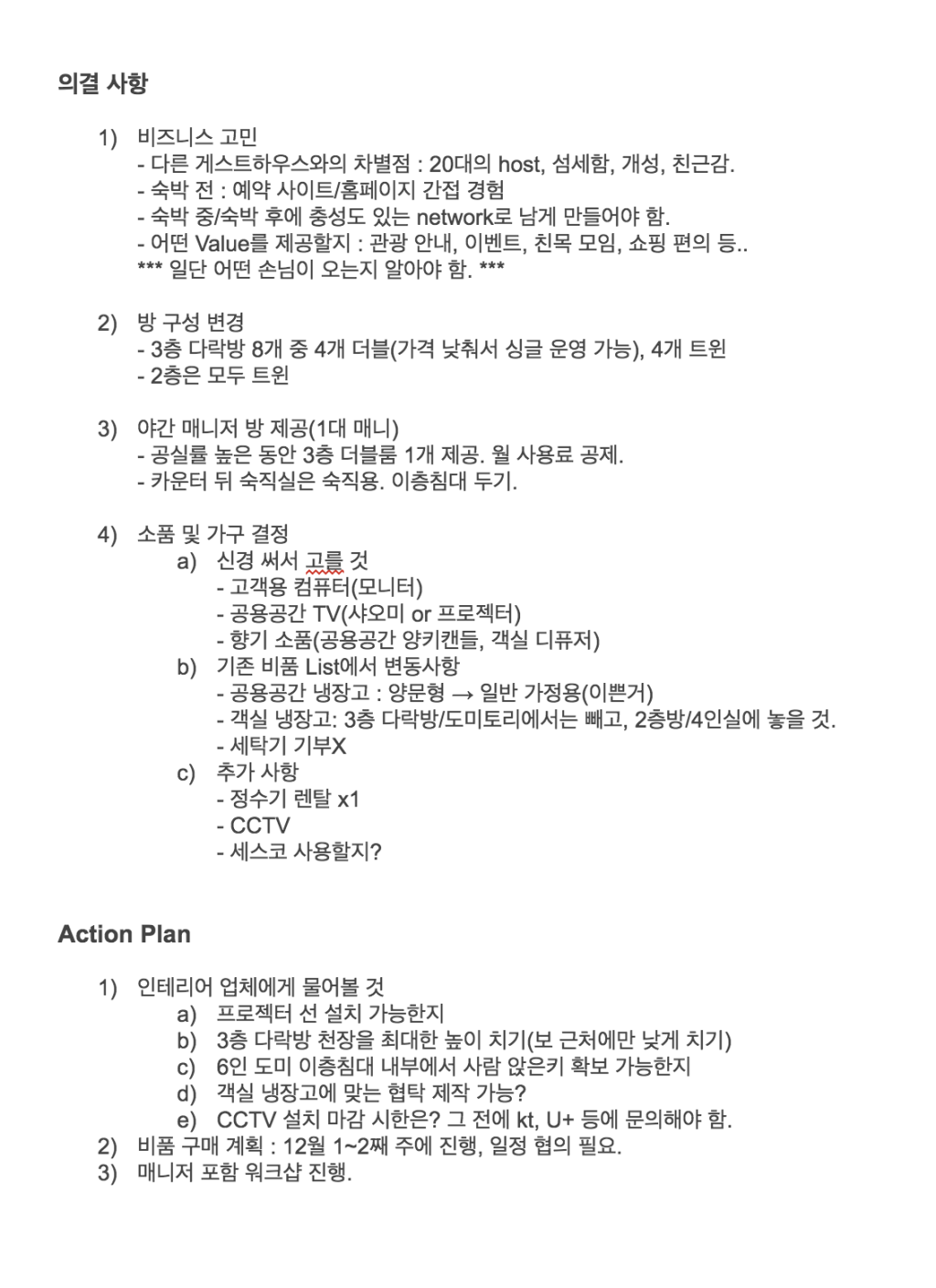
Meeting notes where we hashed out the details during our overnight stays.
Defining Our Values
Having worked at a large corporation, I brought some of those habits into this venture — including an emphasis on establishing company values and operating principles. We spent real time defining things like: "We never lose trust in each other as human beings." "We communicate proactively and build expertise." "We take initiative and solve problems preemptively." "We act with integrity, not self-interest." We documented a set of shared values — almost like a code of conduct.
Looking back three years into operations, I realize that company values don't become real just because you write them down. They take root when the operators live them through action. If you keep those values top of mind and demonstrate them through behavior and habit, they filter down to your staff, manifest in your product and service, and ultimately reach your guests.
Time flew as we finalized design and operational details. Before we knew it, the contractor's promised six-week timeline had passed. Rooms were done. Licensing was in process. All that remained was stocking furniture and supplies.
Eight months after launching the guesthouse project, our grand opening was just around the corner.
[Series Index]
2019.01 Prologue 2019.02 Eyes Open 2019.03 Daydreaming 2019.04 Observing 2019.05 Planning 2019.06 The Meeting 2019.07 Excitement 2019.08 Catching My Breath 2019.09 Doing the Math 2019.10 Lost in the Weeds 2019.11 Breaking Ground 2019.12 Coming Together 2020.01 Grand Opening 2020.02 Epilogue — The Resignation Process
Read the full issue in magazine viewer <<
Subscribe to the magazine <<
⚠️ All rights reserved. Cite this piece as 'ONDA (온다)' when quoting.