From the birth of global OTAs to today — a complete history of the online travel industry
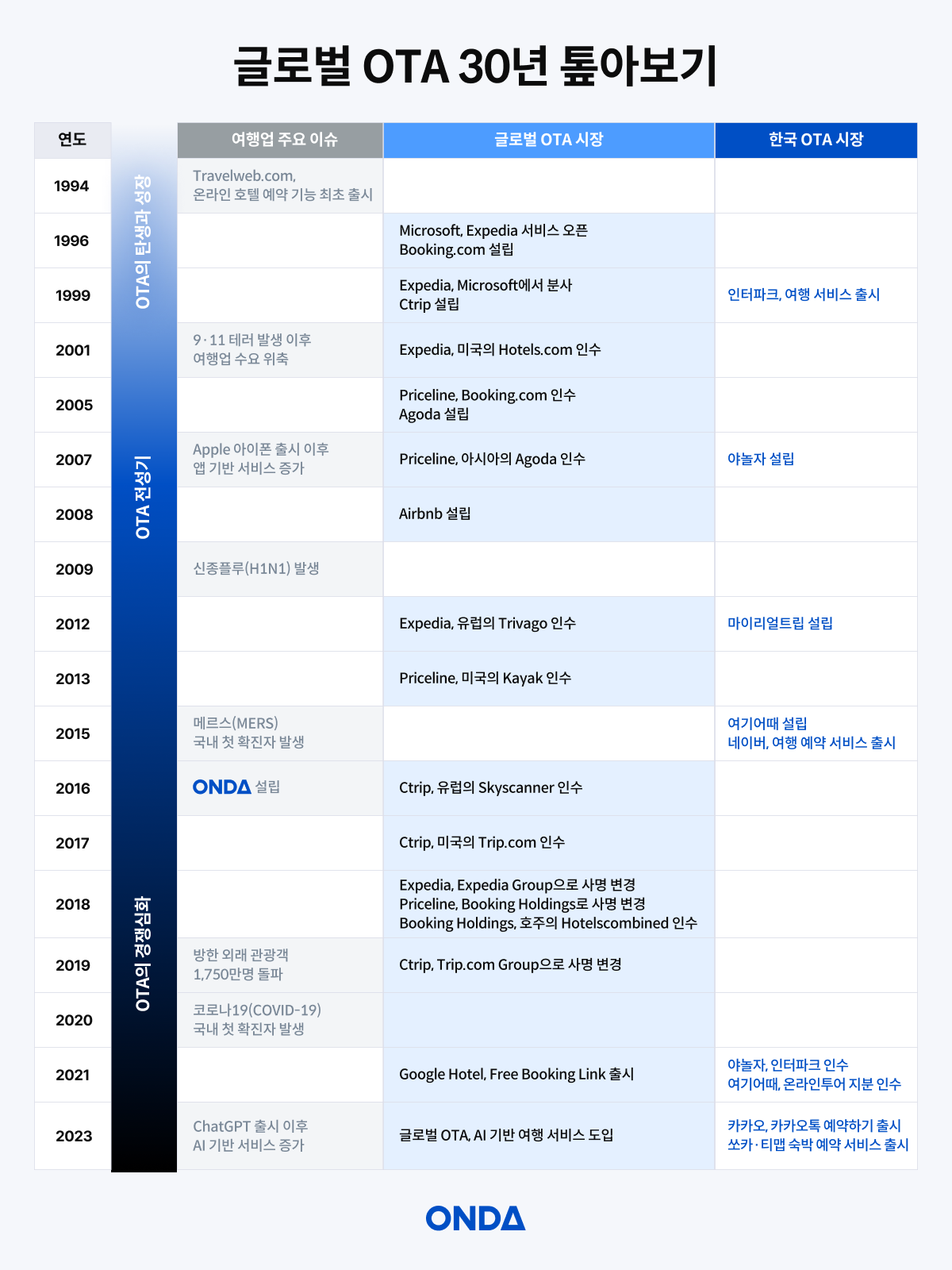
When you're planning a trip, where do you look for flights, hotels, and rental cars? Chances are, you turn to an OTA (Online Travel Agency).
According to the Korea Tourism Organization (KTO), online's share of the global tourism distribution channel will continue to grow — and the online travel booking platform market is expected to expand 89.8% by 2027 compared to 2020.
Today, the global OTA market is dominated by the Big Four: Expedia Group, Booking Holdings, Trip.com Group, and Airbnb hold over 90% of the market.
How did they come to control online travel? Hospitality tech company ONDA traces the full arc — from the birth of OTAs to the AI-powered platforms of today.
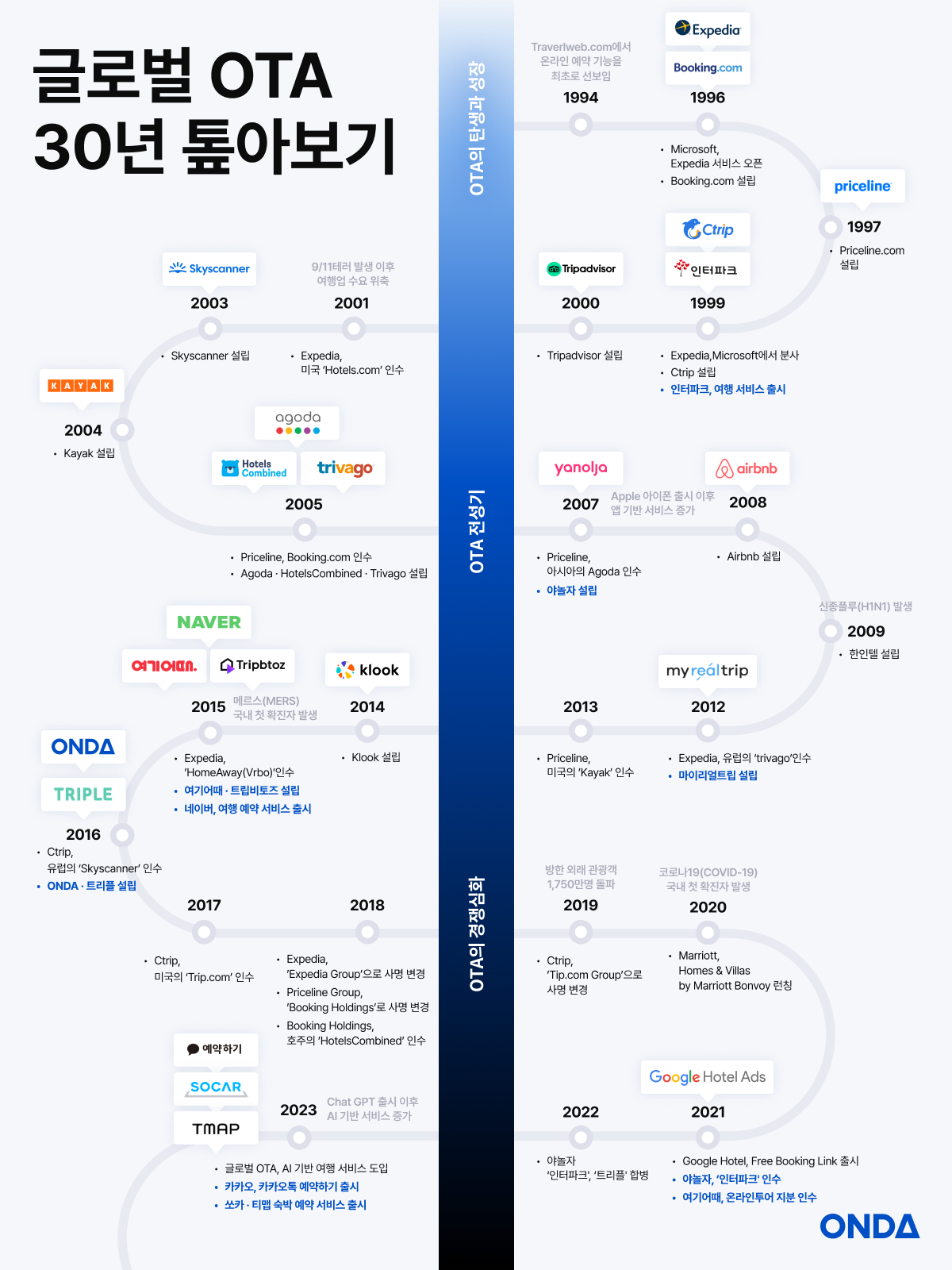
1. 1996–2006: Birth of OTAs and the Oligopoly
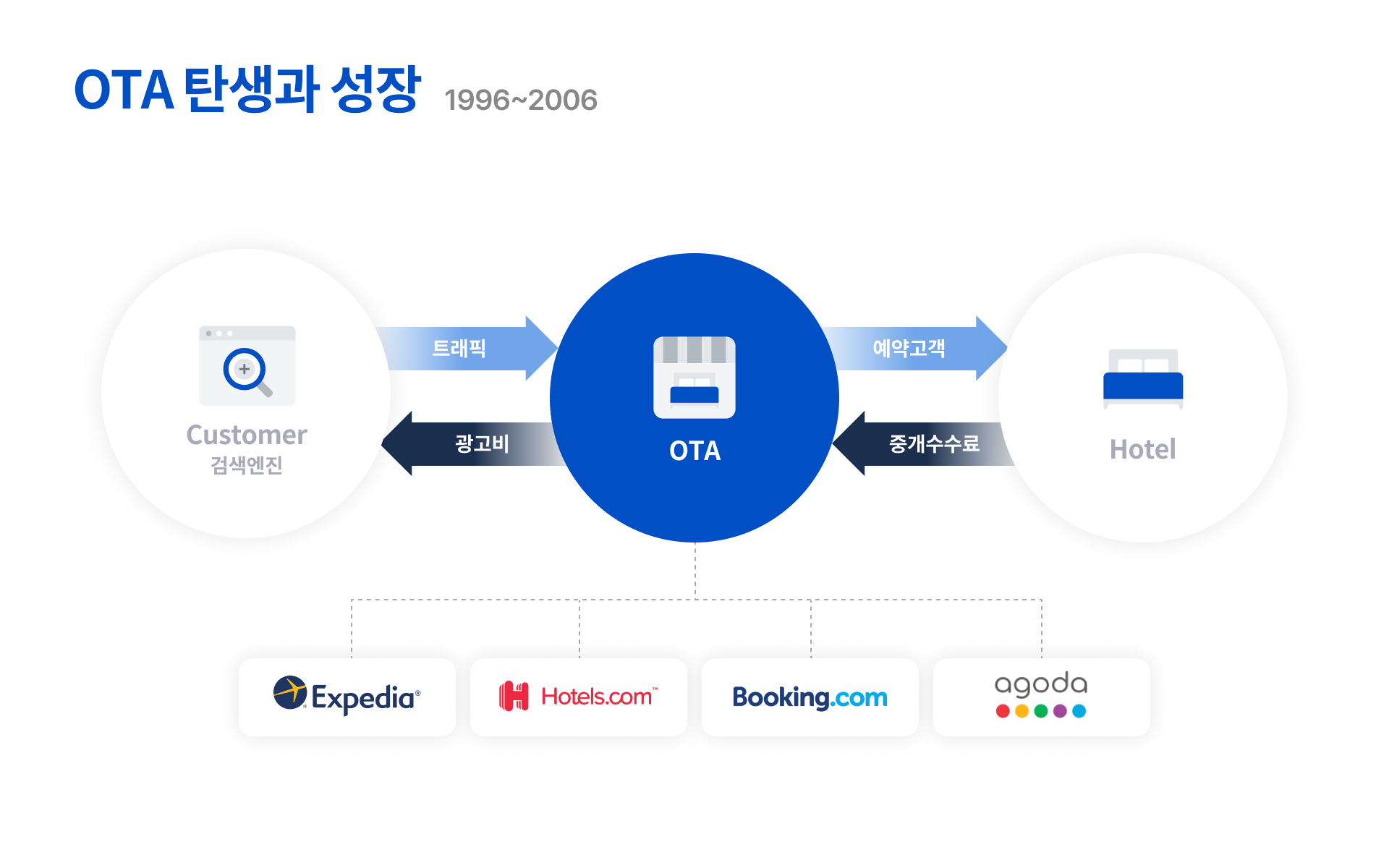
The years 1994–2006 were the dawn of e-commerce, portals, and search engines. This was also when OTAs — platforms specialized in flight and hotel booking — first emerged.
The online travel industry arguably began in 1994 when Travelweb.com became the first to offer online booking. Initially, Travelweb functioned like Yahoo for hotels — aggregating listings. But it soon introduced actual hotel reservations, launching a new category.
From there, OTAs specializing in flights and hotel rooms sprang up fast. Three of today's Big Four were founded in this era.
1) The Big Four OTAs in their early days
Let's look at how Expedia Group, Booking Holdings, Trip.com Group, and Airbnb got their start.
Expedia Group began in 1996 as a small division inside Microsoft, offering flight booking services. The name blends "expedition" and "expedite." Three years later, it spun out as an independent company.
The predecessor to Booking Holdings — Priceline.com — launched in 1997 with a business model built on selling last-minute airline seats at a discount.
Around the same time in the Netherlands, Booking.com launched as Booking.nl — a site connecting hotels with travelers. Just three years later, in 1999, it went public on Nasdaq. In 2005, Priceline acquired it.
Asia's OTA giant Ctrip launched in Shanghai in 1999. As Chinese tourists began traveling abroad in force, Ctrip became the region's fastest-growing OTA.
Meanwhile, Airbnb — now counted among the Big Four — took a different path. It was founded in 2008 in the U.S. with a model based on renting out individual spaces, not hotels. The name came from their original service: offering guests an "air bed and breakfast."
2) The rise of travel metasearch
As the online travel market matured, consumers naturally wanted to compare prices across platforms. That demand sparked the rise of metasearch engines — and kicked off the "race to the bottom" in travel pricing.
The "metasearch engine" emerged around 2000, when Tripadvisor pivoted from aggregating official travel guides to hosting user reviews. It evolved into a reviews community and price-comparison platform rolled into one.
In 2003, Scotland's Skyscanner launched to help travelers compare flight prices and find cheaper tickets.
A year later, the U.S. saw the founding of Kayak, which offered metasearch for travel products. In 2005, HotelsCombined (Australia), Trivago (Germany), and others followed — all focused on hotel and accommodation metasearch.
Five metasearch companies in just a few years. The signal was clear: price wars were about to heat up.
2. 2006–2016: The Era of Consolidation Begins
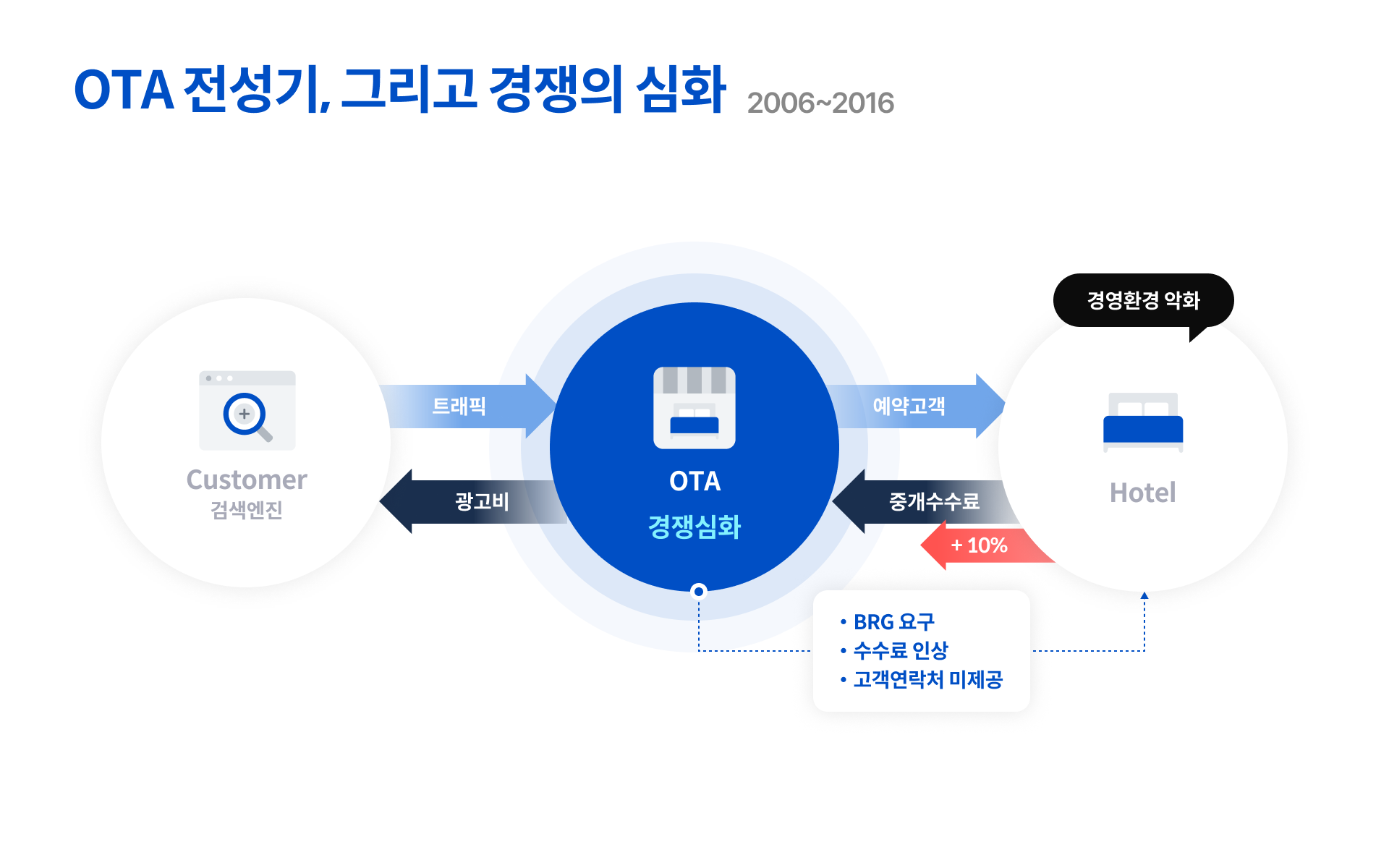
After establishing themselves, early OTAs pursued aggressive M&A strategies to dominate the market. Many date the serious M&A wave to 2006 — but it actually started five years earlier.
1) Aggressive M&A by global OTAs
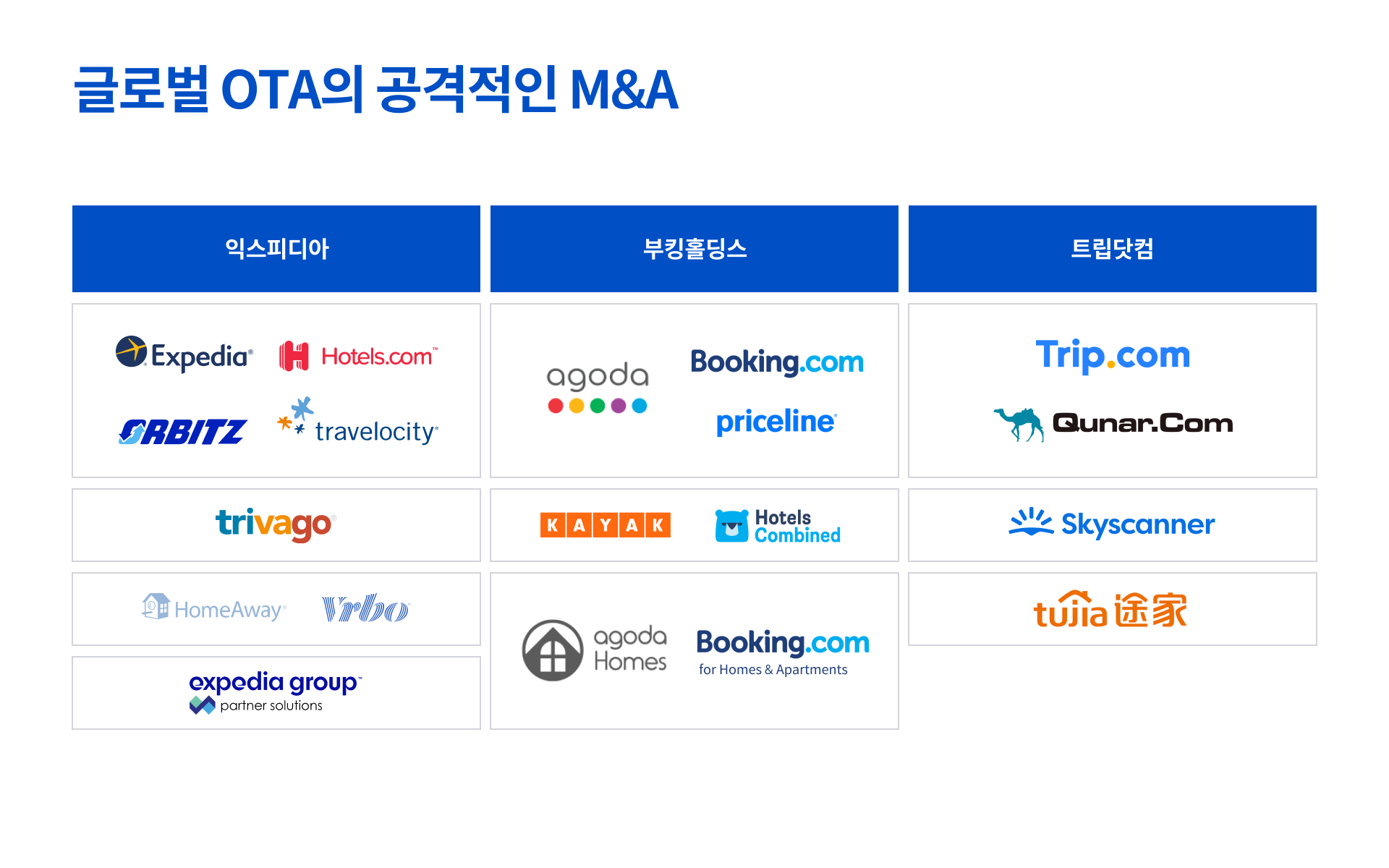
In 2001, Expedia — whose core business was flights — acquired Hotels.com to enter the hotel booking space. At the time, Expedia relied mostly on airline commissions; acquiring Hotels.com allowed it to scale accommodations revenue.
In 2005, Priceline.com bought Booking.com to enter the European market. Two years later, it acquired Agoda, an Asia-focused hotel booking platform, expanding its footprint from the U.S. and Europe to the entire world.
In 2017, Ctrip acquired Trip.com, a platform serving over 60 million users at the time. That deal set the stage for Ctrip to move beyond China and compete globally.
2) The battle for metasearch platforms
The more OTAs proliferated, the more essential metasearch became. Consumers wanted price comparison, and metasearch platforms grew rapidly. Naturally, the Big OTAs moved to acquire them.
In 2012, Expedia bought Germany's Trivago. Booking Holdings followed with Kayak (U.S.) and HotelsCombined (Australia). Finally, Ctrip acquired Skyscanner in Europe. Nearly every major metasearch platform ended up as a subsidiary of a Big OTA.
3) Airbnb shifts travel trends
Airbnb, founded in 2008, hit 10 million cumulative bookings just four years later. By 2021, it had hosted 1 billion guests. Airbnb proved that "shared accommodations" had become a primary lodging category — not just hotels and resorts.
Airbnb faced pushback from the hotel industry and regulators. But its C2C (Customer-to-Customer) model fueled rapid growth. Today, it operates in over 200 countries.
What drove Airbnb's explosive rise? It offered a fundamentally new choice. Hotels, motels, guesthouses — and now, Airbnb. It created a new travel ethos: stay where locals live. Have authentic experiences.
3. 2017–Present: Intensifying Competition and Strategic Realignment
As metasearch normalized price comparison and Airbnb emerged as a new giant, competition among OTAs intensified.
After years of aggressive M&A, the industry's names solidified. In 2018, Priceline Group became Booking Holdings. That same year, Expedia rebranded as Expedia Group. Ctrip became Trip.com Group to signal its global ambitions.
The Big Four as we know them today — Expedia Group, Booking Holdings, Trip.com Group, Airbnb — had arrived.
So how big is the OTA market now?
Over two decades, the Big Three OTAs acquired dozens of competitors and metasearch platforms — and now dominate the travel industry. Nearly every OTA you've heard of is now part of their portfolio.
As online booking's share of travel continues to grow, OTAs worldwide have been growing 2–3x annually. New OTAs emerge constantly. Vertical OTAs targeting niches — long-term stays, pet-friendly, workation — are on the rise. Platform companies from other industries are entering accommodations as well.
For hotels and lodging businesses, this means dealing with more OTAs. Demand for efficient channel connectivity — and channel managers like ONDA — has surged.
But as competition intensifies, well-capitalized OTAs engage in costly ad wars. Hotels have grown more dependent on OTAs, and high commission rates have become a growing pain point.
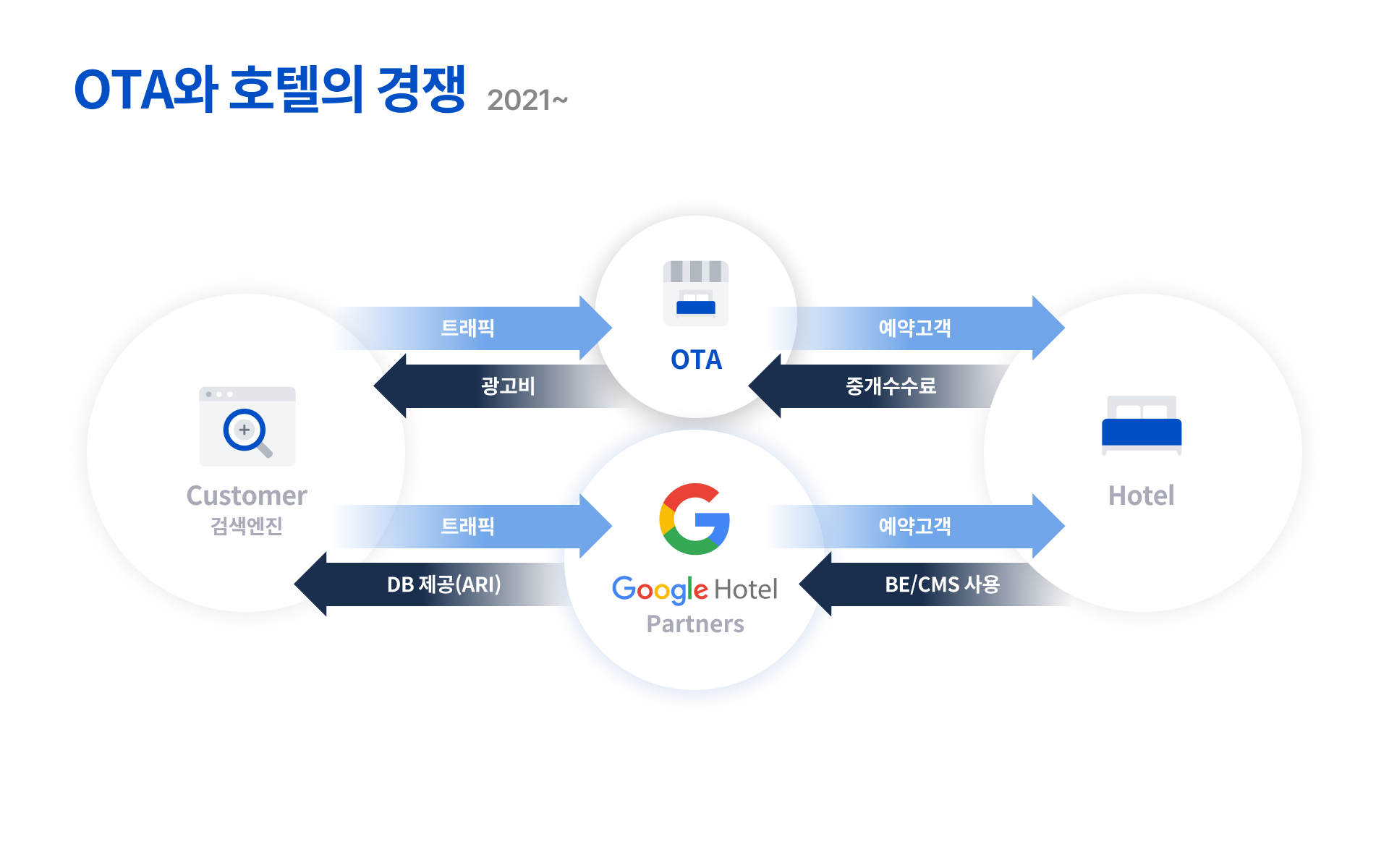
The Big Four still dominate the global market. But the industry is clearly shifting into its next phase of competition.
The clearest signal? Google. Google launched 'Google Hotel Ads' — a service connecting hotels directly with travelers — and moved aggressively into the market. While other OTAs and metasearch engines collect both commissions and ad revenue, Google introduced "free booking links" with minimal commissions, asking only for ad spend in exchange for higher visibility.
This brought Direct Booking (D2C) to the forefront — a new online sales channel that bypasses OTAs entirely. Hotels can now capture customer data, improve satisfaction, and encourage repeat bookings through their own websites — a virtuous cycle previously impossible via OTAs.
Ironically, global OTAs are some of Google's biggest ad clients. But OTAs' ad budgets ultimately come from hotel chains and lodging businesses. Google's blueprint? Cut out the middleman and take ad spend directly from hotels.
In business, there are no permanent friends or enemies. Markets always evolve.
4. 2023–Present: Entering the Generative AI Era
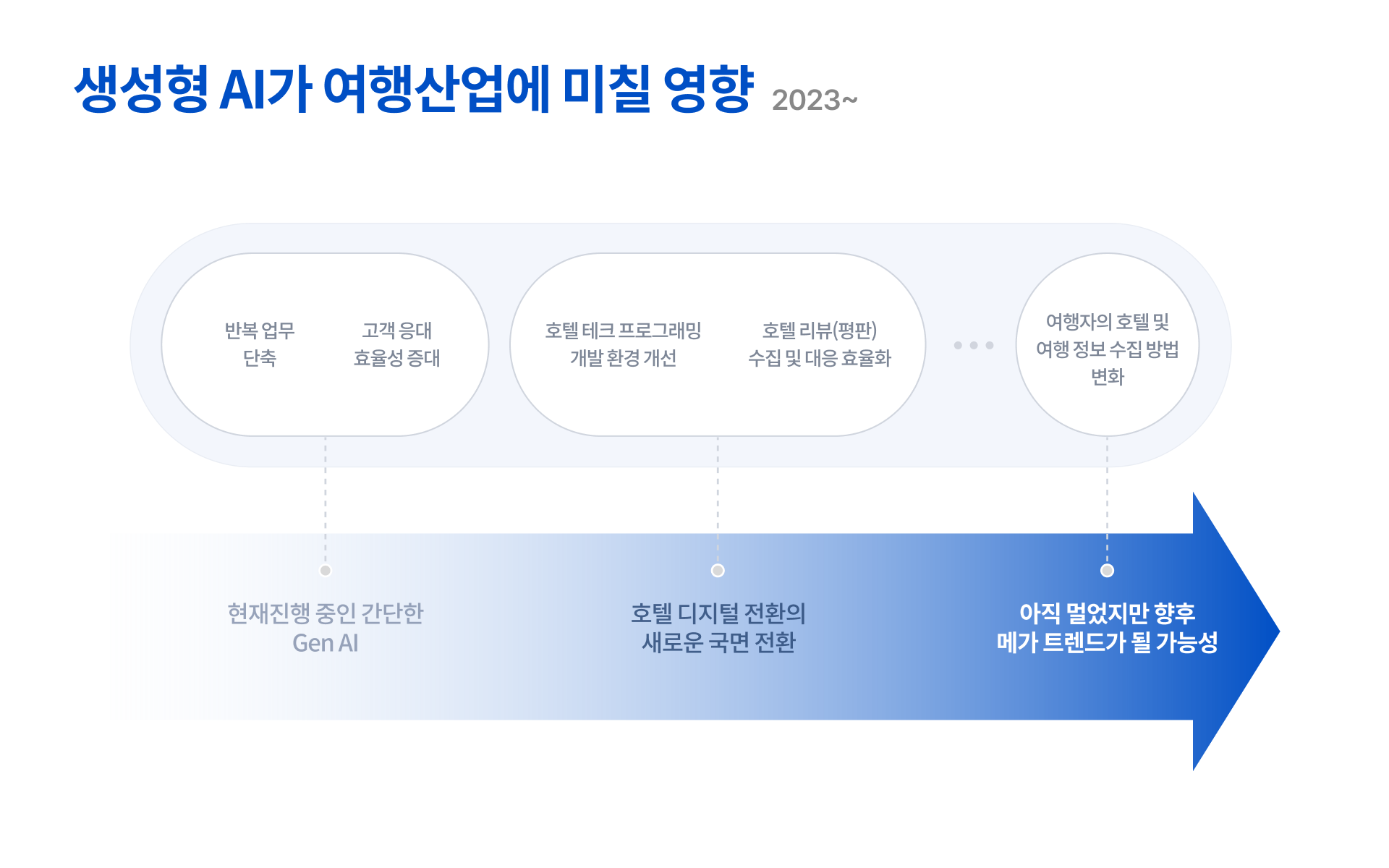
Today, as the world emerges from COVID-19, cross-border travel demand is rebounding fast. Competition in online travel is fiercer than ever.
And generative AI is reshaping entire industries — travel included. Trip planning, destination search, hotel booking — the online travel industry is on the cusp of another seismic shift.
According to Oliver Wyman, over one-third of North American travelers already use generative AI for trip planning. Satisfaction with AI travel services is high.
The advantage? AI can analyze inventory and pricing in real time, delivering hyper-personalized recommendations to travelers mid-search or mid-booking. This drives conversion — and ultimately increases online booking's share of the total travel market.
As global OTAs race to launch AI-powered travel services, more travelers will turn to AI for booking. The online travel industry is moving from the web & app era into the AI era.
⚠️ All rights reserved. Cite this piece as 'ONDA (온다)' when quoting.