What is hotel tech, and how can you apply it to your property?
Why 'Hotel Tech' Matters Now
Hello — we're ONDA, a hospitality tech company. When we introduce ourselves, we use terms like "hospitality tech" and "hotel tech."
The "XX-tech" naming format has been common in the venture world since 2010 — especially in industries where new technology is reshaping old markets. Fintech = finance + technology. Proptech = property + technology.
These are industries where legacy players meet step-change innovation — and a new vocabulary emerges.
In Korea, hospitality is undergoing the same shift. Digital transformation isn't optional anymore. "Hotel tech" is gaining traction.
The kiosk in the lobby. The tablet replacing the bedside phone. Those are visible changes — and they matter. But they're the tip of the iceberg.
Think of it this way: Kakao Bank and Toss are fintech companies. Traditional banks that launch apps are not — because the experience still feels like legacy banking. It doesn't lock you in. It doesn't make you think, I can't go back.
"XX-tech" means creating an experience so good that reverting feels unthinkable. That's the bar for innovation.
So What Exactly Is Hotel Tech?
What qualifies as hotel tech — and how do you apply it to your property?
Change is hard. Especially when you're asking a team that's been running the same playbook for years to adopt unfamiliar tools. You're asking them to walk an uncharted path.
When you enter unfamiliar terrain, what do you need? A map.
Luckily, the industry is drawing maps for us. One of the best comes from Hotel Tech Report, which tracks the U.S. and European markets. It's not a perfect mirror of Korea — but it's a solid starting point for understanding the landscape.
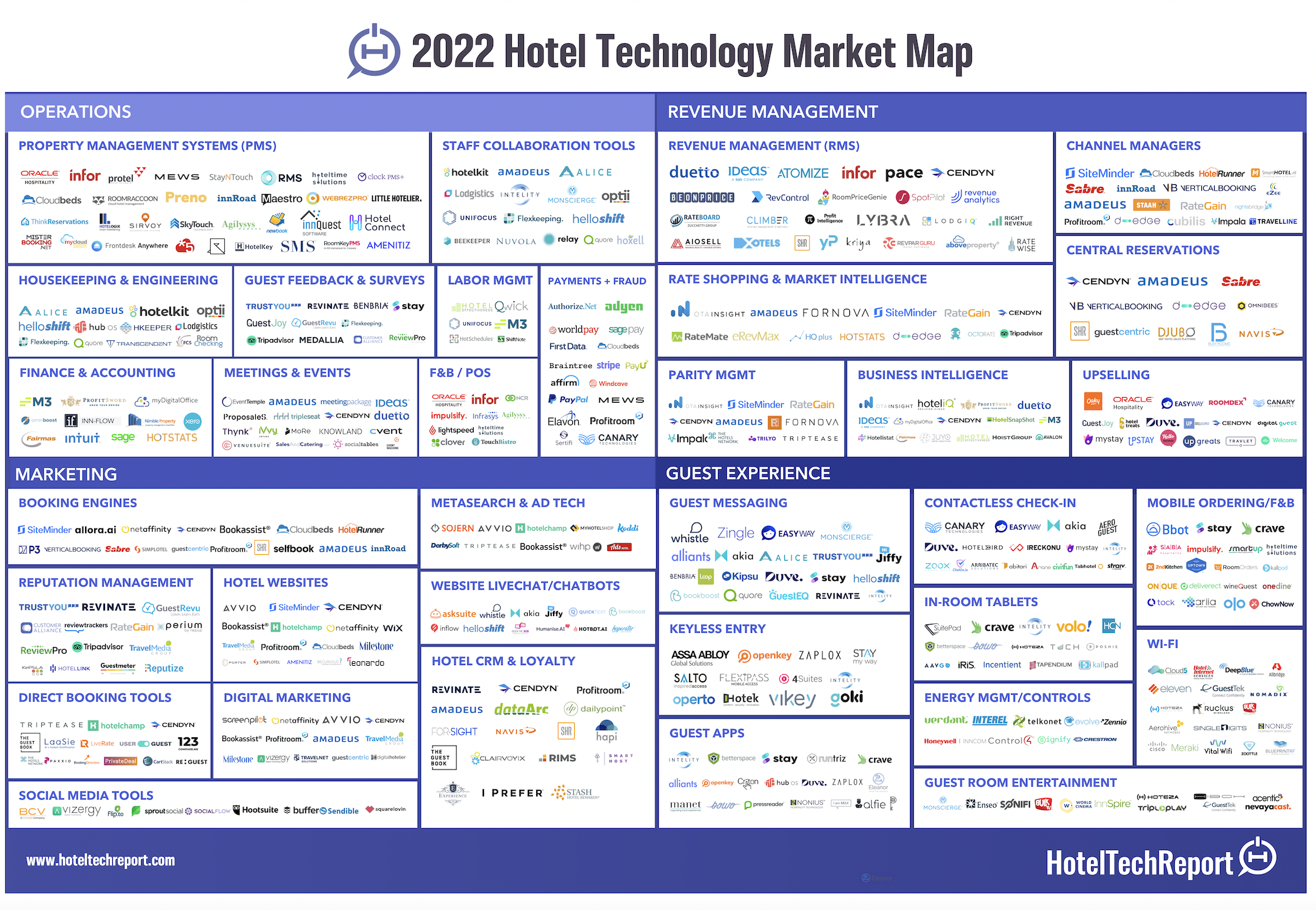
Operations & Revenue Management Tech
At first glance, this map might look overwhelming — logos everywhere. But there's one organizing principle that makes it simple.
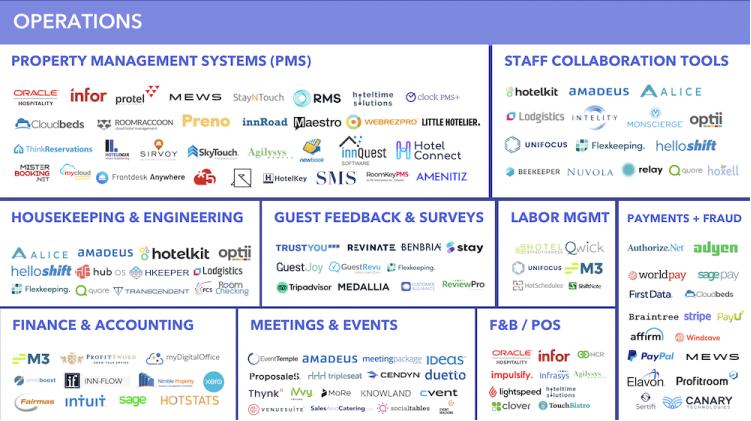
At the top, you'll see Operations — and front and center is the PMS (Property Management System). This is the backbone software for any hotel. It tracks who's checked in, which rooms are clean, and what's available to sell. Globally, one company dominates PMS market share. In Korea, most hotels use a system from another major domestic player.
But even this foundational category is being disrupted. Startups are challenging incumbents whose products don't meet modern needs.
The biggest shift? Moving from on-premise PMS to cloud-based SaaS. Legacy systems require expensive installs, slow updates, and clunky maintenance. Cloud PMS is faster, cheaper, and built for agility — which is critical for reducing operational friction.
Then there are niche tools solving problems legacy PMS ignored:
- Staff Collaboration Tools — improve cross-team coordination
- Guest Feedback & Surveys — collect and analyze guest sentiment
- Housekeeping & Engineering — manage room turnover and facility tech
- Payment — streamline billing and settlement
These tools address real pain points. That's where innovation starts — with friction.
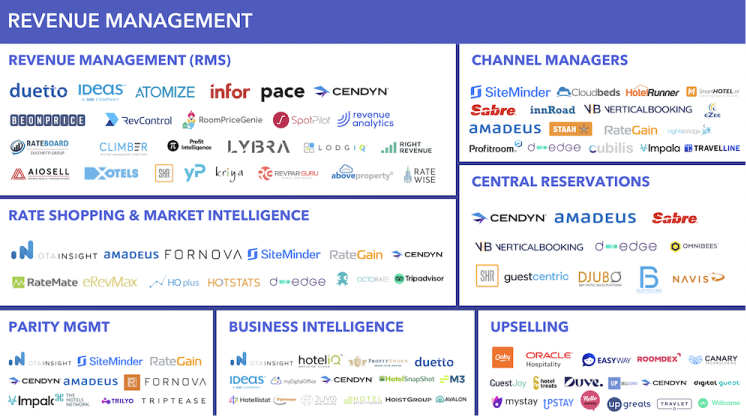
Next: Revenue Management.
Over the last 30 years, the internet spawned countless OTAs. Hotels suddenly had dozens of sales channels. That created new problems: overbookings, rate parity failures, inventory chaos.
Enter the channel manager — one interface to manage all your distribution partners.
What started as a tool to prevent double-bookings has evolved into a revenue booster. Today's systems don't just prevent mistakes — they maximize profit.
In the past, big hotels paid consultants or bought competitor rate data to optimize pricing. That's too slow now. Real-time internet data makes manual pricing obsolete.
Modern revenue management tools use automation and machine learning to adjust pricing dynamically — so you're always competitive.
As channels multiply, so do promotions and rate strategies. Managing them manually is impossible. That's where Business Intelligence (BI) tools come in — think of them as AI assistants for hotel operations.
In Korea, a major UK-based BI provider is partnering with several properties. For hotel leaders, this is an area worth serious long-term investment.
Marketing & Guest Experience Tech
The internet didn't just change operations — it revolutionized advertising. Google, Facebook, Naver — they're fundamentally ad-tech companies.
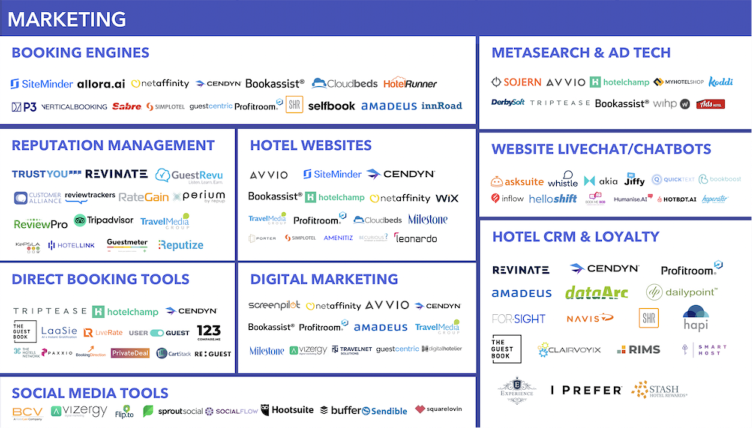
Hotel marketing tech is evolving just as fast. Before OTAs, guests booked via phone, travel agencies, or directly on hotel websites. That direct booking flow relied on a booking engine — the calendar widget where you pick dates and confirm a room.
Old booking engines were simple. Modern ones, like ONDA's, sync with OTAs and prevent overbookings while unifying inventory management.
At the same time, tools to drive traffic to your booking engine have exploded:
- Ad Tech — hotel-optimized online advertising
- Social Media Tools — hospitality-focused campaigns
- Direct Booking Tools (e.g., Google Hotel Ads) — surface your booking engine in search results
Once visitors land on your site, you need to keep them there:
- Website Livechat / Chatbots — answer questions in real time
The hottest trend in marketing right now? CRM (Customer Relationship Management).
A leading Korean marketing newsletter, OpenAds, ranked "Why Performance Marketing Is Fading and CRM Marketing Is Rising" as its #2 most-read article of 2022.
Why? Privacy regulations (GDPR, iOS tracking changes) are crushing traditional online ad efficiency. Customer acquisition costs are soaring.
The solution: retain and re-engage the customers you've already won. That's CRM. And tools that help hotels do this well are surging in importance.
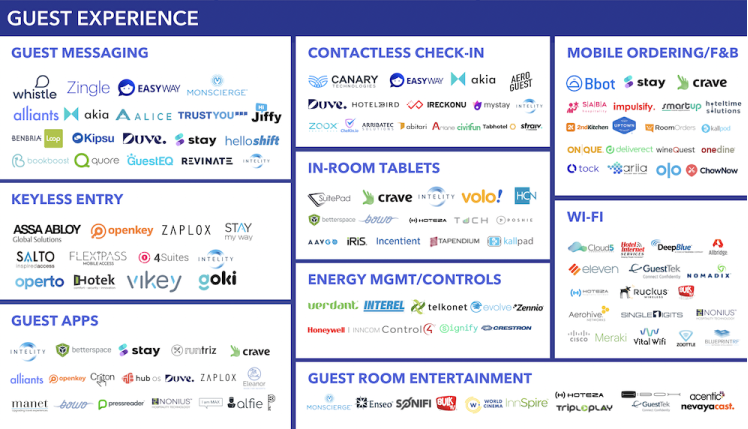
Finally, the Guest Experience layer. This includes your website, check-in kiosks replacing front desks, keyless entry systems, and in-room IoT devices.
This is the most visible — and most trend-driven — part of hotel tech. It's also where you need to be most thoughtful.
If your property targets Gen Z and Millennials and positions itself as a selective or lifestyle hotel, go ahead — deploy cutting-edge tech at the front desk and in rooms.
But if your guests skew older, forcing them onto unfamiliar interfaces can backfire. Instead of innovation, they'll perceive cost-cutting at their expense. You'll be selling inconvenience, not hospitality.
Korea: A Market Just Opening Up
That's the tour of the hotel tech landscape. Most of this innovation started in the U.S. and Europe — conferences on hotel technology have been running for 20–30 years abroad.
ONDA's leadership attended the INTERNATIONAL HOTEL TECHNOLOGY FORUM 2022 in April to showcase our platform and study global trends.
Even as a domestic leader in Korea, we're latecomers on the global stage. This trip reminded us: we don't cover every corner of hotel tech yet — and that means there's enormous opportunity ahead.
So where should your property start?
The answer is inside your building. You don't need to rip out your PMS on day one. Start by asking:
- What's the biggest pain point for our team and our guests?
- Which technology would reduce friction and amplify our strengths?
- If we can't build it ourselves, which partner can help us get there?
That's your starting point. The future of your hotel begins with one smart decision — not a wholesale overhaul.
⚠️ All rights reserved. Cite this piece as 'ONDA (온다)' when quoting.