Testing generative AI for travel itinerary planning
Most of you are already familiar with generative AI services like ChatGPT. Surveys show that over 70% of office workers have tried ChatGPT at least once.
But have you heard of GPTs? GPTs are customized versions of ChatGPT built for specific use cases. Think of it as ChatGPT's app store. The catch: you need a paid subscription to access them.
Do you really need these custom GPTs? For general knowledge, coding help, or translating English text, the free version of ChatGPT—or even Naver's generative AI search, Cue:—works perfectly fine.
I use ChatGPT for every English email these days. The developers at ONDA find it incredibly useful, too.
But generative AI hits a wall when you need constantly updated information.
Travel planning is the perfect example. I'm planning an ambitious trip to Southeast Asia with my one-year-old twins this year. When I ask Naver Cue: or ChatGPT for help, here's what I get:

Basically: "I can't help you—try searching yourself!"
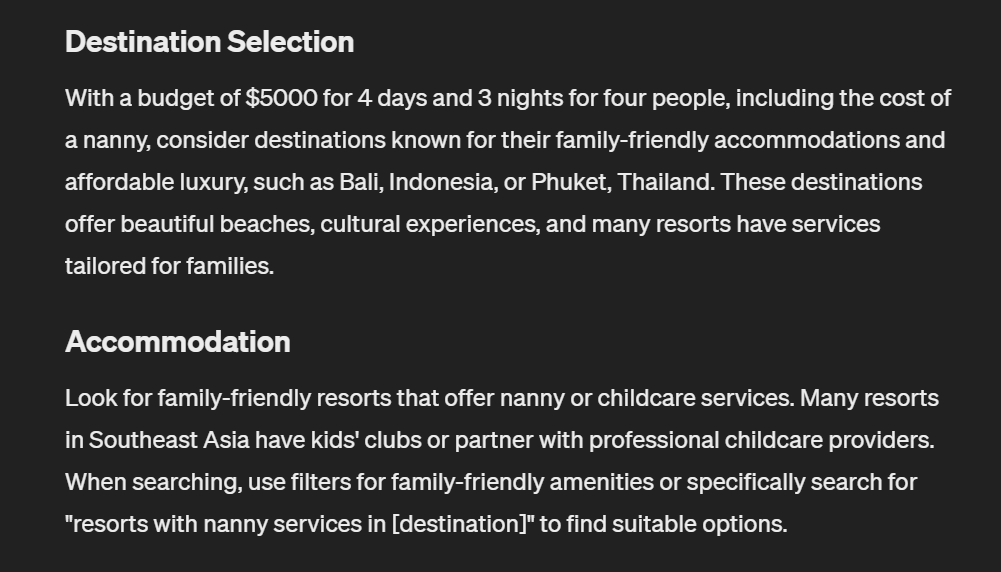
Even when I press further, I get generic, surface-level advice. (Pro tip: ChatGPT often gives better responses in English, so I tried translating my query with DeepL.)
So how do GPTs perform?
Priceline is one of the most serious players in travel AI right now. In the GPTs store, I found a chatbot from Kayak—Priceline's subsidiary—with excellent reviews.
I asked the same question. This time, the response was far more detailed. It specifically recommended Bali, citing its beautiful beaches and family-friendliness. It outlined concrete activities: cultural experiences, leisure, safaris.
What was interesting: it asked me follow-up questions. Once I shared my travel dates, it offered to recommend accommodations with babysitting services, complete with Kayak booking links, prices, and ratings.

When I gave specific departure dates, it recommended flights. At this level, you could realistically plan an entire trip inside the chatbot. The more specific your plans, the sharper the recommendations.
The downside: Kayak only searches within its own platform, so you can't comparison-shop across multiple booking sites.
To compare quality, I also tried "Travel Guide," the most popular travel GPT in the store. It also suggested Bali, with a similar itinerary to Kayak's. But it went further: it broke down how to allocate my budget across different expense categories.

Kayak's bot gave me bookable options with real pricing. Travel Guide gave me a more structured itinerary framework.
Both bots solve ChatGPT's biggest weakness: the inability to search in real time. They give you specific recommendations, which is great news for anyone (like me) suffering from choice paralysis.
I originally planned to write this a month ago but got sidetracked. What's wild: the quality of these services has noticeably improved in just one month.
By the time you read this and try them yourself, the responses might be even better :)