Korea's hotel price-gouging problem is real—but fixing it requires more than enforcement. Annual rate registration and heavier fines miss how hospitality actually works.
A Japanese tourist came to Busan for the BTS concert. She turned around at the door of her accommodation.
The room that normally cost ₩68,000 was now ₩769,000.
11x the regular price (Korea Fair Trade Commission, Feb 13, 2026, survey of 135 Busan accommodations).
A motel in Jongno sold a ₩140,000 room for ₩500,000. They knew foreign tourists had nowhere else to go.
Between November 2025 and January 2026, 213 tourism complaints were filed. 138 were about accommodation. 157 were from foreign visitors — 74% of the total (Tourism Complaint Center).
The government responded. On February 25, 2026, an inter-ministerial task force announced measures to "eradicate price gouging."
As someone who desperately wants Korea to become a tourism powerhouse, I fully support the government's intent.
But will this be enough?
What the Policy Does
Here's what the new measures entail:
| Measure | Details |
|---|---|
| Pre-Registration of Rates | Accommodations must pre-register seasonal rates once a year. "Fair Price Certified" badge for compliant properties |
| Stronger Penalties | First violation = immediate 5-day suspension (current: warning/corrective order) |
| Cancellation Enforcement | New complaint/penalty system for unilateral cancellations and penalty fees during peak season |
| Platform Cooperation | OTAs display "Fair Price" badge, strengthen review features, government-platform MOUs |
They looked at international precedents.
France fines violators up to €15,000 (₩23M). Germany goes up to €25,000 (₩38M). California's Anti-Price Gouging Law caps price increases at 10% during emergencies.
The diagnosis is accurate. One bad experience for a foreign tourist becomes their entire impression of Korea.
But after 18 years in this industry, I've learned one thing clearly:
Enforcement alone doesn't change markets.
Three Questions from the Field
Can annual registration reflect reality?
Accommodation rates change daily. Weekdays vs. weekends. Off-season vs. peak season. Local events or no events.
In the global hotel industry, Revenue Management — real-time rate adjustments based on supply and demand — is standard practice.
Annual registration is a well-intentioned start. But it can't capture an industry where no two days are the same.
There's no standard for "excessive"
The government policy itself admits: "Reasonable pricing standards are lacking."
If peak-season markup guidelines are left to industry self-regulation, who defines the standard?
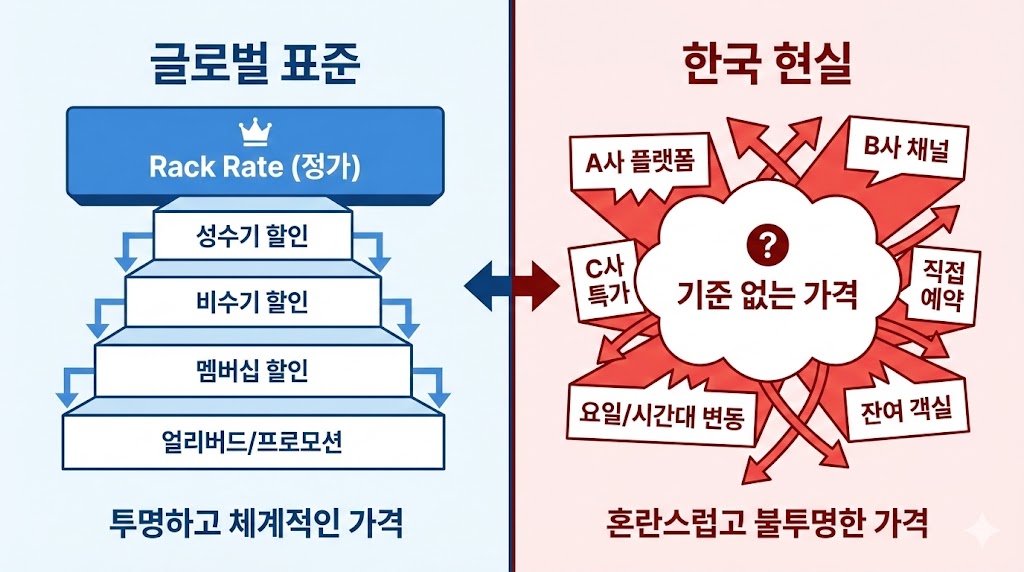
The global hotel industry has a concept called Rack Rate.
It's the official list price before any discounts or promotions.
Think of it as the ceiling price. All discounts move down from there. Consumers use the Rack Rate to judge whether the current price is high or low.
Prices rising with demand isn't inherently wrong.
Airfare doubles or triples during peak season. That's Dynamic Pricing.
The problem is multiplying the price by 10 without a baseline price — and without giving consumers enough information to make an informed choice.
If collusion is involved, it gets worse.
But if a baseline price exists and consumers can see it, the choice becomes theirs. The market decides.
Korea's accommodation market has no such baseline.
The same room is ₩60,000 on Yanolja, ₩50,000 on Yeogi Eottae, ₩70,000 on Booking.com.
Without a baseline, there's no way to judge "what's reasonable."
Who monitors 60,000 properties?
59,619 registered accommodations nationwide (Robin Company, Korean Accommodation Market 2024).
Who has the manpower to monitor real-time rate changes across all these properties?
The Fair Trade Commission's survey of 135 Busan properties alone required significant resources.
Scaling that nationwide reveals clear physical limits.
And one more thing.
If a property owner can make ₩5M in one concert weekend, will a 5-day suspension deter them?
Do the math. The illicit profit exceeds the penalty.
Unless fines reach French (₩23M) or German (₩38M) levels, the deterrent effect is questionable.
Systems, Not Crackdowns
As someone working for a hospitality tech company, I'm careful bringing up technical infrastructure.
But after 18 years in this industry, I've never seen enforcement alone change the market. So I wanted to share this perspective as objectively as possible.
The real issue isn't "catching bad actors." It's "building a structure where gouging becomes impossible."
Transparency Through Technology
Since 2016, France has legally required accommodations to post room rates outside the building.
Breakfast inclusion, Wi-Fi availability — everything must be disclosed. All prices must show the final amount including tax.
The key isn't the posting itself.
It's that once a baseline price is public, anything above it automatically stands out.
Korea can apply the same principle.
Not on building facades, but through digital systems.
When accommodations manage rates through a Channel Manager or PMS, rates are automatically logged by date.
No more annual manual filings. The system records rate history in real time. Anomalies trigger automatic alerts.
You don't inspect 60,000 properties with people. You inspect them with data.
How Global OTAs Self-Police
Global OTAs have one powerful mechanism:
Verified review systems.
What happens if you sell a ₩70,000 room for ₩770,000 on Booking.com?
Reviews come in immediately. Ratings drop. Search rankings fall. Bookings decline. The market punishes automatically.
This is where domestic platforms differ.
According to the Korea Consumer Agency, 100% of top-listed motel products on Yanolja and Yeogi Eottae were paid ads.
They say "recommended," but it's really "who paid the most."
In a Korea Federation of SMEs survey, 92.4% of respondents said "ranking order is unfair."
Global OTAs also have paid placements. They're not perfectly fair.
But their base algorithms factor in quality metrics like review scores, conversion rates, and price competitiveness.
Quality properties are more likely to rank higher.
That's fundamentally different from rankings determined by ad spend alone.
Under this system, price-gouging properties naturally get filtered out.
No government enforcement required.
How France Reformed the OTA Ecosystem
France went a step further.
The Macron Law (Loi Macron, 2015) banned OTAs' Price Parity clauses.
Hotels can now offer lower prices on their own websites than on OTAs. Germany followed suit.
Why does this matter?
It lets accommodations build their own channels.
When properties aren't 100% dependent on platforms, pricing power returns to owners.
Platforms have less room to distort prices.
Korea should consider this direction.
An ecosystem where owners have direct channels, appear on global OTAs simultaneously, and where price transparency operates naturally within that structure.
AI Era, New Standards for Tourism Infrastructure
France used law. Global OTAs used algorithms. Both cleaned up their markets.
Everyone perceives change at their own pace, but we're living in the eye of an AI revolution that everyone can feel.
As someone riding that wave firsthand, there's one more point I want to raise.
Traveler behavior worldwide is changing.
We're in an era where people ask ChatGPT, "Recommend a budget-friendly place to stay in Seoul."
AI-recommended accommodations and AI-trusted information are starting to shape traveler choices.
From this perspective, the standards for tourism infrastructure — preparing for the near future, or perhaps the reality that's already here — must also evolve.
AI reads structured data.
Price history. Review scores. Facility information. Government certification status. When this data is systematically organized, AI determines "this property is trustworthy." If "Fair Price Certified" badges are structured so AI can read them, AI services worldwide can leverage that information.
For Korea to become a tourism powerhouse, we need infrastructure that AI can read, not just humans.
A digital ecosystem where government certification systems, platform pricing data, and property facility information are interconnected.
That's the next stage the public and private sectors must build together.
Korea has companies with accumulated experience and know-how in standardizing and globalizing accommodation products.
When this on-the-ground expertise meets government policy, "a country without price gouging" can become a system, not a slogan.
A Country Where Gouging Is Impossible
Let's summarize.
Eradicating price gouging isn't about "catching bad actors." It's about "building a system where gouging becomes impossible."
The system needs three things:
- Baseline Price Structure — Like Rack Rates: publicly available, comparable baseline prices for each property
- Transparent Tech-Driven Monitoring — Infrastructure that monitors rate changes across 60,000 properties through data, not people
- Global-Standard Self-Policing — An ecosystem where reviews and algorithms reward quality properties and eliminate gougers
In 18 years in this industry, I've met plenty of price gougers, but most owners operate honestly and transparently.
It's unfortunate when a few bad actors tarnish the entire industry's reputation while the majority work with integrity.
From that perspective, I believe the government's measures are moving in the right direction.
If technical infrastructure is added to this foundation, Korea can become a tourism powerhouse trusted by travelers worldwide.
Not a country that "catches" gougers, but one where gouging is "impossible."
Isn't that the next stage for K-Tourism?