Moon Seong-sik went from selling fish cakes on social commerce to running 15 pensions and a sales agency for 200 properties. His approach: lease underperforming rural pensions, digitize their distribution, and scale without billion-won upfront costs.
Pension Online Sales Agency Specialist
Moon Seong-sik, CEO of SM Company
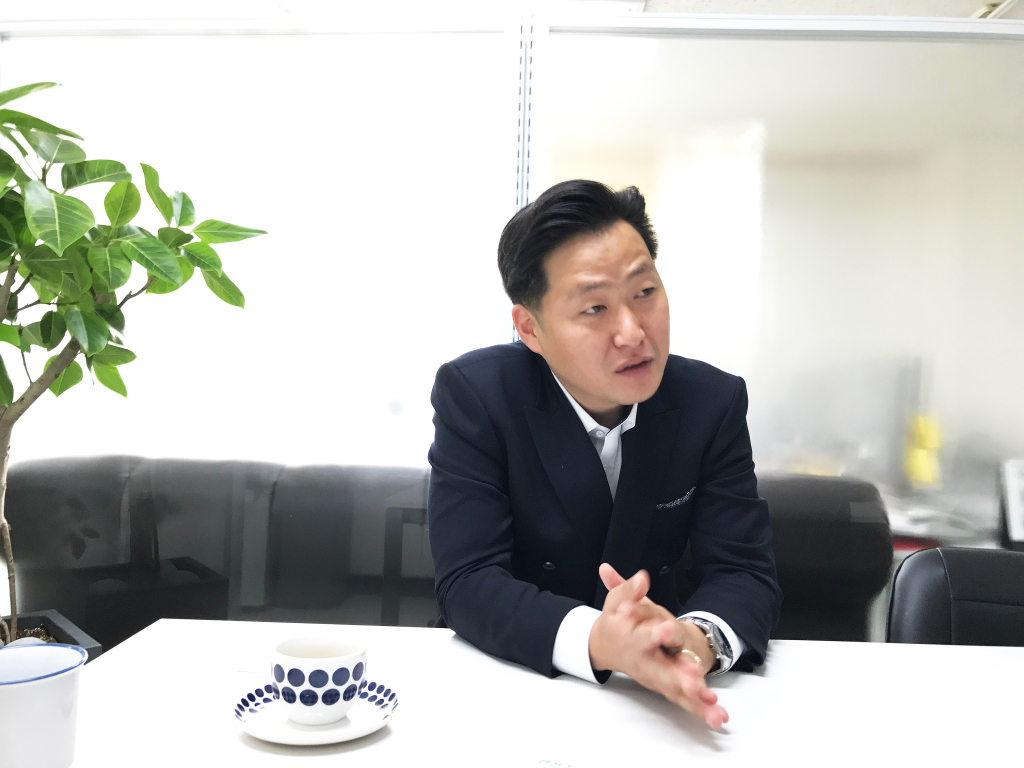
Q. Thanks for sitting down with us. Can you introduce yourself to our readers?
Hello. I'm Moon Seong-sik, CEO of SM Company — we specialize in online sales agency services for pensions. I've been in the pension business for about five years now. Currently, I directly operate 15 pensions, and I also run a sales agency for room inventory. Recently, I launched an online real estate brokerage site for pension rentals and sales as well.
Q. Out of all the businesses you could've chosen, why pensions?
Three or four years ago, when social commerce platforms like Ticket Monster, Coupang, and WeMakePrice were taking off, a friend suggested we partner on something using those channels. Back then, you could sell almost anything on social commerce and it'd do well. At first, we sold fish cakes, seafood — all sorts of products. Then we got an offer to sell tickets for the Bugok Hawaii water park, and that's when we started dipping into travel and leisure. Gradually, we received proposals to sell pension rooms, and that's when I fell in love with the accommodation space. After that, I went all-in on pensions.
Most pension owners are over 50 and aren't always up to speed on hospitality trends. These days, sales and occupancy are driven online — but many owners aren't comfortable with that. So we're stepping in to help with that gap.
Q. You mentioned you don't just sell for others — you also operate your own pensions.
Right. Early on, we mainly did sales agency work. Four or five years ago, pension owners were heavily reliant on Naver ads, but then social commerce exploded and rooms started selling without any ads at all. The problem was that most pension owners live in rural areas and had no idea these platforms existed. That's when I thought, "We could sell their inventory for them." That's how SM Company started. We managed and sold rooms for around 200 pensions. Once I gained confidence in the sales side, I started thinking, "Why don't I just run a pension myself?"
But opening a pension through purchase or new construction costs anywhere from ₩1–2 billion. That's when I had the idea: leasing. When people open a restaurant, they don't buy the building — they lease the space. I applied that logic to pensions, and the profit structure turned out to be pretty solid. Sure, there was trial and error at first, but now my family is involved in running them too.
Now I'm working on something even bigger: franchising. The name is set — "Sangsang Pension" (Imagination Pension) — but we're still building out the concept. I want to capture our know-how and identity in the brand. There are about 25,000 to 30,000 pensions in Korea, and fewer than 10% are actually doing well. So I want to create a franchise structure that helps struggling owners improve their service and facilities — and lift their revenue by 50% to 100%.
Q. There are already several accommodation franchises in the market. What makes yours different?
That's something we're constantly discussing internally. What sets us apart? What's our identity? Franchises in Korea don't have the best reputation — people tend to see headquarters as extractive. Look, I'm not running a charity. I want to pursue "minimal profit" while genuinely helping pension owners. Even a little bit of information or operational know-how can boost revenue by 50–100%, but owners often lack access to that — and don't know where to turn. That's where our consulting comes in.
It's not just about launching a pension. We also provide service training to ensure customer satisfaction. Even if a property has great facilities, if the service is poor, it ruins the entire trip. Our motto is: "No matter which Sangsang Pension you visit, customer satisfaction should be above 90%."
Also, with so many Koreans traveling abroad now, we're planning to develop luxury pool villas that rival overseas resorts — offering hotel-level service in Korea. We have great facilities here, but service has always been a weak spot.
Q. How does the pension franchise process and revenue model work?
If you join as a franchisee, we first recommend a property through our real estate brokerage site and help with the contract. Then we provide training on sales management, on-site operations, service standards, and accounting. We don't charge franchise fees, deposits, or royalties. Instead, we handle everything from room sales to settlement — and take a commission on revenue. Because we bring years of operational know-how, your revenue and operating profit will be significantly higher than if you went solo.
Q. What's SM Company's secret to driving sales?
There are several levers — on-site management, service, cleanliness — but the most important is sales channels. Korea has about 70 distribution channels, and it's impossible for pension owners to manage all of them individually. Most owners stick to Naver ads, Yanolja, and maybe one or two TV-advertised platforms like Uri Pension. They often don't even know about mobile-first platforms like Daily Hotel or Yeogi Eottae. The key is diversifying channels to maximize exposure and bookings — but owners struggle to keep up with trends.
Even we don't sell on all 70 channels. But if you pick the top 10 core channels, the other 60 are mostly connected to them anyway. So we focus on those 10 high-impact channels and drive sales through them.
Q. Can you share a real example of how much you've improved occupancy?
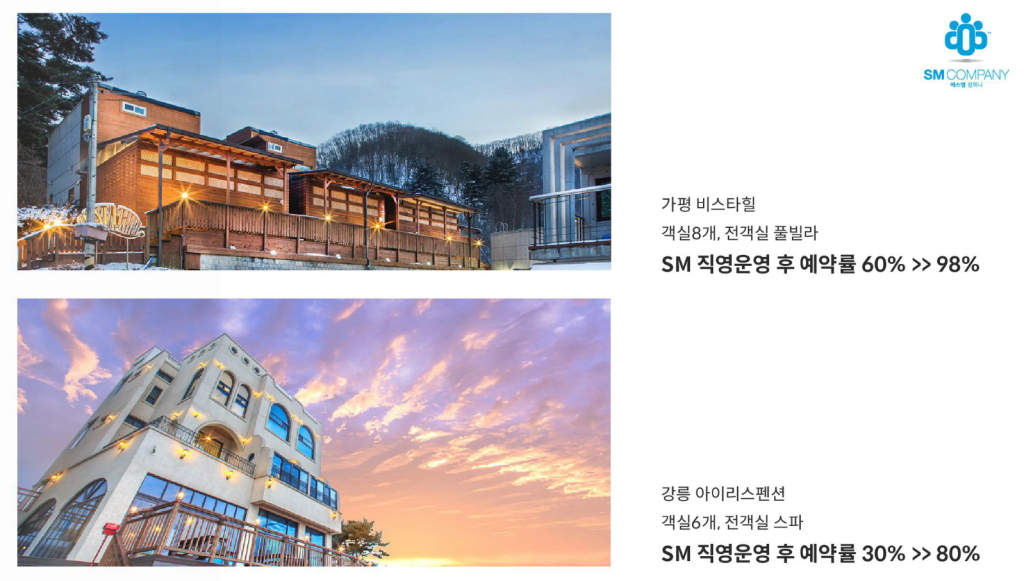
Take Vista Hill in Gapyeong, which we operate directly. It has eight rooms, all pool villas. Previously, they sold through just three social commerce platforms and had about 60% occupancy. After we took over, we expanded to 10 channels and pushed occupancy to 98%. For Iris Pension in Gangneung, we went from 30% to 80%. Going from 30% to 80% means revenue skyrocketed.
Just by adding sales channels, you can see this kind of lift. But pension owners don't know how to do this — and managing it all is overwhelming. That's where outsourcing to us makes a huge difference.
Q. So does adding channels work for any pension?
Not really. For mid-tier and above properties, adding channels can make a real difference. But for lower-tier pensions, it doesn't work. If the facility quality isn't there, more channels won't help. On the flip side, if a pension has top-tier facilities but the owner doesn't know how to operate it, that's where we can unlock serious value.
Q. Compared to other sales agencies, what's SM Company's strength?
Honestly, we don't have the massive systems or capital that bigger firms have. But we try to understand pension owners' perspectives and respond with care. A lot of clients who switched to us from other agencies did so because they were frustrated with poor communication. Most agencies just take their commission and don't know much about actual operations. We run 15 pensions ourselves, so we empathize with owners and communicate much better. I think that's our edge.
Q. Advice for aspiring pension entrepreneurs?
Pensions started popping up 14–15 years ago, and many are still using the same playbook from back then. But the market has changed. Overseas travel is surging, and hotels and resorts are slashing rates — pension demand is shrinking. So if you're thinking about opening a pension, whether through new construction or leasing, concept is everything.
Take kids' pensions, for example. Korea doesn't have many yet. A kids' pension that opened recently in Gapyeong is doing incredibly well. Families with kids are a huge segment, and they love properties with character-themed rooms, kiddie pools, and lots of activities for children. A generic pool villa won't cut it anymore. If you build a clear concept and execute strategically, your odds of success go way up.
Q. How do you see the pension market evolving?
As I mentioned, demand is shifting to overseas travel and domestic hotels and resorts. The pension market is shrinking, and the customers who are left want high-quality properties. If you have an aging facility and don't renovate, you're going to struggle. Even new builds — if they're cookie-cutter — will have a hard time. You need a differentiated concept, differentiated facilities, and differentiated service to survive long-term.
Another opportunity: attracting international tourists. We're preparing strategies to sell through overseas booking channels. If we can tap into foreign traveler demand, that's another path to revenue growth.
Q. Finally, what are your plans moving forward?
The main goal is franchising. Alongside that, I want to offer startup consulting and even write a book on pension entrepreneurship and operations. A lot of retirees dream of moving to the countryside and running a pension, but information on pension startups is extremely limited. I learned everything through trial and error — and I keep thinking, "If someone had given me a heads-up, things would've been so much easier." I want to share what I've learned. I've got hands-on experience in operations, sales, and agency work — so I can offer practical, grounded advice. I want to help people who are preparing to launch their own pension.
SM COMPANY — Pension Online Sales Agency Specialist
8F, Gyeongnam Building, 1082 Cheonho-daero, Gangdong-gu, Seoul
02-471-0832, 0837
View full magazine <<
⚠️ All rights reserved. Cite this piece as 'ONDA (온다)' when quoting.