OTA expansion: in-house vs. outsourced — how should you decide?
⚠️ All rights reserved. Cite this piece as 'ONDA (온다)' when quoting.
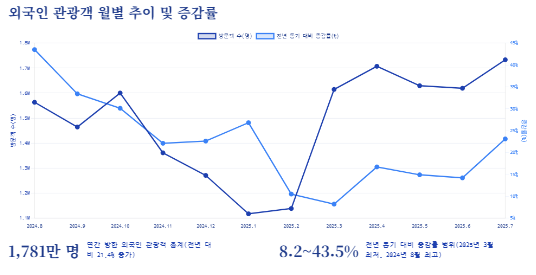
International arrivals to Korea are surging. In July 2025 alone, 1.73 million foreign tourists visited — up 23.1% year-over-year. Cumulative arrivals from January through July topped 10 million for the first time.
What's more telling: this isn't a one-off spike. Every month from August 2024 to July 2025 saw over 1 million visitors, totaling 17.8 million — officially surpassing pre-pandemic 2019 levels.
The message for small and independent hotels is clear: international guests are no longer optional — they're essential.
From "Youke" to "Sanke": How Chinese Travelers Changed
About 30% of inbound visitors are from China — and the profile has shifted dramatically.
Gone are the days of "youke" (游客) tour groups. Today's dominant cohort is "sanke" (散客): independent travelers who book their own hotels, plan their own itineraries, and prioritize experiences over package deals.
This shift is a golden opportunity for smaller properties. While tour groups funneled into chain hotels via travel agencies, young independent travelers discover and book unique stays through OTAs and social media.
They're not just shopping. They want cultural immersion, K-food, beauty treatments — experiences. They gravitate toward intimate, design-forward, story-rich accommodations — exactly where small hotels shine versus generic chains.
OTA Expansion: In-House vs. Outsourced — How Do You Choose?
To capture international demand, listing on global OTAs is non-negotiable. 62% of travelers worldwide book via OTAs, and 43% use metasearch engines like Kayak and Trivago.
But here's the fork in the road: manage your OTA presence yourself, or outsource it?
🔧 DIY Management: The Reality Check
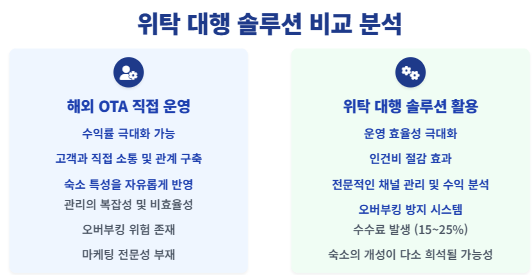
Running your own OTA channels is tempting. You save on commissions, own the customer relationship, and control your brand story.
But the execution is brutal.
First, the ecosystem is a maze. Expedia owns Hotels.com and Trivago. Booking.com owns Kayak and HotelsCombined. Each platform has its own backend, policies, and language requirements.
Second, it's 24/7 operations. Fail to sync inventory in real time → overbookings. Miss a guest inquiry → lost conversion. International time zones mean inquiries hit at 3 a.m.
Third, it demands expertise. You need pro-level photography, multi-language copywriting, competitive pricing analysis, and marketing chops — or you disappear in search rankings.
Bottom line: DIY works if you're already comfortable with OTAs, speak foreign languages, and have IT infrastructure in place. Otherwise, you're trading commission savings for operational quicksand.
⚡ Outsourced Management: Cost vs. Efficiency
"But the commission eats into my margins."
Fair. But reframe it: this isn't a cost — it's an investment.
First, you buy back time. Instead of wrestling with channel managers and pricing tools, you focus on guest experience.
Second, you gain expertise. Specialists handle dynamic pricing, competitor analysis, and campaign execution — things most small hoteliers don't have bandwidth for.
Third, operations scale smoothly. Automated real-time inventory sync across all channels eliminates overbookings entirely.
Fourth, revenue actually grows. Real-world data from outsourced operations shows average revenue lifts of 64%.
Using a platform like ONDA, the commission you pay is offset by labor savings + revenue gains + operational efficiency — resulting in higher net profitability.
Decision Time Is Now
The inbound tourism boom is real. But not every small hotel will capture it. The difference between winners and stragglers? Speed of decision.
You have two choices to make right now:
Choice 1: Build in-house capability vs. outsource
- If you have OTA expertise, language skills, and tech fluency → go direct and maximize margin
- If building that capability takes months → outsource and enter the market immediately
Choice 2: Wait and see vs. act now
- Hitting 10 million arrivals in 2025 is just the beginning. First movers lock in visibility before competition intensifies.
- The longer you wait, the more expensive and crowded the market gets.
Delay is a choice to lose. The international guest market is at your door. Open it — or watch someone else walk through.