As inbound tourism surges, hotels are wondering how to capture their share. We break down what Asian travelers specifically want—from booking to check-in to loyalty—so you can deliver.
Hi there—Korea's inbound travel market is roaring back. We're on track to hit 10 million international arrivals by year-end. Today's Weekly ON is all about how to win those travelers for your hotel ✈️
⚠️ All rights reserved. Cite this piece as 'ONDA (온다)' when quoting.
In This Issue
🏨 3 Things Hotels Must Remember to Attract International Travelers
💡 Three Rounds of Lodging Sale Festas—Did They Work?
⌨️ #InboundRecovery #2024TravelTrends #ChineseTourists #AirlineOutlook #NextYearTarget
🏨 Industry Deep Dive
3 Things Hotels Must Remember
to Attract International Travelers
Global travel is racing back to normal. According to UNWTO, international tourism reached 87% of pre-pandemic levels by Q3 2023—and should hit 90% by year-end.
Inbound travel to Korea is bouncing back just as fast. Through October, international arrivals recovered to 61% of 2019 levels. This year will easily surpass 10 million visitors.
As foreign tourists return, hoteliers are asking: How do we capture them? And how do we deliver an experience they'll love?
We'll walk through booking, check-in/out, and loyalty—three universal touchpoints—and break down what global travelers (especially Asian ones) actually want.
1. Booking & Payment: Mobile-First
No surprise: most travelers search for hotels online. Globally, 59% search on mobile, 37% on desktop.
When it comes to booking, OTAs like Booking.com and Expedia dominate—along with metasearch engines like Tripadvisor and Trivago. 62% of global travelers book through OTAs; 43% use metasearch.
Asian travelers skew even harder toward OTAs and metasearch. 68% book via OTA, 50% via metasearch—the highest rates globally.
Interestingly, North American travelers use hotel direct websites just as much as OTAs. They value that direct channel.
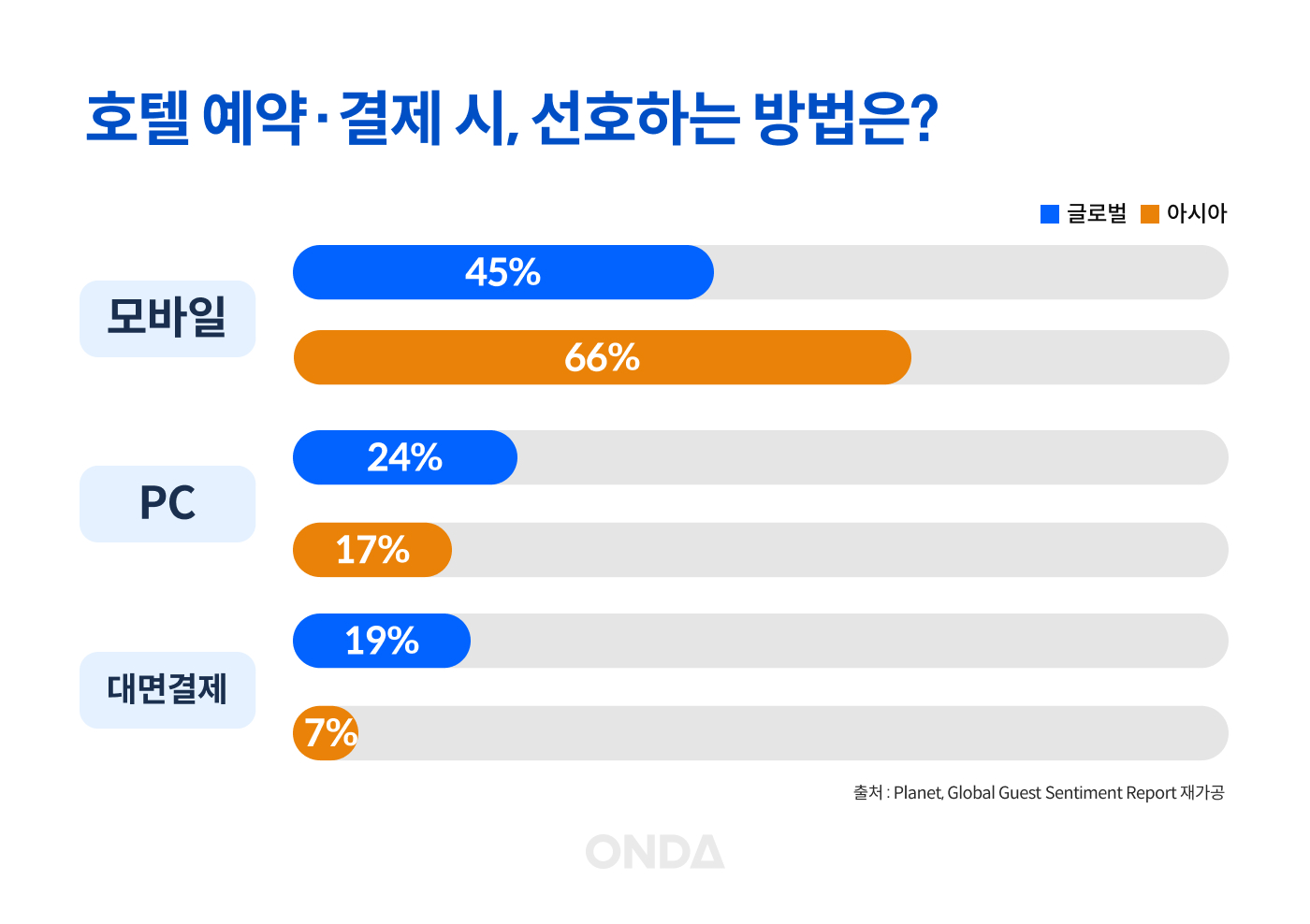
Preferred booking and payment channels also differ by region. Mobile dominates globally—but Asian travelers (66%) prefer mobile checkout far more than the global average (45%).
In the Americas and Europe, over 20% still prefer paying at the property. In Asia, only 7% want to pay on-site. They expect digital-first payment flows.
Preferred payment methods vary too. Credit cards lead everywhere—but are less dominant in Asia (64%). Asian travelers strongly favor mobile wallets like Alipay and WeChat Pay (59%).
To deliver seamless booking for Asian guests, integrating local mobile payment methods is table stakes.
2. Check-In/Out: Digital & Fast
COVID normalized contactless tech. Now 59% of global travelers prefer self-check-in via personal device or kiosk—skipping the front desk line. 13% actively avoid face-to-face interaction with staff.
Regional differences are stark. In North America and Europe, 57% and 56% still prefer checking in with a person—higher than the global average. Self-check-in rates are correspondingly lower.
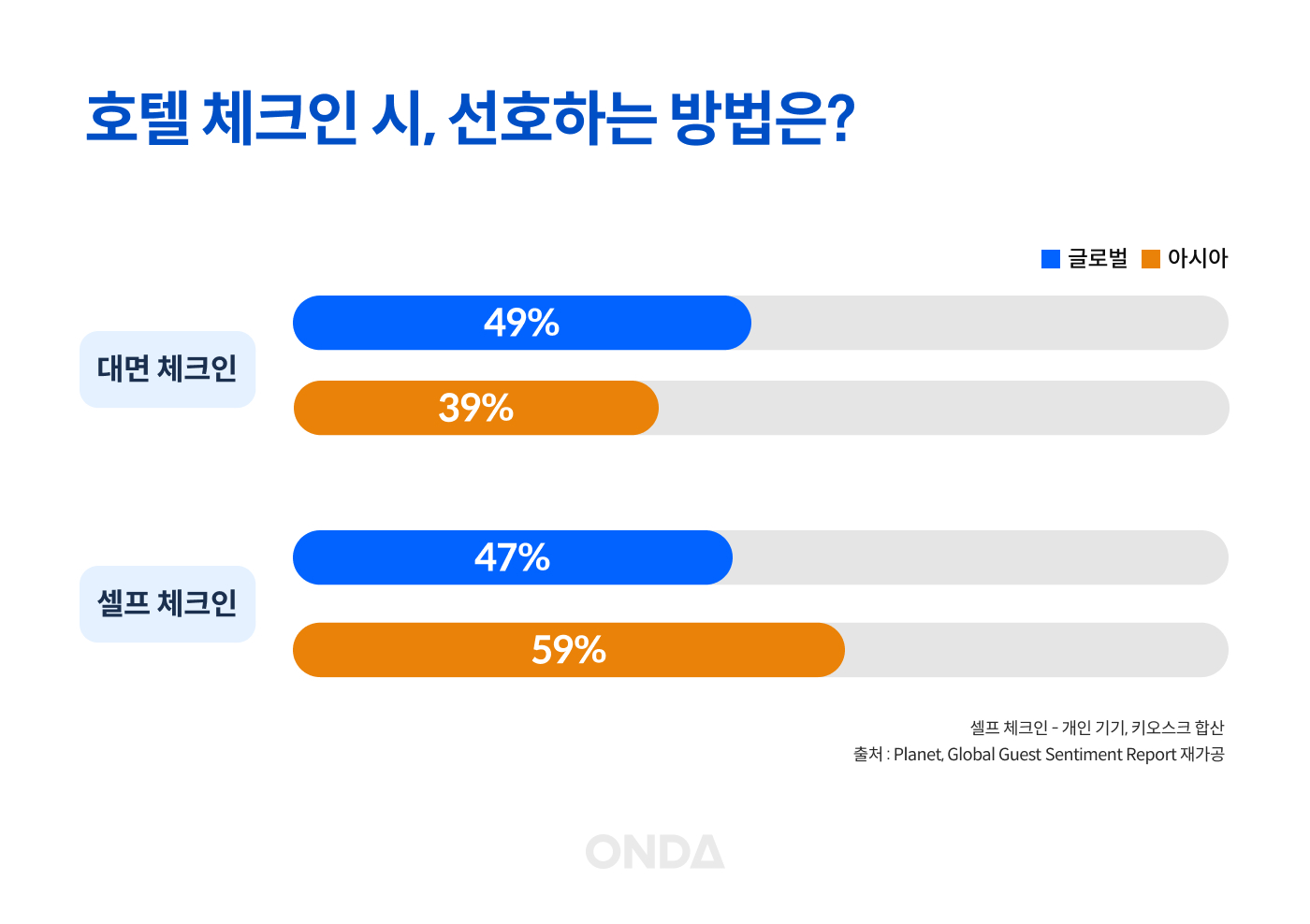
Asia is the opposite. Face-to-face check-in preference is 10 points below the global average. Asian travelers overwhelmingly prefer digital self-check-in.
For check-out, the story converges: everyone wants speed. Over half (55%) of global travelers prioritize a fast, queue-free checkout process. Chinese travelers (63%) care most about zero-wait checkout.
You've delivered a great booking and stay experience. Now—how do you bring them back?
What do global and Asian travelers value in hotel loyalty programs?
👉 Check out all 3 things international travelers want
💡 Hospitality Trends
Three Rounds of
Lodging Sale Festas—Did They Work?
Korea's Ministry of Culture, Sports and Tourism and Korea Tourism Organization ran lodging discount campaigns three times this year: spring (May–July), Chuseok (Sept–Oct), and fall (Oct–Nov). The result?
~3 million domestic travelers (including companions) were mobilized. 54% said the discount coupon prompted a spontaneous trip—evidence of real demand activation. Some even canceled or downsized overseas trips in favor of domestic travel.
68% of bookings were used outside the Seoul metro area, spreading tourism revenue across regions.
ONDA's data also shows a sharp spike in lodging bookings during campaign periods. Full analysis coming in the 2023–24 Hospitality Data & Trends Report (January 2024)—stay tuned.
👉 Full story
⌨️ Keyword News
1️⃣ Inbound Recovery 👉 [full story]
TL;DR: Korea's inbound tourism recovered to 61% of pre-COVID levels
The story: Through October, ~8.8M foreign visitors arrived—61% of 2019's 14.6M. The U.S. surpassed 2019 (103%), Japan hit 67%. China—once the top source market—is stuck at 31%, with no meaningful uptick even after group tour restrictions lifted in August.
2️⃣ 2024 Travel Trends 👉 [full story]
TL;DR: 2024 trends: personalized, niche travel experiences
The story: Korea Tourism Organization forecasts 5 trends for 2024: ▲rest-focused travel ▲single-theme trips ▲hidden local spots ▲smart tech-enabled travel ▲accessible-for-all travel. 7 in 10 Koreans now book accommodations, transport, and dining online. Expect more AI-powered personalized travel recommendations.
3️⃣ Chinese Tourist Spending Shifts 👉 [full story]
TL;DR: Chinese travelers now spend less at duty-free, more on lodging, clinics, and convenience stores
The story: As Chinese tourism shifts from groups to independent travelers, spending patterns are changing. They're chasing trendy cafés and restaurants featured on social media—traveling like locals. Duty-free spending dropped nearly 50% vs. 2019, while lodging, healthcare, and retail spending rose.
4️⃣ Airline Industry Outlook 👉 [full story]
TL;DR: Global airlines headed for record results in 2024
The story: IATA forecasts airlines will carry 4.7B passengers next year—surpassing 2019's 4.5B. Through Nov 2023, Incheon Airport's traffic to the Americas, Japan, and Middle East already exceeded 2019 levels (101%, 109%, 108%). Most other regions hit 60–80% recovery (excluding China).
5️⃣ 2024 Tourism Target 👉 [full story]
TL;DR: Government sets 20M inbound visitors target for 2024
The story: Korea aims for 20M international arrivals and $24.5B in tourism revenue next year. Plans include: ▲expanded group e-visa fee waivers ▲higher tax refund thresholds ▲year-round mega-events ▲visa policy easing ▲better transport booking & mobile payment systems.