In Part 2, I promised to share real success stories. Here it is: What happens when a motel drops daytime rentals and lists on global channels? One floor, one experiment. A Seoul motel started small—and within three months decided to transform the entire property. Here's how it worked...
In Part 2, I promised to share real success stories. Here it is:
"A motel actually pulled it off. Eliminated daytime rentals. Listed on global channels. What happened?"
The One-Floor Experiment
Motel A in Seoul. A typical small-to-midsize motel.
They didn't overhaul the entire property at once. They converted just one floor as a pilot.
Here's what changed:
- Eliminated daytime rentals on that floor—overnight stays only.
- Added a microwave, water purifier, and vending machine so long-stay guests could grab simple meals.
- Registered with a next-gen channel manager to list on Booking.com, Agoda, and other global OTAs where foreign travelers actually search.
- Signed up for a free booking engine service to create an English website with online reservations, optimized for Google Maps and Google search.
- Used AI translation tools to make English signage and QR codes linking to an English explainer page.
No major renovation. No interior construction. Two weeks of setup. Initial investment: essentially zero.
From pilot floor to full-property commitment? Less than three months.
Let's look at the numbers.
The Numbers Tell the Story
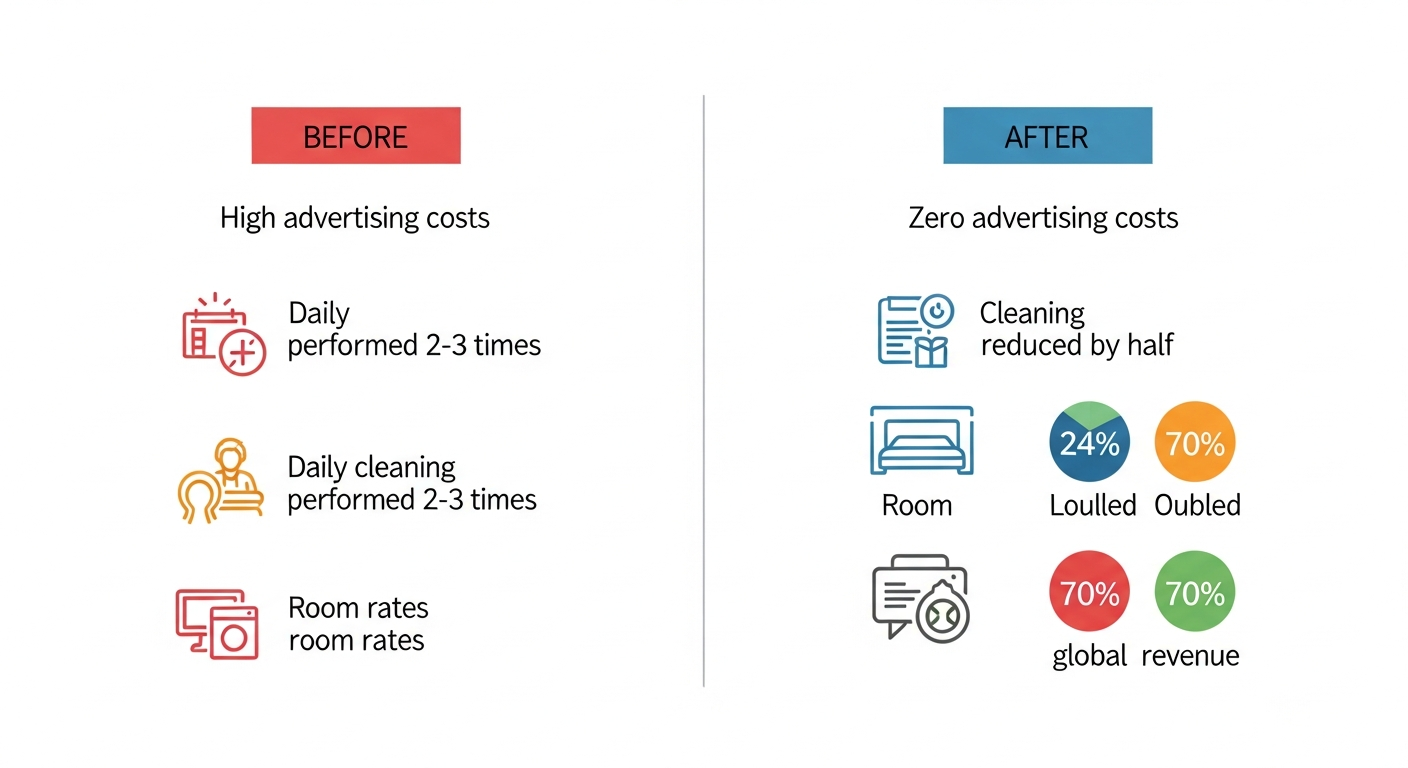
Ad spend: ₩3–5M per month → ₩0.
Gone were the monthly ad fees poured into Yanolja and Yeogi Eottae. Global OTAs don't charge upfront ad costs—they take commission only when bookings happen. No bidding wars, no ad budget arms race.
ADR (Average Daily Rate): more than doubled.
Daytime rentals fetch ₩30,000–₩50,000. When they switched to overnight-only and raised nightly rates by about 30%, rooms still sold well. To foreign visitors, Korean motel pricing remains a bargain. With daytime rentals gone and overnight rates up, ADR more than doubled.
Housekeeping costs: cut in half.
Daytime rentals require cleaning after every checkout—two or three times a day. Overnight-only meant average length of stay jumped to about two nights. No need to clean daily. Cleaning frequency dropped by more than half, taking labor, laundry, and supply costs down with it.
Global channel revenue share: over 70%.
More than 70% of total revenue now comes from Booking.com, Agoda, and other global OTAs. The rest? Direct bookings via Google search and Korean OTA overnight reservations.
OCC (occupancy) dipped slightly. No more daytime turnover means you can't hit 100%+ anymore. But profit per room sold? Incomparable. Lower rotation, higher profitability.
High occupancy feels good, but it comes with hidden costs. Doors, furniture, fixtures, bathrooms—they wear out faster. The 2–3 year renovation cycle we mentioned in Part 2 speeds up. Three daytime turnovers a day means triple the wear versus one overnight guest. Lower occupancy extends asset life. You're saving on future renovation costs.
Let's get more concrete. Here's a monthly P&L simulation for a 30-room motel.
Before — Daytime-Focused (Korean OTAs)
| Item | Amount |
|---|---|
| Revenue (daytime + overnight, avg. ₩40K × 105% OCC) | ₩37.8M |
| Platform commission (11.5%) | △₩4.35M |
| Ad spend (Korean platforms) | △₩3.5M |
| Labor (front desk + housekeeping, 3 staff) | △₩8M |
| Laundry (2–3 turnovers/day) | △₩3.5M |
| Utilities (water/gas/electric) | △₩3.5M |
| Supplies/fixture replacement | △₩2M |
| Loan interest (₩500M @ 3.5% APR) | △₩1.45M |
| Operating profit | ~₩1.5M |
Running at 100%+ occupancy with no days off, and you clear ₩1.5 million. Barely enough to cover the owner's salary—if that. After interest, nothing's left. This is the reality for most daytime-focused motels today.
After — Global Overnight-Focused
| Item | Amount |
|---|---|
| Revenue (overnight only, avg. ₩100K × 70% OCC) | ₩63M |
| Platform commission (global OTA 16%) | △₩10.1M |
| Ad spend | ₩0 |
| Labor (front desk + housekeeping, 1–2 staff) | △₩5.5M |
| Laundry (avg. 2-night stay, half or less) | △₩1.8M |
| Utilities | △₩3M |
| Supplies/fixture replacement | △₩1.2M |
| Loan interest (same) | △₩1.45M |
| Operating profit | ~₩39.95M |
Same motel. Same 30 rooms. OCC dropped from 105% to 70%. Yet operating profit jumped from ₩1.5M to nearly ₩40M. Zero ad spend, half the housekeeping and laundry costs, and ADR more than doubled.
This simulation is based on Motel A's real conversion data, scaled to a 30-room property.
Not every motel will see identical results. Location, facility condition, and operational capability all matter. There are risks in going global, too.
Peak-season volatility may be higher than with Korean daytime rentals. You'll need to factor in currency fluctuations, OTA policy changes, and the ability to handle foreign guests (review management, communication).
But the direction is clear: same property, same location—different market, fundamentally different profit structure.
A motel working until dawn to squeeze out ₩1.5M in profit now clears ₩40M while running at lower occupancy. Work less, earn more.
This is the economics of "daytime to overnight."
Summary:
| Item | Before (Daytime Focus) | After (Global Overnight) |
|---|---|---|
| Monthly ad spend | ₩3–5M | ₩0 |
| ADR | ₩30–50K (incl. daytime) | ₩80–120K |
| Housekeeping frequency | 2–3 times/day | Half or less |
| Global revenue share | 0% | 70%+ |
| OCC | 105% (barely) | ~70% |
| Renovation cycle | 2–3 years | Extends to 4–5 years |
| Operating profit (30 rooms) | ~₩1.5M | ~₩40M |
It started with one floor.
No AI magic. Just signed up for a few services, tinkered for a couple of weeks, and fundamentally changed the business model.
Why Now
Timing is everything. This experiment succeeded because three trends—covered in Part 2—are converging right now.
First: demand is exploding. 2025 saw 18.94 million inbound tourists, an all-time high. 2026 will almost certainly break 20 million.
Second: supply is shrinking. Airbnb's mandatory business registration wiped out 30,000–34,000 listings. Tens of thousands of rooms are already gone, with more to follow.
Third: new supply is blocked. Hotel construction takes five years from permits to opening. PF loan defaults and soaring construction costs mean supply shortages will persist through 2029 (Asia Economy, Feb 11, 2026).
Demand is overflowing. Supply is contracting. New inventory isn't coming.
There are 30,000 legal accommodations nationwide that can fill this gap. Motels.
The problem? Most of those 30,000 motels aren't listed on global OTAs or Google Hotels. They're invisible to foreign travelers. This is the "51.5% paradox" we examined in Part 2.
Motel A flipped that paradox.
They just listed on the right channels. And their revenue model transformed.
What Foreign Travelers See in Korean Motels
"Why would foreigners stay at a motel?" Start by reframing the question.
Koreans associate motels with daytime rentals. Foreign travelers have no such preconception. To them, a Korean motel looks like this:
On Booking.com, average accommodation in Seoul's Hongdae area runs about ₩100,000 per night. A motel priced at ₩80–120K gets reactions like "These facilities at this price?" Whether they're from Southeast Asia, Europe, or Japan—whether they're K-pop fans or backpackers—it's a rational choice.
Look at Booking.com reviews for Korean motels: "Best value," "Clean and spacious," "Can't believe this price." The "love hotel" stigma exists only in Korean minds.
Where Foreign Travelers Book
You need to know which platforms foreigners actually use. Here's ONDA's analysis of OTA preferences by nationality:
| Nationality | Preferred OTAs |
|---|---|
| Taiwan/Hong Kong | Agoda > Booking.com > Trip.com |
| Southeast Asia | Agoda, Booking.com |
| North America/Europe | Booking.com, Airbnb |
| Japan | Booking.com, Rakuten Travel |
| China | Trip.com (Ctrip), Qunar, Fliggy |
The pattern is clear:
Asia → Agoda. Western markets → Booking.com. China → Trip.com. List properly on these platforms, and you capture most foreign demand.
Yanolja and Yeogi Eottae aren't where foreign travelers go. For guests accustomed to global OTAs, Booking.com, Agoda, and Trip.com are the natural choices. And unlike Korean platforms, global OTAs don't run ad auction models. They charge 15–18% commission when bookings happen (Hotel&Restaurant, OTA commission analysis). No burning millions per month.
Remember the numbers from Part 2: Korean platforms charge 11.5% commission plus ₩1M+ monthly ad spend—totaling about 20% of revenue. Global OTAs? 15–18% commission, ₩0 ad spend.
Real burden is lower or comparable on global OTAs. Yet ADR is much higher.
And one more thing: Google Maps as a distribution channel is opening up.
Google Maps has 2 billion monthly active users globally and commands roughly 70% of the global map app market (Business of Apps, 2026). Foreign tourists everywhere use it to navigate, search for accommodations and restaurants.
Except in Korea—until recently, it didn't work properly.
Walking directions and car navigation were broken. An 18-year data export restriction was to blame.
Korea Tourism Organization surveys consistently ranked "wayfinding" as the lowest-rated infrastructure item (80.4% satisfaction), with Google Maps topping the list of apps foreigners found frustrating (30.2%) (Newsis, Mar 14, 2025).
Then in February 2026, the government granted Google conditional export approval for 1:5,000 scale high-precision maps (ZDNet, Feb 27, 2026).
Once Google Maps enables full navigation and detailed mapping in Korea, foreign travelers' search behavior will shift. They'll find accommodations on the map, check reviews, and book—right there.
Whether you're visible on Google Maps will determine whether foreign travelers can find you at all.
FYI: In 2021, ONDA became the first Korean hospitality tech company to partner with Google Hotels.
Properties listed through ONDA appear directly in Google Search and Google Maps, enabling direct bookings (D2C) without OTA intermediation. Lower commissions, instant access to guest contact info.
What Motel A Actually Did
Here's Motel A's transformation, step by step. Nothing fancy.
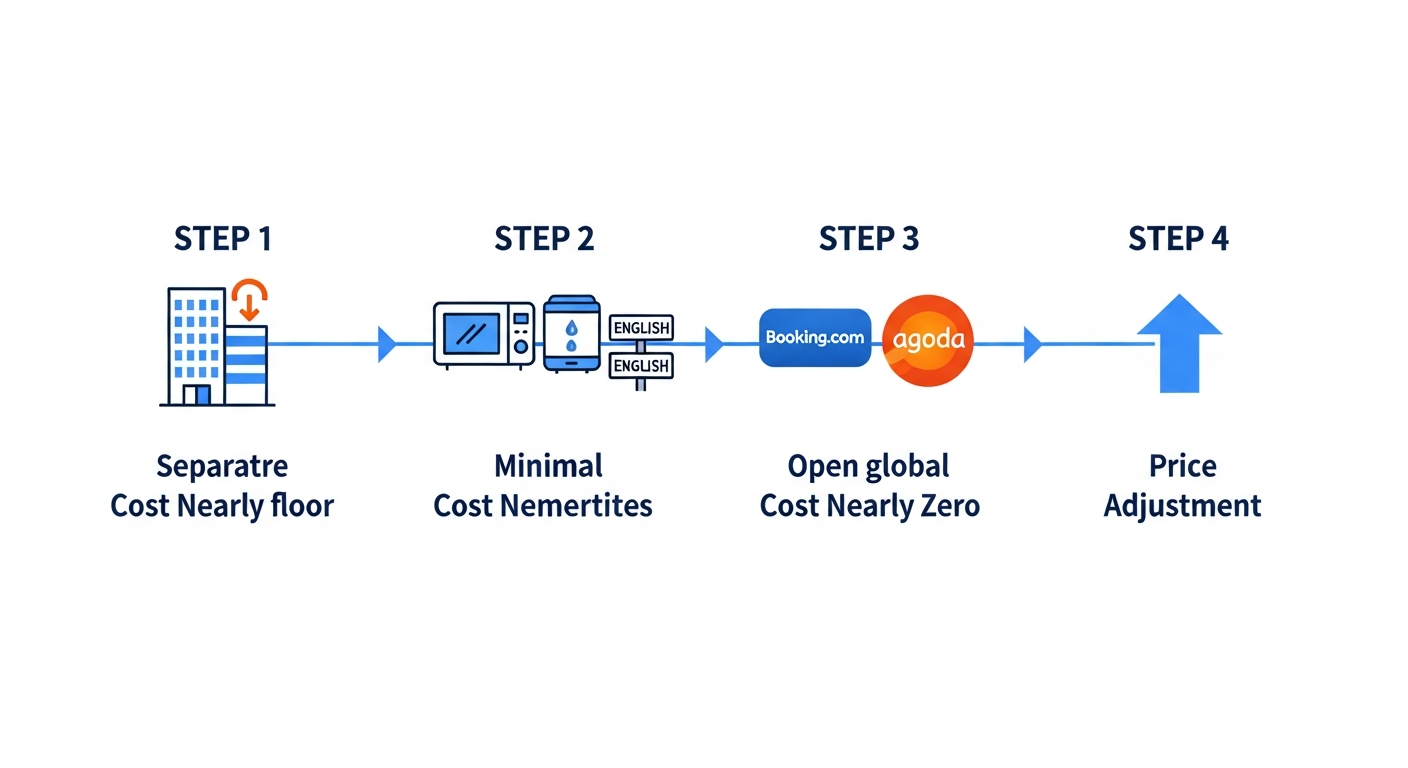
Step 1: Isolated one floor.
Too risky to change everything at once. They eliminated daytime rentals on one floor, converted it to overnight-only. The rest of the property kept running as before. If it worked, expand. If not, revert. Low stakes.
Step 2: Added minimal amenities.
Microwave, water purifier, vending machine. Enough for long-stay international guests to handle simple meals. English signage made with AI translation tools, linked to an auto-generated English homepage. Check-in instructions, Wi-Fi password, emergency contact. Stocked rooms with international outlet adapters. Total cost: minimal.
Step 3: Opened global channels.
Registered on Google Business. Listed on Booking.com, Agoda, and Trip.com via a channel manager. Without a channel manager, you'd have to join each OTA separately, manually input room details—in English—and manage pricing and inventory across multiple dashboards. Not realistic.
Motel A used ONDA's next-gen channel manager. Agoda booking, Booking.com reservation, website booking—all managed on one screen. Change the price once, it updates everywhere.
Step 4: Adjusted pricing.
Raised overnight rates on the converted floor by about 30%. "Won't that hurt sales?" They worried. But for foreigners, even the raised price was still cheap. And international guests booked minimum two-night stays. Housekeeping costs dropped while sales stayed strong.
That's it. Not a hundred-million-won renovation. A shift in mindset and channels.
Other Motels Taking the Same Path
Motel A isn't alone. Similar patterns are emerging among motels listed on global OTAs.
The common thread? No major facility investment. Just opened the channels and prepared to communicate in English.
Motels Won't Disappear
In Part 1, we traced 70 years of history. Inns became parktels. Love hotels became boutique hotels. Motels have evolved with every era.
In Part 2, we diagnosed the crisis. Domestic market saturation. Platform ad wars, declining daytime demand, rising costs. Symptoms from the same root. No solution within that structure.
In Part 3, we found the exit. Look outward and the answer appears. 20 million visitors are coming to Korea. Airbnb supply dropped by tens of thousands of rooms. Hotels will be short until 2029. There are 30,000 properties nationwide that can fill this massive gap.
The fifth evolution keyword: "Global Budget Hotel."
| Before | After |
|---|---|
| Daytime-focused | Overnight-focused |
| Couple guests | Foreign + business travelers |
| Yanolja/Yeogi Eottae | Global OTAs + direct website |
| Millions in monthly ad spend | ₩0 ad spend |
| Domestic market | Inbound market |
The 1988 Olympics gave birth to parktels. The 2026 era of 20 million inbound arrivals will birth the "global budget hotel."
History repeats—but only for those who prepare.
Motels won't disappear. They'll just evolve.
Start with one floor. Start now.