Over half of Korea's 60,000 lodging properties are motels, yet owners are struggling despite market dominance. Platform commissions and ad costs now consume 20% of revenue, turning survival into a structural trap.
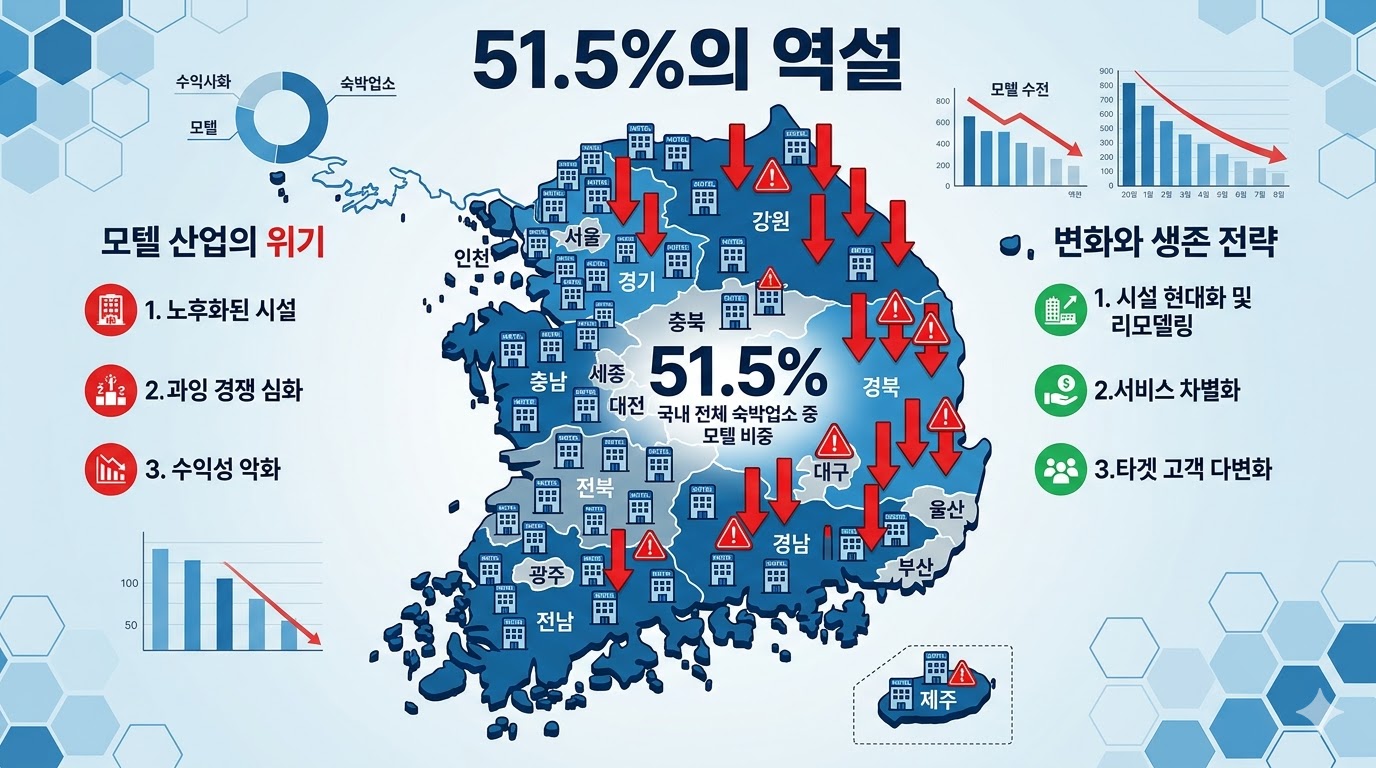
As of 2024, South Korea has about 60,000 lodging properties nationwide. 51.5% of them are motels (59,619 properties, according to Robin Company's "South Korea Lodging Market 2024" report).
More than half the market.
And yet, the owners of this massive market segment say the same thing over and over:
"It didn't used to be this hard."
I've been in this industry for 18 years.
Running ONDA for a decade, I've spoken directly with thousands of accommodation owners.
But over the past few years, the faces of motel owners have noticeably darkened.
Stories of multi-million-dollar renovations that barely cover the interest payments are no longer surprising.
The size of the number and the reality of the suffering move in opposite directions.
This is the 51.5% paradox. What has driven this market to this point?
The Battlefield Changed. The War Didn't End.
Yanolja. Yeogi Eottae.
If you own a motel, you have complicated feelings about these two names.
Grateful, but also resentful. You can't run a business without these platforms.
Over 80% of revenue for small and midsize motels comes from them. Walk-in customers keep shrinking.
The problem is the price you pay.
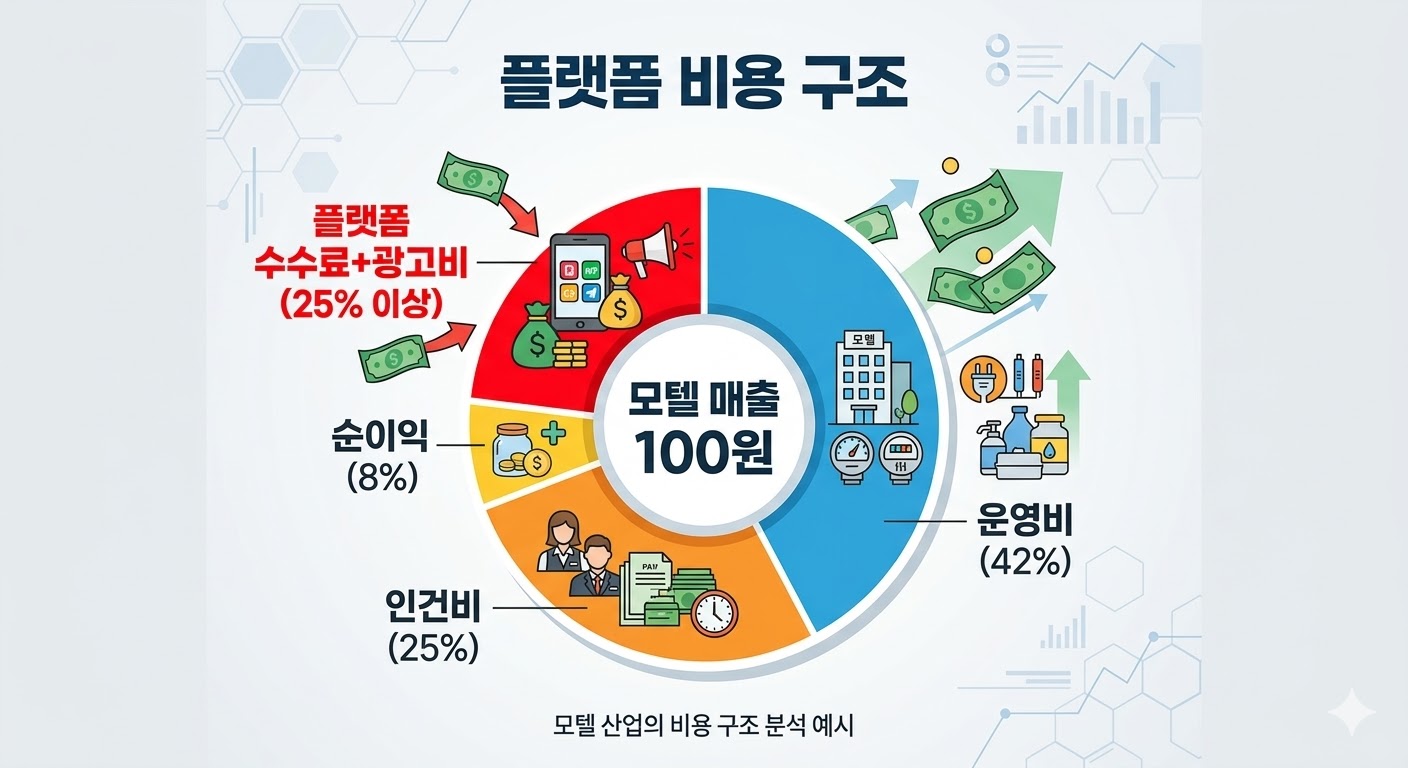
In 2024, the Korea Federation of SMEs surveyed 1,103 small businesses on online platforms (News1, 2024).
Here's what they found for accommodation apps:
| Item | Figure |
|---|---|
| Average sales commission | 11.5% (range: 8% to 17%) |
| Average monthly ad spend | ₩1,079,000 |
| Commission + ads combined | ~20% of revenue |
Sell a ₩50,000 room, and at least ₩10,000 goes to the platform.
On top of that, you're burning over ₩1 million a month in ads. If you don't advertise, no one finds you.
Your competitors advertise too. The ad bidding war spirals endlessly.
This phenomenon is a structural outcome predicted by platform economics.
Platforms typically leverage information asymmetry to drive initial marketing. In the early days, when supply lags behind demand, suppliers have the upper hand.
There was a time when simply listing on the platform brought customers.
That was true for Hanintel (my first startup), and also for Yanolja and Yeogi Eottae in their early days.
But South Korea is a closed market of 50 million people.
Domestic demand has limits.
Once supply catches up, competition begins inside the platform. Bidding for top placement becomes rent-seeking.
You're fighting over a fixed pie. The pie itself doesn't grow. Costs just keep rising.
So what happened in the end?
The money you used to spend on neon signs and flyers offline just moved online — into ad budgets.
The battlefield changed. The war didn't end.
The Fair Trade Commission has noticed the problem.
In August 2025, it fined Yanolja and Yeogi Eottae ₩1.54 billion.
The reason: they sold coupon ad products to listed properties, then let unused coupons expire without refunds.
Yeogi Eottae set coupon validity to just one day, auto-expiring any unused on the same day.
The total value of expired coupons: ₩35.9 billion (Law Times, Aug 12, 2025).
The Ministry of SMEs and Startups then requested the prosecution file criminal charges. The Korea Small & Medium Hotel Association filed a class-action lawsuit on behalf of 5,000 to 8,000 affected properties.
Fines were imposed. Lawsuits are underway. But the structure hasn't changed. You still can't run a business without the platforms.
Don't list and you go under. List and you make nothing. That's the first paradox.
Day-Use as the Survival Formula
Day-use (daesil) rooms are the backbone of motel revenue. Or at least, they used to be.
Morning day-use. Afternoon day-use. Overnight. Turn the room two, three times a day.
This turnover rate was the essence of the motel business.
Overnight-only doesn't make the numbers work.
You need occupancy over 100% to barely turn a profit. Day-use wasn't optional. It was the survival formula.
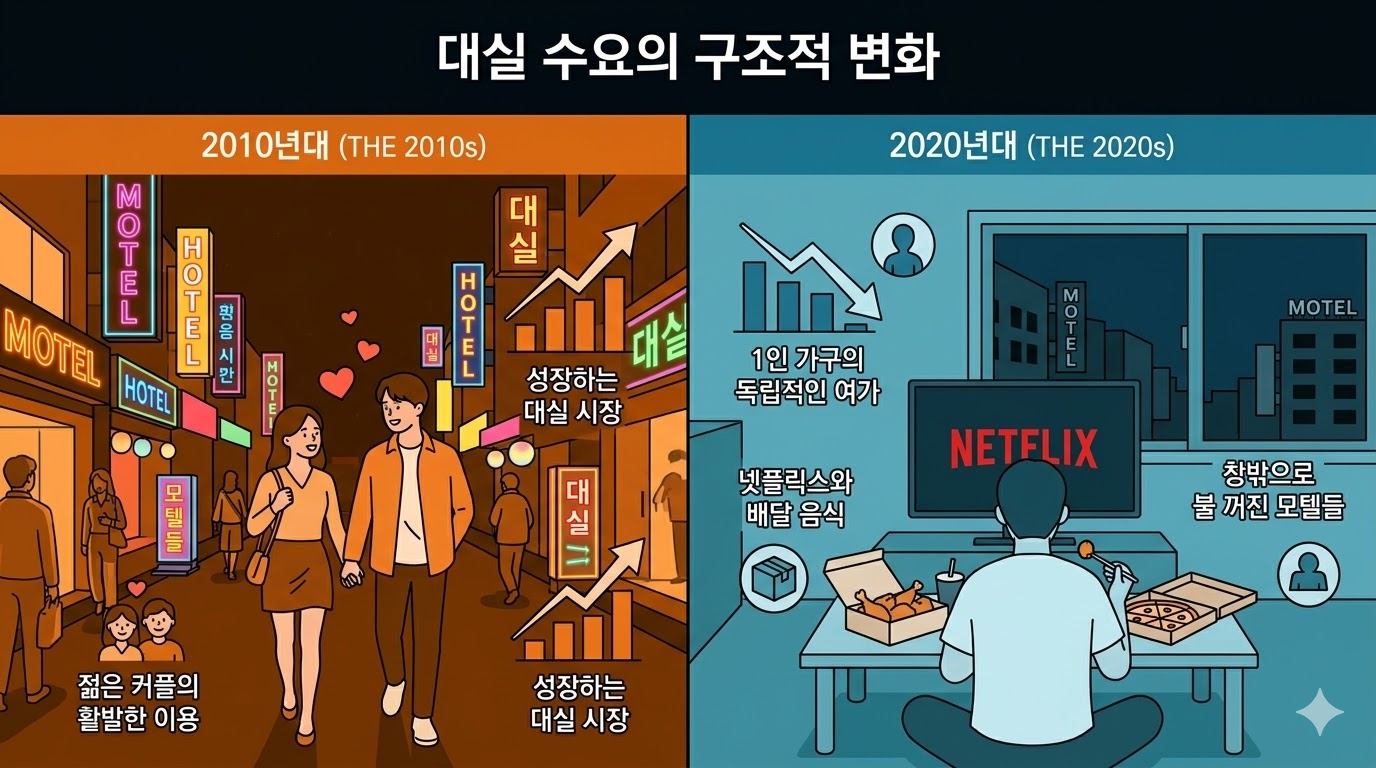
Ten years ago, motel owners said it clearly: "Just catch the couples." Back then, they were right.
Now, almost no one says that.
The numbers tell the story.
According to Statistics Korea, the number of marriages in 2022 hit a record low of 192,000 — less than half of the 435,000 in 1996. There was a slight rebound in 2024, but not enough to reverse the structural decline.
Single-person households reached 8.045 million in 2024, accounting for 36.1% of all households (Statistics Korea, 2025). That's up from 27.2% a decade ago. More than one in three households is now a solo household.
Couples no longer need to wander looking for a private space. Dating itself has declined.
A 2024 PMI survey found that 75.8% of unmarried people in their 20s and 30s are not currently dating.
25.5% have never dated at all. And they don't go out much anyway.
OTT usage jumped from 41% in 2019 to 89.2% in 2024 — doubled in five years.
Monthly users of food delivery apps exceeded 27 million (Wiseapp, 2025).
They watch Netflix at home. Order delivery. Don't leave the house.
Motel day-use was built on the premise of "couples going out." That premise itself is crumbling.
Motels aren't competing with the motel next door anymore. They're competing with "not going out at all."
Consider Gen Z still living with their parents.
Even when they do go out for privacy, they choose Airbnbs or vibe-focused boutique stays over motels. They spend on "Instagrammable" spaces.
To capture shrinking demand, you have to compete on facilities.
Newly built motels, freshly renovated interiors — that's where people go.
The problem: the effect doesn't last.
In 1–2 years, you're "outdated" again. You get treated like a relic.
To stay popular, you need to reinvest every 2–3 years.
Spend millions on a remodel. Then millions more on the next one. It's an endless investment cycle.
Day-use has another invisible cost: operations.
Every time a guest leaves, you clean and change linens. Turn the room three times a day, you clean three times. Labor, laundry, supplies — every time. The higher the turnover, the higher the operating cost.
But raising day-use prices? Out of the question.
Competition is brutal. Raise your price, and customers walk next door.
Meanwhile, costs only go up.
Minimum wage rose from ₩5,580 in 2015 to ₩10,030 in 2025 — an 80% increase in 10 years.
City gas rates went up twice between 2022 and 2024.
The Bank of Korea base rate shot from 0.5% in 2022 to 3.5%, and still hovers above 3%.
For motel owners carrying millions in loans, the interest burden is incomparable to before.
Revenue stays flat. Costs keep climbing. Cost squeeze.
High turnover, no margin left. Cracks are forming in the old day-use formula.
What Half the Market Is Missing
Everything up to this point, most motel owners already know.
Platform fees are steep. Day-use isn't what it used to be. Everyone nods along.
But on the other side, the opposite problem is emerging.
According to the Korea Tourism Organization, 18.94 million foreign tourists visited South Korea in 2025 (Jan 30, 2026). An all-time high.
2026 is on track to break 20 million.
K-pop, K-drama, K-beauty fandoms are converting into actual tourist demand.
We've seen this before.
Back in 2016, Chinese tourists alone reached 8.99 million.
Seoul hotels ran out of rooms.
Tour operators bussed groups from Incheon Airport to Pocheon and other Gyeonggi-do outskirts, put them up overnight, then drove them back to Myeongdong in the morning for shopping and sightseeing.
A two-hour drive was no big deal for Chinese tourists.
When Seoul ran out of rooms, demand overflowed into the greater metro area.
Now, a similar situation is happening again.
Bigger. Stronger.
Supply is shrinking.
In October 2025, Airbnb enforced mandatory business registration nationwide. Of the roughly 72,000 listed properties, 30,000 to 34,000 unlicensed units faced delisting (Airbnb official announcement, Oct 16, 2025).
AirDNA analysis showed that 74% of Seoul Airbnbs and 92% of Busan listings were "entire place" rentals — effectively illegal operations (Digital Daily, Jul 25, 2025). Tens of thousands of units are leaving the market.
New supply is also blocked.
According to Asia Economy (Feb 11, 2026), Seoul tourist hotel rooms grew 23.8% over three years (2016–2019) but only 3.7% over six years (2019–2025). Hotels take about five years from permit to completion.
With the real estate PF crisis and construction cost spikes, new permits and groundbreakings have effectively frozen. Industry forecasts predict hotel supply shortages lasting until 2029.
Demand at record highs. Airbnb supply down tens of thousands of units. Hotel construction stalled.
Supply shortage is coming back.
Yet motels — which make up half the market — aren't positioned to capture this massive opportunity. That's the reality.
Foreigners can't book motels on Yanolja or Yeogi Eottae.
Foreign travelers use global OTAs: Booking.com, Agoda, Airbnb, Expedia, Trip.com, etc.
Global OTA commissions from inbound tourism alone are estimated at ₩1 trillion annually.
Reverse-engineering transaction volume from commissions gives you a sense of the scale.
But most motels aren't listed on global OTAs.
English is a barrier. The systems are complicated. Owners don't have the bandwidth. The reasons vary, but the result is the same:
You make up half the market, but to 20 million foreign visitors, you don't exist.
This is the real 51.5% paradox.
Face the Problem. Then You See the Path.
Motels aren't struggling because owners lack diligence or effort.
It's because the domestic market is locked.
A closed market of 50 million people.
Inside it, platform ad bidding spirals endlessly. Couple demand shrinks structurally. Costs rise while you can't raise prices.
All of these symptoms trace back to the same root.
As long as you only look inward, there's no answer within this structure.
But turn your gaze outward, and the story changes.
20 million people are coming to Korea.
Airbnb supply has dropped tens of thousands of units.
Hotels will be short until 2029.
Motels — which represent half the market — can fill this gap. The ones that prepare to welcome international guests and move first will win.
In fact, some motels have already transformed. They dropped day-use. They leaned hard into global OTAs. What happened?
We'll cover that in the next piece.
⚠️ All rights reserved. Cite this piece as 'ONDA (온다)' when quoting.