How will residential lodging facilities reshape the accommodation market?
Writer: Park Ji-hoon, General Manager, SoTA Collection
Editor: Lee Chae-eun, Manager, ONDA
64,923 accommodation units just dropped from the sky?
On January 15th, Korea's Ministry of Land, Infrastructure and Transport announced amendments to the 「Building Act Enforcement Decree」 that would require all new residential lodging facilities to register as lodging businesses under the「Public Health Control Act」, and mandate that sales notices explicitly state 'not for residential use — must register as lodging business.' The ministry also introduced a two-year grace period for existing residential lodging facilities currently operating as lodging businesses but used as residences — allowing them to convert to residential officetels or housing without incurring enforcement fines.
Translation: residential lodging facilities, which had been exploited for residential use thanks to generous tax benefits compared to other real estate, can no longer be used as homes. All facilities — including newly opened ones — must now register as lodging businesses. According to the Ministry of Culture, Sports and Tourism, there are 64,923 residential lodging facility rooms nationwide (as of June 30, 2019). In a sense, over 60,000 underutilized rooms are suddenly entering the accommodation market.
How will this policy shift reshape the accommodation industry?
Legal definition of residential lodging facilities
Before we explore how residential lodging facilities might impact the accommodation market, let's define what they actually are. 'Residential lodging facilities' is the legal term for serviced residences — essentially officetels with hotel-style services.
The legal definition spans two key statutes: the Building Act and the Public Health Control Act.
Lodging business (residential) under the Public Health Control Act refers to residential lodging facilities. The key difference between standard lodging facilities and residential lodging facilities is the presence of cooking facilities. Standard lodging facilities — hotels, motels, etc. — don't have kitchens. Residential lodging facilities do, making them essentially "livable hotels," or residence hotels.
While the concept of residences has been around for a while, the Public Health Control Act Enforcement Decree was only amended relatively recently to legalize their operation. As a new accommodation format, how did residential lodging facilities emerge?
A brief history of residential lodging facilities
Residential lodging facilities are also called serviced residences, and understanding the origins of that term helps explain how they came to be. In Korea, the concept debuted in 1988 when the Grand Hilton Hotel converted some rooms into apartment-style units for the Seoul Olympics. That same year, Swiss Grand Hotel launched Korea's first true residence — targeting long-stay foreign visitors with hotel services in a space that felt like home. Average occupancy exceeded 90% through the mid-90s.
This success sparked the 'Korean-style residence' model — where individual rooms were sold off and managed by operators. Real estate developers would sell serviced apartment or officetel units to investors, then manage them under contract and return profits. The concept evolved into an investment vehicle. As residence operators expanded from long-stay to short-stay guests, conflicts with hotels escalated. Some hotel brands that had franchised foreign chains switched to family hotel licenses, while domestic brands built on unit sales models remained.
Since these facilities served both long-term rentals and short-term stays, many unit buyers began living in their own rooms. As the line between residence and short-term lodging blurred, the Korea Hotel Association filed illegal operation charges against residences in 2010, putting serviced residences in jeopardy.
However, in July 2011, the Ministry of Health and Welfare amended the Public Health Control Act Enforcement Decree, legalizing residences by adding a 'stay-type lodging facility' category. It was later renamed 'residential lodging business' to distinguish it from general lodging — cooking facilities allowed — giving it clear legal standing.
A lack of coordination between government agencies created a loophole: The Ministry of the Interior and Safety allowed residential registration because these facilities had kitchens and longer stays than hotels. But the Ministry of Land, Infrastructure and Transport classified them as temporary accommodation, exempting them from the resale restrictions applied to apartments.
The result: a tax-advantaged investment product that offered living infrastructure while dodging apartment regulations. This led to a wave of properties built as apartments or residential officetels, then converted to lodging facilities — and back again.
What do residential lodging facilities mean today?
Looking back at their history, residential lodging facilities up until 2020 could be interpreted in two ways:
A) "Residential" lodging facilities
Facilities that can be rented out like officetels
B) Residential "lodging facilities"
Facilities that can be operated as lodging businesses hotel-style, but with living amenities like kitchens and washing machines in each room
In short, they functioned like officetels available for rent, with the option to register as lodging businesses and operate them directly — a lucrative income-generating real estate product. While similar to officetels, officetels are taxed as housing. After the '7.10 Real Estate Measures' raised tax rates for multi-home owners, the tax benefits of residential lodging facilities gained even more attention.
But the backlash against enjoying housing tax benefits while actually living in these units never stopped. They also sparked controversy over sprawl, since unlike apartments or officetels, they can be built in semi-residential and commercial zones. In 2021, the government began emphasizing interpretation B), defining residential lodging facilities as facilities that must operate as lodging businesses.
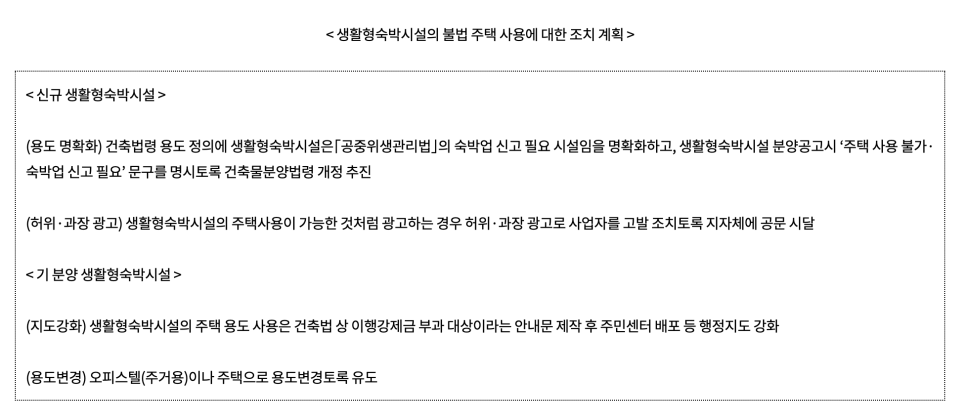
As noted at the start, the 「Building Act Enforcement Decree」 announced by the Ministry of Land on January 15th prohibits residential use and mandates lodging business registration.
Who's jumping into the residential lodging facility market?
So who's interested in this hot-button issue, and who's actually investing in residential lodging facilities?
Let's revisit the appeal of residential lodging facilities
First, let's dive deeper into why these facilities are getting so much attention. Because they're not classified as housing, residential lodging facilities 1. avoid regulations that apply to apartments, like comprehensive real estate tax. Similarly, since they're not housing, 2. you can get larger loans, and 3. anyone can buy in without a housing subscription account.
They're also 4. exempt from multi-home capital gains tax surcharges, and because they're governed by the Building Act, 5. they're not subject to resale restrictions — you can flip your contract immediately after signing. Being commercial facilities, 6. they can be built in prime locations with excellent transit access — another advantage.
And compared to condos — another option for long stays with cooking facilities — general condos fall under the Tourism Promotion Act and can't be sold unit by unit. But residential lodging facilities can be sold, owned, and traded room by room. 7. Individual registration is possible for each room.
Who's actually investing in residential lodging facilities?
So people considering post-sale flipping for capital gains, or those who want to invest in real estate but can't buy apartments or officetels because they're multi-home owners, tend to invest heavily in residential lodging facilities. For officetels in particular, prolonged vacancies bring serious risk — management fees, interest, loan repayments — so the ability to generate income from short-term stays makes residential lodging facilities especially attractive.
Are there problems with residential lodging facilities?
So are there any issues with the residential lodging facility market?
As mentioned, residential lodging facilities must ultimately be operated as lodging businesses. But most unit buyers lack hospitality expertise, so they often outsource operations to management companies.
In this process, many properties get handed to operators without solid systems or hospitality know-how, leading to significant losses for buyers. Choosing a management company that discloses information transparently and maintains ongoing communication with unit owners is crucial.
Beyond that, many facilities haven't been properly operated as lodging businesses until now. Going forward, they'll need to adopt IT infrastructure like PMS (property management systems) and smart lock systems to run professionally.
Today we explored the meaning and pros and cons of residential lodging facilities. Hopefully this cleared up some questions. Next time, we'll walk through legal essentials related to residential lodging facilities.
SoTA Collection
SoTA Collection leverages ONDA's PMS, IoT solutions, and accumulated data to drive better growth in the property management industry.
If you're curious about residential lodging facilities or property management services, click the link below!