Part two of Attorney Choi's labor law series breaks down who's actually covered under Korea's Labor Standards Act—especially when family runs the front desk and headcount sits right at the threshold.
02. Labor Standards Act: Who's Covered in Hospitality
Writer: Choi Chang-gyun, Managing Partner, Seocho Labor Law Firm
Editor: Somora, ONDA
Seocho Labor Law Firm
Seocho Labor Law Firm specializes in hospitality HR management. We advise numerous accommodations, conduct training for hospitality franchise HQs (including Yanolja), and help create better workplaces across the industry.
We believe happy workplaces lead to happy lives. This series shares essential labor law insights for anyone building those workplaces.
Hospitality HR inquiries
Website: www.노무법인서초.com Blog: https://blog.naver.com/cpla7582 Tel: 02-6053-5482 Address: 5F Platinum Tower, 398 Seocho-daero, Seocho-gu, Seoul

Photo by rawpixel.com from Pexels
An employee who recently left your property sends you a message:
"I looked into it — I think I wasn't paid overtime, night shift premiums, or annual leave pay. You'll need to settle this."
You dig into labor law. The protections they're citing only apply to businesses with five or more employees. At your property, you have yourself, your spouse, two sons, their wives, and two hired staff.
Do you owe those payments?
To answer that, we need to unpack Korea's Labor Standards Act. Article 11(1) says: "This Act applies to all businesses or workplaces regularly employing five or more workers. However, it shall not apply to businesses or workplaces where only cohabiting relatives work, or to domestic workers."
Article 11(2) adds: "For workplaces with four or fewer workers, certain provisions of this Act may apply as determined by presidential decree."
So the real questions are: How do we determine "five or more workers"? And which rules apply even when you're under five? Let's break it down.
How to Count "Five or More Employees" in Hospitality
First: It's not headcount — it's regular staffing.
"Regularly five or more" doesn't mean you always have five people clocked in. It means your typical staffing pattern hits five or more. Even if some days drop below five, if you regularly operate with five or more, the law applies.
So check how many people work on a given day. If you have a cashier, front desk, and housekeeping totaling five to six people on paper, but housekeeping only comes once a week and the cashier twice a week — and daily staffing never exceeds four — you're under five.
Second: Only employees on your payroll count.
Legally, only workers employed by your business count. If you use outsourced housekeeping or contract parking attendants, they don't count — they're employed elsewhere.
And they must be employees. You (the owner) don't count. If you hire a manager as an independent contractor, they don't count. If you're a corporation, registered executives don't count.
But if someone is an employee, they count — regardless of nationality or employment type. Foreign housekeeping staff? They count. Workers with bad credit or immigration issues? Still employees under labor law.
Third: In family businesses, hiring even one outsider changes everything.
A business run entirely by cohabiting relatives isn't covered by the Labor Standards Act. But hire one non-family employee, and suddenly everyone except the owner counts toward the five-person threshold.

If daily staffing doesn't hit five, you're not a five-plus workplace. (Photo by Volha Flaxeco on Unsplash)
Counting Shift Workers and Rotating Schedules
Every-other-day shifts count as two workers per day. If handoff happens at 10 a.m., one person works before, one after — that's two.
Three-shift rotations (day/night/off, six-day cycles) also count as two — even if you hire a third person to cover the rotation.
Knowing this, you can now answer the opening question.
Key Rules That Apply Once You Hit Five Employees
If you're at five or more, here's what kicks in:
1. Overtime, night shift, and holiday premiums
Work beyond 8 hours/day or 40 hours/week — or work between 10 p.m. and 6 a.m. — gets 1.5× regular pay.
This hits hospitality hard, especially every-other-day shifts. Overtime isn't calculated per calendar day but per continuous work period. A 24-hour shift with 3 hours of breaks = 13 hours of overtime.
2. Annual paid leave
Employees under one year get one day per month of perfect attendance. After one year, they get 15 days/year (plus one extra day per two years worked, capped at 25).
3. Restrictions on discipline and dismissal
Transfers, disciplinary action, and termination now require due process. Employees can appeal to the Labor Relations Commission.
4. Weekly hour cap
Total weekly hours — regular + overtime — cannot exceed 52 hours.
Key Rules That Apply Even Under Five Employees
Even if you're under five, these still apply:
1. Minimum wage
As of 2019: ₩8,350/hour minimum.
2. Weekly paid rest day
Employees working 15+ hours/week who show perfect weekly attendance get one paid day off per week.
3. Advance notice of termination
Employees who've worked three months or more must receive 30 days' notice before termination (applies to hires after Jan 16, 2019).
4. Severance pay
Employees working 15+ hours/week for one year or more are entitled to severance.
That's the landscape: how to count employees, what applies when, and the must-follow rules no matter your size.
Next time: Writing employment contracts in hospitality — what to watch out for. See you in September.
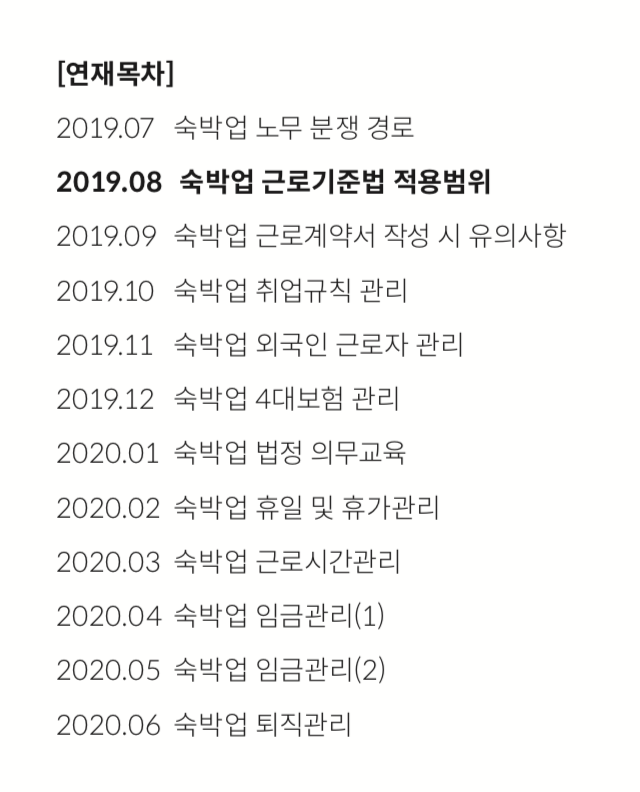
📖 Series Index
01. How Hospitality Labor Disputes Unfold
02. Labor Standards Act: Who's Covered in Hospitality
-
Writing Employment Contracts in Hospitality
-
Managing Work Rules in Hospitality
-
Managing Foreign Workers in Hospitality
-
Managing the Four Major Insurances
-
Mandatory Training Requirements
-
Managing Holidays and Paid Leave
-
Managing Work Hours
-
Managing Wages (Part 1)
-
Managing Wages (Part 2)
-
Managing Employee Exits