Attorney Shin Yul breaks down Korea's official refund rules for booking cancellations—what guests can claim, what properties can keep, and how to handle peak-season disputes without escalating to lawsuits.
01. Refund Standards for Booking Cancellations
Writer Attorney Shin Yul
Editor Somora, ONDA Manager
Shin Yul Law Office
Shin Yul Law Office specializes in hospitality law and the sharing economy, serving clients primarily in the Gyeonggi and Incheon regions with a full range of legal services.
Through this column series, I'll share insights from years of client consultations — unpacking the legal issues that come up when starting and running lodging businesses, explained in plain language.
Contact
Blog: https://blog.naver.com/iwillsue
Tel: 032-294-0056 / Fax: 032-294-5301
Address: Dohyung Bldg. #401, 37beon-gil 16, Haegik-so-ro, Michuhol-gu, Incheon (Haegik-dong)

Photo by Eric Rothermel on Unsplash
Hello, I'm Attorney Shin Yul. It feels like 2019 just started, but August is already here — peak summer vacation season and the busiest booking period for accommodations.
1. What if a guest cancels a peak-season reservation at the last minute?
Most booking policies impose cancellation fees or deduct refunds when guests cancel unilaterally. From a property's perspective, a sudden cancellation — especially during peak season — means scrambling to resell the room, often unsuccessfully. The financial hit can be significant.
That's why cancellation penalties are essential for lodging businesses. But from the guest's side, losing hard-earned vacation time and forfeiting payment for a room they didn't use can feel deeply unfair.
This tension sparks frequent disputes over refund policies, many escalating into bitter arguments. So for this first installment, I'll walk through the proper refund standards when a guest cancels a booking.
2. There are official guidelines for resolving these disputes.
Under Korea's Framework Act on Consumers, Article 16 states:
Article 16 (Resolution of Consumer Disputes)
① The State and local governments shall take necessary measures, including establishing related bodies, to ensure that consumer complaints and damages are resolved promptly and fairly.
② The State may establish Consumer Dispute Resolution Standards by Presidential Decree to facilitate the resolution of disputes between consumers and businesses.
③ These standards serve as the basis for settlement or recommendation in dispute resolution only when the parties have not explicitly agreed on another method.
The Fair Trade Commission has published a 165-page Consumer Dispute Resolution Standards document covering a wide range of sectors. This is publicly available (e.g., through the Korea Consumer Agency) and serves as the interpretive foundation for consumer relief and unfair terms review.
Without clear, industry-standard refund rules, disputes between hosts and guests would drag on endlessly. The government recognizes this — which is why official refund standards for lodging exist (see pp. 88–90 of the current standards).
3. Even if a guest cancels on check-in day, you can't charge the full rate.
The Consumer Dispute Resolution Standards define what happens when a guest cancels for personal reasons during "peak season"¹:
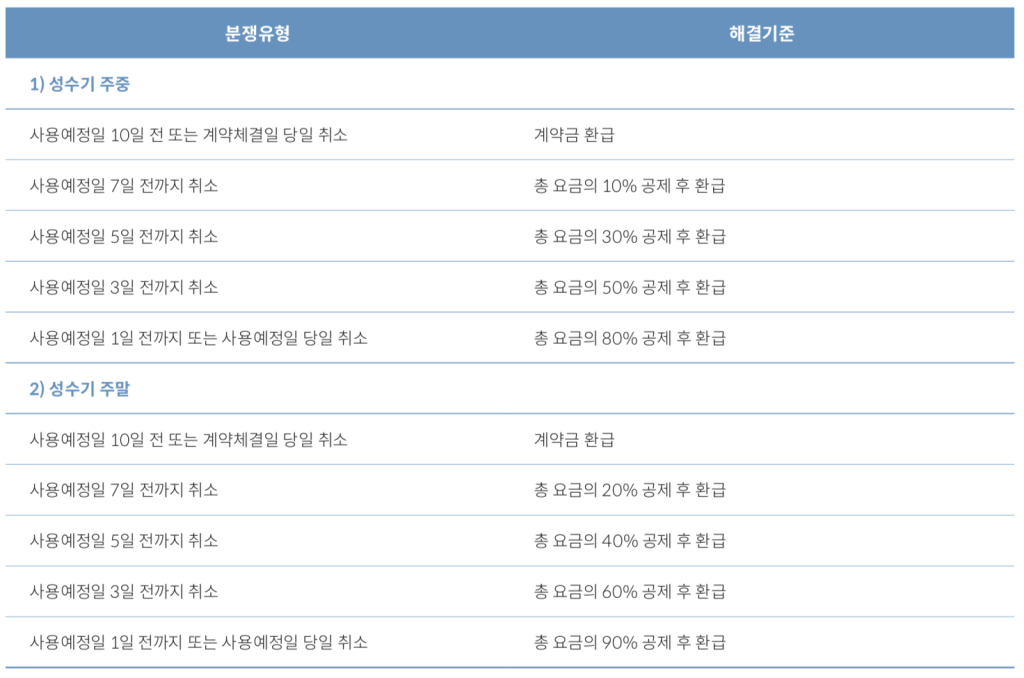
Cancellation due to guest's fault
"Peak season" is defined by the business's terms of service. If not specified, the default is:
- Summer: July 15 – August 24
- Winter: December 20 – February 20
"Weekends" include Friday and Saturday nights, plus nights before public holidays.
Here's an example:
On August 1, 2019, a guest books a stay for August 10 (Saturday) through August 11 (Sunday). Total cost: ₩300,000. The guest pays ₩100,000 as a deposit.
On August 9 (Friday) — one day before check-in — the guest calls: "Something came up. I need to cancel. You can keep the deposit."
This is a peak-season weekend cancellation made one day before check-in. According to the table, you can deduct 90% of the total rate and refund the rest.
- 90% of ₩300,000 = ₩270,000 deductible
- You've received ₩100,000
- You can still claim ₩170,000 in cancellation fees from the guest.
But notice: even for day-of cancellations, the deduction is capped at 90% — not 100%.
So if the guest had paid the full ₩300,000 upfront and canceled the day before (or even on check-in day), you'd still owe them ₩30,000 (10%) back. For operators, this might feel unfair — especially during peak season when you've turned away other bookings.
4. These standards aren't just consumer protection.
The Consumer Dispute Resolution Standards are advisory — they have no binding legal force on their own. They're a mediation framework, not law.
That said, they carry enormous practical weight. If your refund policy exceeds these standards without strong justification, consumer protection agencies will almost always rule against you — and you risk penalties for unfair contract terms. Deviating beyond the guidelines is risky.
But here's the thing: these standards protect operators, too. They shield you from unreasonable guests.
Take the example above. If a guest books during peak season, cancels at the last minute (costing you real revenue), then demands a full refund — the standards give you solid legal ground to refuse. They're your defense against so-called "black consumers" making bad-faith demands.
5. Takeaway
In this first installment, we've covered the official refund standards for lodging cancellations under Korea's Consumer Dispute Resolution Standards.
To avoid disputes — or resolve them quickly when they arise — properties should:
- Draft terms of service that align with these standards
- Explain and provide those terms to guests at booking
Realistically, briefing every guest during peak season isn't feasible. But at minimum, know the rules and be ready to reference them. Having a policy grounded in official standards will help you respond confidently and fairly when conflicts come up.
¹ Standards also exist for off-season cancellations and cancellations due to operator fault, but this article focuses on peak-season guest cancellations. Full details are available in the Consumer Dispute Resolution Standards (pp. 88–90) via the Korea Consumer Agency website.
[Series Index]
2019.08 Refund standards for booking cancellations
2019.09 Standards for minors staying at lodging facilities
2019.10 Hidden camera crimes in lodging businesses
2019.11 Key considerations for partnership agreements
2019.12 Running Airbnb on leased property: issues at lease termination