Hidden camera crimes in lodging facilities: What hotel and guesthouse operators need to know about illegal surveillance, liability, and prevention.
03. Hidden Camera Crimes in Lodging Facilities
Writer Attorney Shin Yul
Editor ONDA Manager Somora
Shin Yul Law Office
Shin Yul Law Office currently focuses on the Gyeonggi and Incheon regions, specializing in hospitality and the sharing economy, providing a wide range of legal services.
Through this column, based on inquiries from clients, I'll walk through — in a somewhat lighter way — the various legal issues and interpretations that come up when opening and operating lodging businesses.
Contact
Blog: https://blog.naver.com/iwillsue
Phone: tel. 032-294-0056, fax. 032-294-5301
Address: Room 401, Dohyung Building, 16, Hagiksoro 37beon-gil, Michuhol-gu, Incheon, South Korea

Photo by Daniel von Appen on Unsplash
1. Tackling an uncomfortable topic: hidden camera crimes
Hello, this is Attorney Shin Yul. This piece is about something unpleasant but necessary — illegal surveillance in lodging facilities, commonly known as "hidden cameras."
Guest rooms are intimate spaces. They're managed by operators, yet they're where deeply private moments happen. That makes them attractive targets for individuals with harmful intentions and warped sexual attitudes.
As a lodging operator, you need to manage this risk carefully. Fail, and you could find yourself in serious trouble.
2. Filming and distributing illegal footage carries severe criminal penalties
Let's start with the criminal law. Korea's Act on Special Cases Concerning the Punishment of Sexual Crimes, Article 14, states:
Article 14 (Filming Using Cameras, etc.) ① A person who photographs another person's body, which may cause sexual desire or sexual humiliation, against the will of the person being photographed, using a camera or other device with similar functions, shall be punished by imprisonment for not more than five years or a fine not exceeding 30 million KRW. <Amended Dec. 18, 2018>
② A person who distributes, sells, leases, provides, or publicly displays or screens (hereinafter referred to as "distribution, etc.") the photographed material or its copies (including copies of copies; hereinafter the same in this paragraph) under paragraph (1), or a person who, even if the filming under paragraph (1) was not against the will of the person being photographed at the time of filming, subsequently distributes, etc., such material or copies against the will of the person being photographed, shall be punished by imprisonment for not more than five years or a fine not exceeding 30 million KRW. <Amended Dec. 18, 2018>
③ A person who commits the crime under paragraph (2) for profit by using an information and communications network as defined in Article 2, subparagraph 1, item (a) of the Act on Promotion of Information and Communications Network Utilization and Information Protection, Etc. (hereinafter referred to as "information and communications network"), against the will of the person being photographed, shall be punished by imprisonment for not more than seven years. <Amended Dec. 18, 2018>
This law strictly punishes anyone who films or distributes footage that arouses sexual desire or causes sexual humiliation. Lodging facilities, by their nature, are especially vulnerable to footage being captured not for personal gratification but for commercial distribution — which amplifies the social damage.
3. You can be held liable even if you didn't commit the crime yourself
If the lodging operator commits the crime, there's no defense. But here's the problem: even if you didn't do it, you can still face administrative and civil consequences.
Article 5 of the Public Health Control Act states:
Article 5 (Prohibition of Illegal Camera Installation by Public Health Business Operators) Public health business operators shall not install cameras or other devices with similar functions that are used in acts in violation of Article 14, paragraph (1) of the Act on Special Cases Concerning the Punishment of Sexual Crimes.
The law prohibits installing hidden cameras in lodging facilities and allows for administrative sanctions.
In June 2019, the law and its enforcement rules were amended, establishing specific penalty standards. Critically, if an employee installs an illegal camera — even without the operator's knowledge — the operator is still considered responsible due to their management and supervisory duties.
So if your employee gets caught filming illegally, you — the operator — face the penalty, not the employee. That means you're obligated to prevent misconduct by anyone under your supervision.
Even worse: legislators decided lodging businesses carry a higher risk of illegal filming than other public health businesses. The penalties reflect that. First offense? Three-month suspension. Second offense? Business closure.
Bottom line: lodging operators must be extra vigilant — or risk disaster.
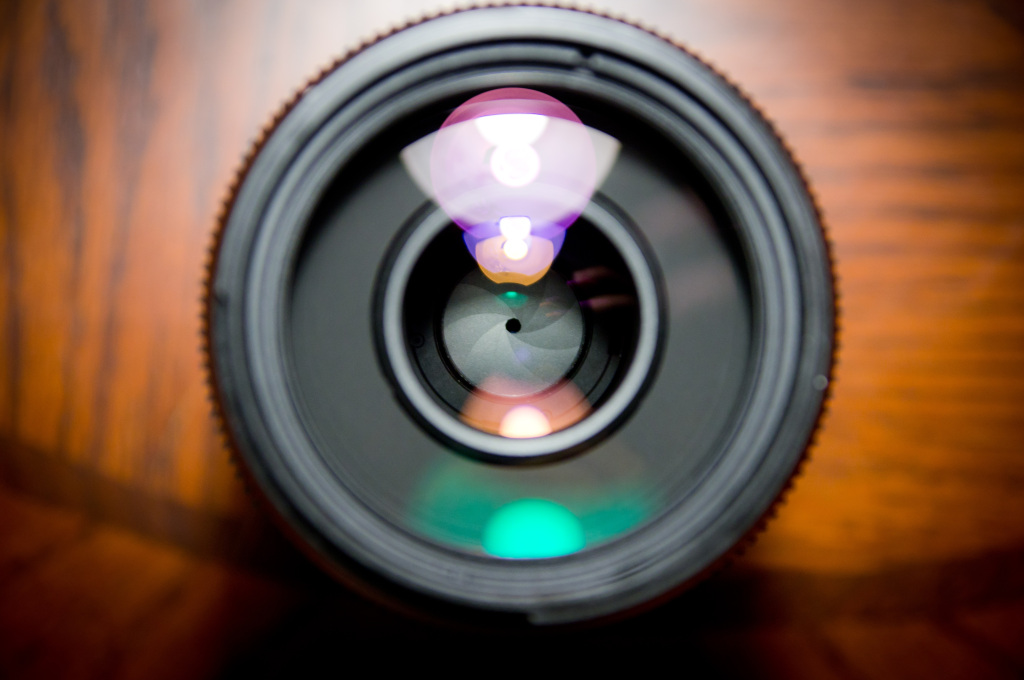
Lodging operators must be more vigilant than anyone about illegal surveillance to avoid unintended harm.
4. Even if a guest installs a hidden camera, you can still be in trouble
Not long ago, a ring was busted for posing as guests, installing hidden cameras in dozens of lodging facilities, and live-streaming guests' private moments. It made headlines.
In that scenario, the lodging operator isn't criminally liable — and won't face administrative penalties. But once word gets out that your property was used for a surveillance crime, your reputation tanks. You might also face civil liability for failing to protect guests or for negligent facility management.
5. Closing thoughts
Every industry has vulnerabilities to specific social harms. Lodging businesses, by their nature, are easy targets for people with twisted sexual impulses or profit motives.
Hidden camera crimes targeting hotels and guesthouses have been a major social issue for years — and regulations have grown harsher in response. If your property caters to couples or sees high foot traffic, you need to closely monitor both staff and suspicious guests.
At the end of the day, preventing your business from being exploited for crime should be a top priority — for your guests, your reputation, and your business.
Next time, we'll cover partnership agreements in the lodging business. Thank you.
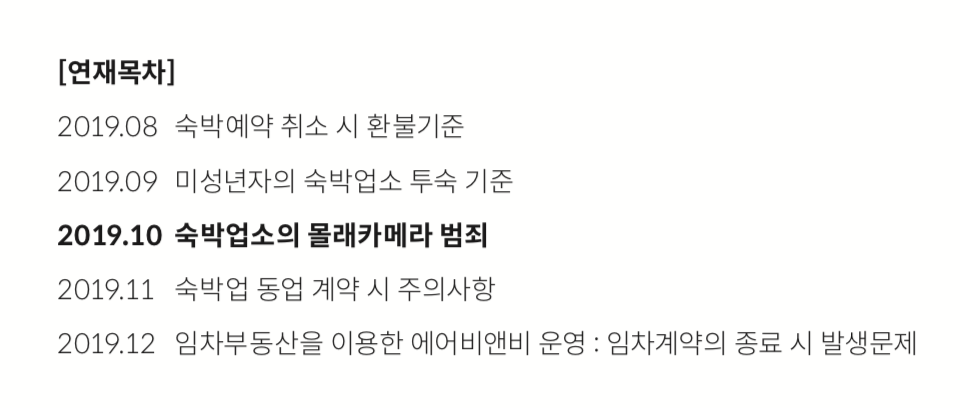
[Series Index]
2019.08 Refund Standards for Booking Cancellations
2019.09 Standards for Minors Staying at Lodging Facilities
2019.10 Hidden Camera Crimes in Lodging Facilities
2019.11 What to Watch for in Lodging Business Partnerships
2019.12 Operating Airbnb on Leased Property: Issues Arising Upon Lease Termination
View Full Magazine <<
Subscribe to the Magazine <<
⚠️ All rights reserved. Cite this piece as 'ONDA (온다)' when quoting.