As ministries unveil their 2024 policy directions and budgets, domestic tourism remains central to Korea's economic recovery. Here's what hospitality operators need to watch this year.
Hello subscribers — as Korean government ministries roll out their 2024 policy priorities and budgets, we're breaking down what matters most for hospitality operators. Here's your guide to the year ahead.
⚠️ All rights reserved. Cite this piece as 'ONDA (온다)' when quoting.
In this issue
🏨 2024 government policy priorities for hospitality
💡 Where online travel is headed post-pandemic
⌨️ #LuxuryHotelStrategies #DrugBustBans #StayLengthFlexibility #EuropeTouristTax #PetTravelRace
🏨 Industry Deep Dive
2024 Government Policy Priorities
for Hospitality
Korea's ministries are announcing their 2024 policy directions and budget allocations. Domestic tourism — seen as key to economic recovery — is getting renewed investment this year.
Let's unpack the '2024 Tourism Budget' and the '2024 Economic Policy Direction' to see which policy shifts will shape the hospitality landscape.
Tourism budget up 6.6% year-over-year
On January 3, the Ministry of Culture, Sports and Tourism confirmed its 2024 tourism budget at ₩1.3115 trillion — a 6.6% increase over 2023. That's more than double the average government spending increase (2.8%), reflecting a push beyond recovery to record performance.
Budget line items telegraph priorities. The ministry's four focus areas are clear. Let's see what that means in practice for domestic tourism activation.
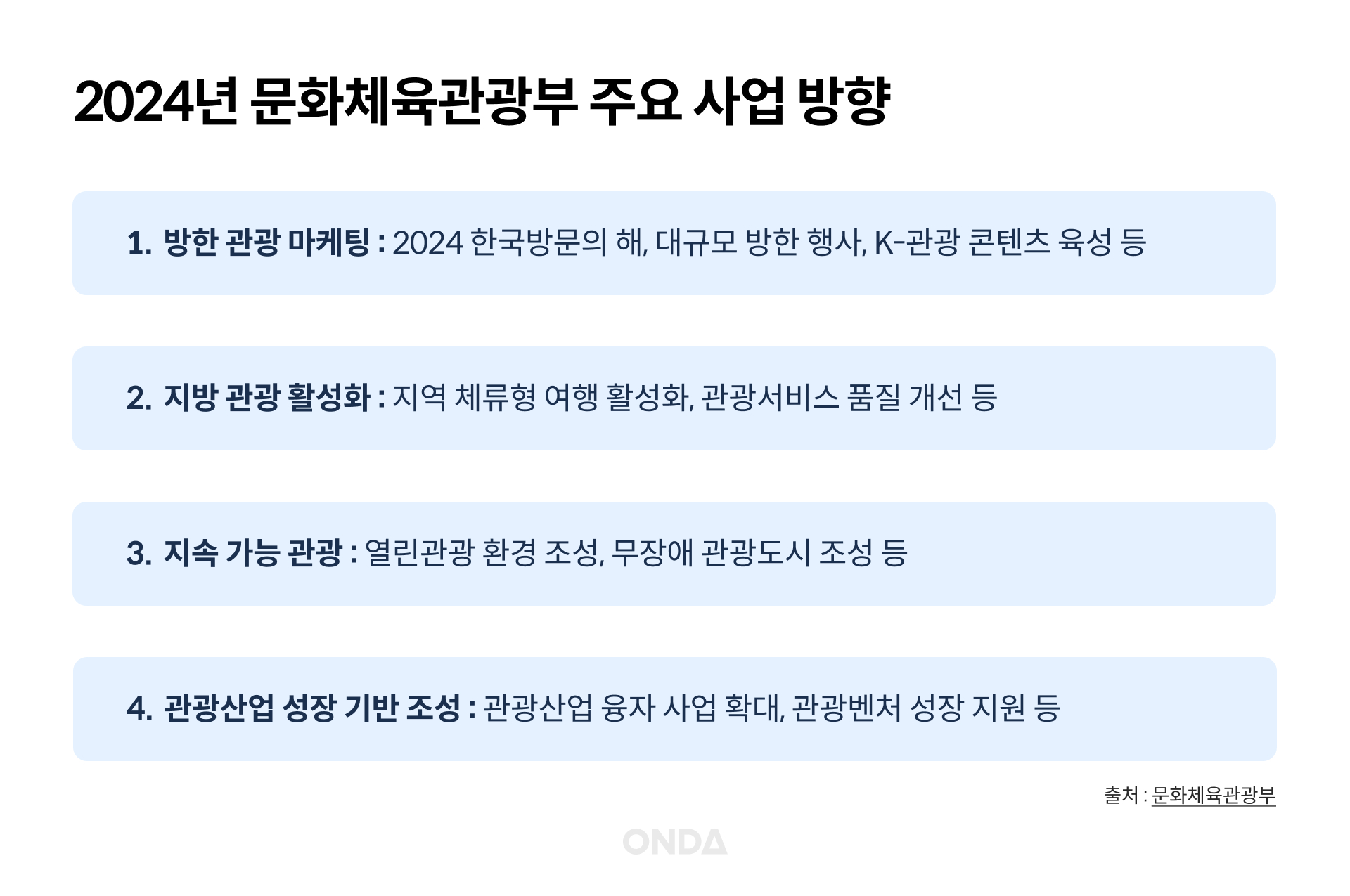
Marketing push for 20 million inbound visitors
The government aims to hit 20 million inbound tourists in 2024, extending the 'Visit Korea Year 2023–2024' campaign. Marquee events include Korea Grand Sale (Jan–Feb), Korea Beauty Festival (June), and a major K-Culture Festival (September).
Overseas, the ministry plans 'K-Tourism Mega Roadshows' in 25 global cities to convert Hallyu interest into actual bookings.
K-Tourism content development continues. Research shows K-Content popularity directly correlates with inbound visitor numbers — markets with high K-Drama/K-Pop engagement send more tourists.
The plan: develop tour packages around K-Pop and K-Drama, and elevate regional festivals into global-scale events.
Support for sports tourism, wellness tourism, and MICE is also scaling up. Operators should track local events and festivals to adjust pricing dynamically or launch co-marketing promos.
Extended-stay travel to activate regional economies
To fix over-concentration in Seoul and Jeju, the government is offering incentives for regional tourism. ONDA's industry surveys confirm this as a top concern: demand too narrowly focused on established destinations and property types.
The pilot 'Digital Tourism Resident Card' program — offering QR-based discounts on lodging, dining, and activities in depopulating regions — is expanding from 15 to 40 regions. Currently live in Ganghwa, Taean, and Pyeongchang, among others.
Workation support is scaling up, and the government is designating 'Night Tourism Special Cities' to boost extended stays. Service quality monitoring in major tourist zones (following recent pricing scandals) will also intensify.
Southern Korea properties should note the 'Southern Korea Regional Tourism Development Project' — a decade-long, ₩3 trillion initiative (through 2033) to build a 'K-Tourism Resort Belt' spanning Busan, Gwangju, Ulsan, South Jeolla, and South Gyeongsang.
To drive domestic and inbound tourism, economic incentives matter. What support policies and reforms are coming?
👉 Full 2024 Tourism Economic Policy Direction
💡 Hospitality Trends
Where Online Travel Is Headed
Post-Pandemic
Global usage of travel apps — OTAs, transport, airline/hotel direct booking apps — is surging. Mobile and online channels now dominate the booking journey.
Data.ai reports that travel app downloads worldwide topped 3 billion in 2023, up 13% year-over-year. Travel OTAs (Booking.com, Expedia, Trip.com) saw the sharpest rise at +34%.
Time spent in travel apps is also climbing: total usage hit 15.7 billion hours in 2023, up 25% from 2022. Travelers now use apps for the full journey — search, booking, and reviews.
What about Korea? In November 2023, domestic online travel and transport transaction volume hit ₩2.016 trillion, up 28.3% year-over-year. It's held above ₩2 trillion for five straight months post-endemic.
Full story below.
👉 Read the Full Story
⌨️ Keyword News
1️⃣ Five-Star Hotel Strategies 👉 [Full story]
TL;DR: Korea's luxury hotels unveil 2024 strategies and visions
The story: Five-star hotels cite differentiated content and customer experience, ESG commitments, and regional partnerships to attract domestic and international guests.
What content? Experiential and regionally-rooted programming. Hotels are doubling down on diverse guest needs — more differentiation ahead.
2️⃣ Drug Bust Penalties 👉 [Full story]
TL;DR: Hotels face closures if guests are caught with drugs — law expected July 2024
The story: A new law authorizes business suspension or closure if guests are caught using narcotics in guest rooms. Takes effect this July.
How it works: Law enforcement decides. If prosecutors file charges under 'providing a venue for drug sales or use,' the hotel gets hit with suspension orders.
3️⃣ Stay Length Flexibility 👉 [Full story]
TL;DR: Korean hotels diversify stay lengths to match demand
The story: Hotels are launching ultra-short and ultra-long packages to capture different segments. Stay duration varies by location and guest type.
Examples: DoubleTree by Hilton Seoul Pangyo offers 4-week packages. Phoenix Park has 10-hour/30-hour packages. Hanwha Hotels & Resorts lists 6-, 9-, 14-, and 29-night options.
4️⃣ Europe Tourist Taxes 👉 [Full story]
TL;DR: European cities introduce or hike tourist taxes to combat overtourism
The story: Venice, Valencia, Amsterdam, Paris, and others are imposing or raising tourist taxes to manage overtourism pressure.
Korea? Jeju proposed an 'environmental conservation levy' last year but the plan is on hold.
5️⃣ Pet Travel Race 👉 [Full story]
TL;DR: Hotel industry races to capture 'petfam' travelers
The story: Hotels are expanding pet-friendly packages and promotions. Post-endemic demand remains strong — more hotels are building dedicated pet rooms.
The market: KB Research says 5.52 million Korean households (25.7% of all households) own pets — representing 12.62 million people as of 2022.