Korean properties pay 15% commissions per OTA booking. Social media marketing cuts that cost by driving direct reservations—but most owners don't know where to start.

Photo by Nick Morrison on Unsplash
02. Why Your Property Needs Social Media Marketing (And How to Win at It)
By Somora, Marketing Manager at ONDA
Why Your Property Needs Social Media Marketing (And How to Win at It)
Hi everyone — Somora here, Marketing Manager at ONDA. Hope you had a nice Lunar New Year break! I actually spent mine prepping this piece for you (yes, tears were shed). But it's worth it to share insights that actually help.
Welcome to the February issue of Magazine ON's Social Media Marketing series. Today we're digging into why properties should do social media marketing in the first place — and laying out concrete strategies for making it work.
Social media marketing for properties… why bother?
Last time we talked about what marketing actually is, and I touched briefly on OTAs (Online Travel Agencies). To understand why social matters, let's start with a question.
How many of the channels shown below are you currently using to sell your rooms? In every training session and seminar I've led, only one property owner said they weren't using any — a Chinese couple who didn't even have KakaoTalk. Everyone else? They're on OTAs.
Using OTAs to sell your property is smart — we've said this across multiple Magazine ON columns. Global platforms spend big on marketing and promotion for you. They bring traffic your property couldn't afford to reach alone. Some owners complain about commission rates, but think of them as ad spend. If the channel increases your odds of getting booked, that 15% can be well worth it. That's why we always tell property owners: don't resent the commission. It's the cost of exposure.
That said, 15% per booking is no joke. If you sell a room for ₩100,000, ₩15,000 goes to the OTA. Sell 10 rooms a month? That's ₩150,000 in fees. Even big hotel chains wrestle with this — which is why they lean so hard on BRG (Best Rate Guarantee) policies, as we covered in last month's industry roundup.
Bottom line: OTAs help you sell more rooms and reach more guests. But you pay for that privilege. So now let me show you how to reduce those fees and keep more revenue in-house.
How many of these channels are you currently using to sell your rooms?
The goal: drive direct bookings
"Drive direct bookings" might sound random, but hear me out. First, let's define it.
Direct booking means a guest books directly through your channels — no middleman, no OTA, no travel agent. Your "owned channels" include: your property website's booking engine, phone calls, email, and social media. Remember the old pension days when you'd take a call, share your bank details, and wait for the wire transfer? That was direct booking.
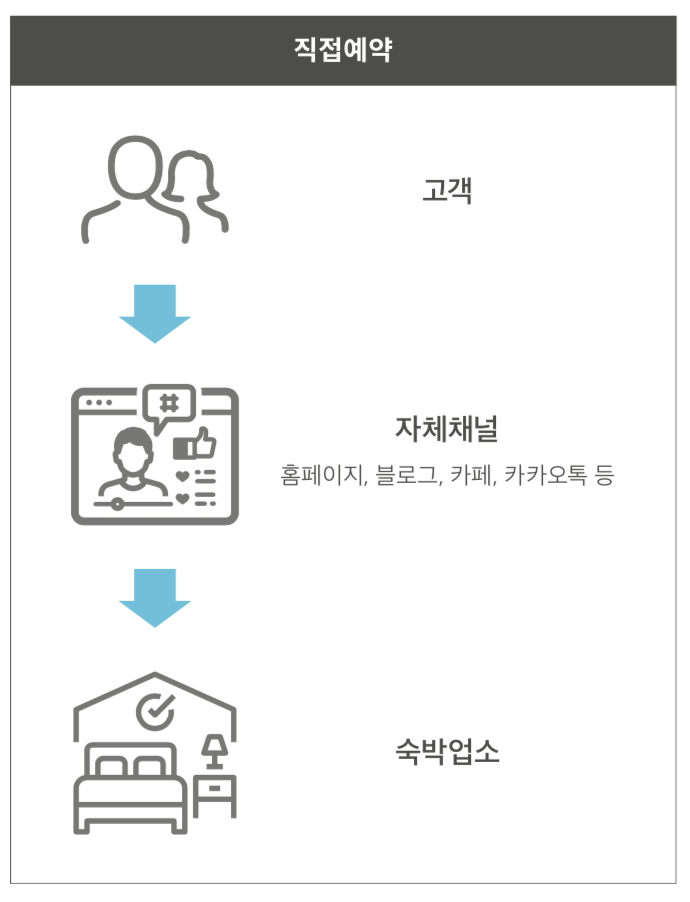
Why push for direct bookings? Simple: you don't pay OTA commissions. That 15% fee you've been handing over? Gone. Even if you accept credit cards through your own booking engine, card processing fees top out around 7% — still way less than half of what OTAs charge. Direct bookings mean higher profit margins. That's the math.
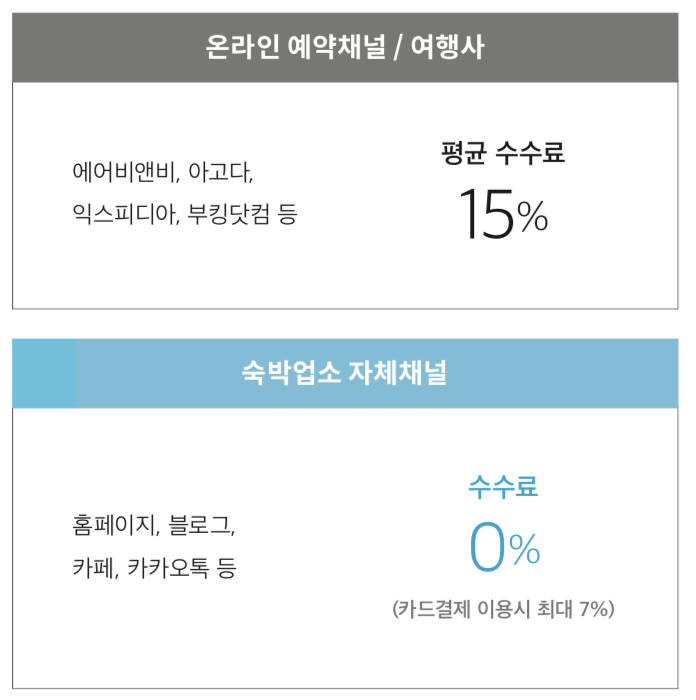
Cut OTA commissions by driving direct bookings through your own channels.
How direct bookings tie into social media marketing
Here's where social media marketing becomes critical. Smartphones changed the game. The internet and social platforms are now so ubiquitous that kids and seniors alike are scrolling daily. Social media user counts are exploding — over 3 billion people worldwide, representing 98%+ of internet users, are on social. Korea's no different. Over 90% of the population is online, and more than 70% of those people use social media.
Usage of platforms like Naver Band, Naver Blog, Instagram, Facebook, and KakaoTalk keeps climbing every year. Koreans spend an average of 65 minutes per day on social. These platforms aren't just for chatting anymore — people buy products, leave reviews, discover brands, and share their lives there.
The hospitality industry is no exception. Here's proof: Guesthouse Ando in Gangneung (an ONDA partner) accepts bookings only via Instagram, using ONDA's real-time booking widget. No other OTAs. No paid ads. And they're consistently fully booked.
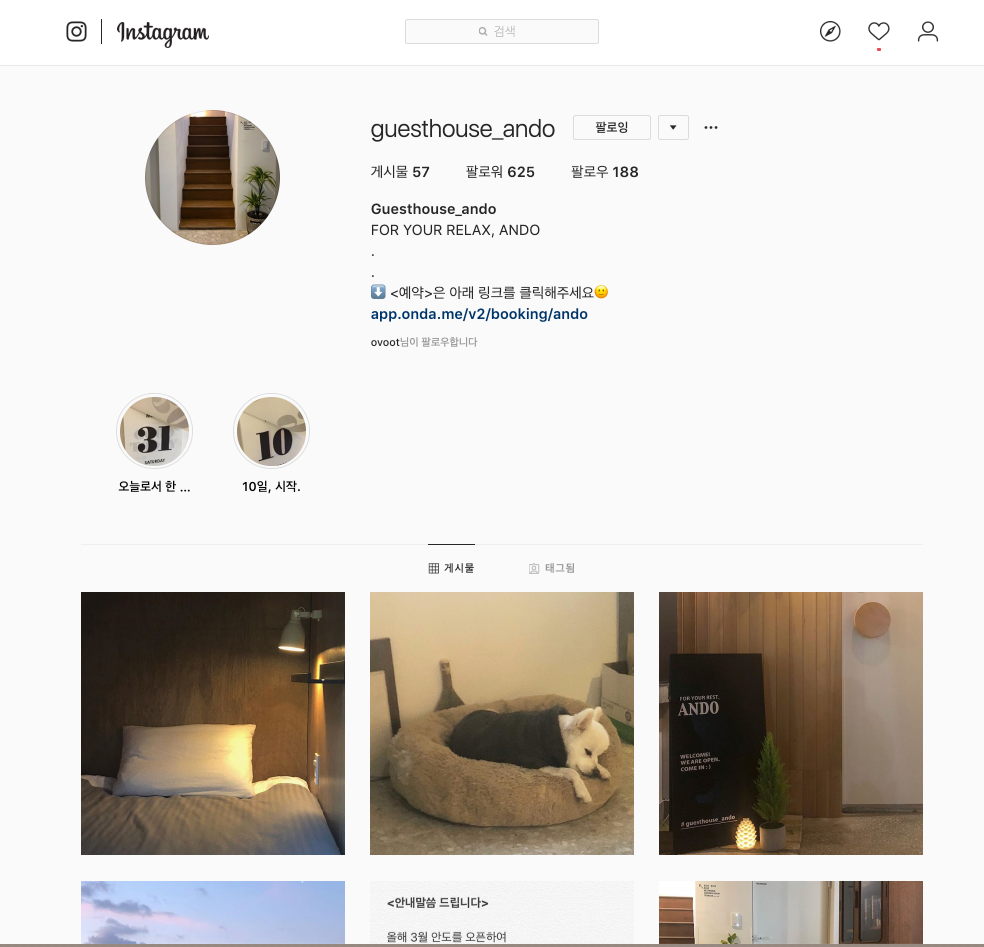
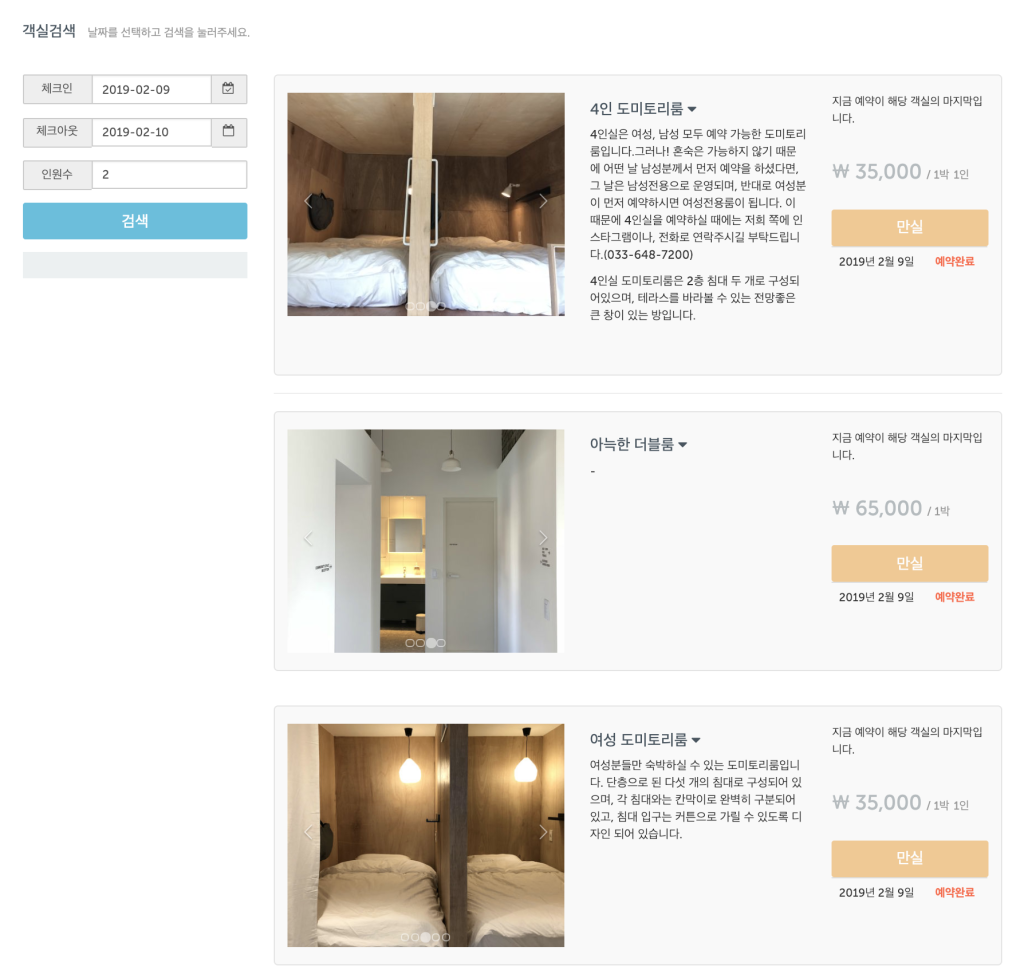
Guesthouse Ando's Instagram and real-time booking engine
Why you must do social media marketing
Social media marketing for properties isn't just about advertising. It's a tool for communication, a way to build affection and loyalty. It helps you understand your guests and create new value based on that insight. And it positions your brand as a trendsetter.
In 2019, skipping social media marketing is basically choosing to fall behind. That's why big companies invest heavily in it. That's why courses and books on social strategy flood the market. And that's why we keep emphasizing it.
Success strategies for property social media marketing
Alright, you're sold. You're ready to start. But how do you do social media marketing well? Where do you even begin? Which platform should you pick?
Social moves fast — trends shift by the minute. So let me give you a framework. Here are the strategies I recommend for running successful property social media.
Important note: Each strategy builds on the one before it. Strategy #2 requires completing #1. Strategy #3 requires #2. And so on.
#1. Before launching: nail down your property's identity
Before you open any social account, you need to solidify your property's identity. This isn't just for social — it's foundational for long-term, sustainable operations.
What's your property's concept? What core value do you offer guests? Can you summarize it in one word or one sentence? Who's your target audience? What's your price range? You need clarity on guest demographics: gender, age, occupation, region. Get this right, and the rest of the strategy (choosing platforms, creating content, activating channels) flows naturally.
Small and mid-sized properties can't afford to blow money on marketing. You have to be efficient. The shortcut to efficiency? A razor-sharp identity and a clearly defined target audience. Spending ₩1 million to reach 100 highly targeted guests with tailored messaging beats spending the same ₩1 million to scatter generic ads across 10,000 random people. Same budget. Wildly different results.
#2. Choose the right social platform for your property
Ideally, you'd manage multiple social channels flawlessly. But if you lack bandwidth or expertise, juggling too many platforms backfires. You'll spread yourself too thin and do everything poorly — which hurts more than it helps.
So start with one platform. Focus on it. Once you've mastered that channel and have bandwidth to grow, then expand.
The key is figuring out which platform fits your property best — and prioritizing it. Every platform has its own vibe, audience, content format, and strategy. Researching just one takes time. Here's a shortcut: the platform that fits you usually fits your property. Most properties reflect their owner's personality. If you're the one managing the account, pick a platform that feels natural to you and matches your property's character. You'll adapt faster and use it better.
We'll go deeper into platform-specific traits in the March issue of Magazine ON.

The key is figuring out which platform fits your property best — and prioritizing it.
#3. Strategic marketing — set a main channel
If you do decide to run multiple channels, designate one as your main hub. Decide which channel is your primary driver, which ones amplify content, and what the role of each platform is in your overall strategy.
Let me break this down. Your ultimate goal with social is to get your target guests to see your content. So first, check the stats: which platforms are most popular with your audience's age group, nationality, gender, and region?
For example, if you're targeting university students or couples in their mid-20s, Instagram (the most popular platform among 20-somethings in Korea) should be your main channel. If your guests are couples in their 30s with kids, KakaoStory or Naver Band might be better. Teens and early 20s? YouTube or Twitter. Your property type determines where you focus.
#4. Plan your content strategy
You've set up your channels. Now what? You need content that grabs attention. Just having an account won't bring guests. You have to post content people actually want to see.
But creating standout content in a world where trends change by the second? That's tough. To cut through the noise, you need content that's unique, compelling, and relevant.
"Content creation is too hard!" I hear this constantly. And yes, it's hard. We're not big corporations with content teams. I struggle with it every day too. But you don't have to be perfect from day one. Start simple. Here's how:
First, gather input on what your target guests care about. Know what they want to hear, then consistently deliver that on social.
If you host couples in their 20s, post about nearby date spots, restaurants, cafés, hot places, travel tips. If you're a kids-friendly pension, share family-friendly activities, lists of nearby no-kids-zone spots. If you're a pet-friendly property, highlight dog-friendly restaurants and tourist spots. If most of your guests are international, write in English or other languages — and target your content to foreign audiences.
Also, set clear goals for your social presence and build a long-term content plan. Instagram thrives on lifestyle content and aesthetic photos. Naver Blog demands detailed, objective info. Facebook wants relatable, shareable posts. Tailor your content to the platform.

Your ultimate goal with social is to get your target guests to see your content.
#5. Activate your channels — and keep them active
Some owners open a social account… and then abandon it. Big mistake. An inactive channel can hurt you more than help.
Imagine: You launch an Instagram account, post once, then go silent for two years. A potential guest finds your profile. They see one post from 2017 and nothing else. What do they think? "Is this place even open? Do they respond to messages? What does it look like now?" All they get is a bad vibe — this property doesn't care.
Once you open a social channel, you have to post regularly and manage it consistently. Social is built on interaction. Community matters. That's why events and promotions that encourage guest participation are so valuable. They boost engagement and amplify your reach.
Examples: return-guest discounts, comment-and-share giveaways, post-your-stay-for-a-discount campaigns. Send discount coupons via KakaoTalk. Run fun quizzes. Match the event format to the platform, keep it fresh, and watch engagement grow.
#6. Grow your follower base
If you nail strategies #4 and #5, #6 happens naturally. More followers won't instantly boost revenue, but a growing follower count improves your property's image. It also gives you direct access to guest feedback — comments, reviews, preferences. That feedback helps you improve. And authentic guest reviews attract even more followers.
But here's the catch: social takes time. Don't expect overnight results. You might pour time and money into great content and still not see immediate traction. Even celebrities struggle with this. Park Joon-hyung (from the legendary K-pop group god) launched his YouTube channel "Wassup Man" and initially had fewer than 1,500 subscribers — despite being famous. But he kept posting consistently, with creative editing and topics people cared about. Word spread. Now he has 1.8 million subscribers.
Everyone says "get more followers, likes, subscribers" to succeed on social. True. But you can't force it overnight. The only real strategy is patience + consistency + quality content (based on strategies #4 and #5). And if you embed a real-time booking link or button in your social profiles, conversion rates naturally follow.

A growing follower count improves your property's image and helps you gather valuable guest feedback.
What if you can't manage social consistently?
If social media feels overwhelming or you can't commit to regular updates, don't force it. Stick with OTAs. Pay the commission and let them handle promotion. That's a perfectly valid strategy.
If content creation is the bottleneck, consider simpler approaches: repost guest reviews, curate content from past stays. Low stress, low effort — still effective.
ONDA's GDS (Global Distribution Service) was built for property owners like you. Many Korean pension owners are older and find social/digital marketing daunting. With ONDA GDS, one contract automatically lists your property on dozens of domestic and international OTAs. We handle reservations, guest management, and settlements — all for a 15% commission on total sales. We even throw in a free website. When you factor in labor costs and ad spend, it's extremely cost-effective.
Curious about ONDA GDS? Check page 18 of this magazine or visit onda.me.
Social media is a long game
Social media marketing is a marathon, not a sprint. It requires patience and sustained effort. Done right, it delivers real bookings. Done half-heartedly, it's a waste of time.
Remember: consistency and attention are everything. The more time you invest, the more care you put in, the faster your social presence grows.

Photo by Amanda Jones on Unsplash
[Series Index]
2019.01 Social Media Marketing — What Is It, Really? 2019.02 Why Your Property Needs Social Media Marketing (And How to Win at It) 2019.03 A Guide to Social Media Platforms 2019.04 Simple Social Media Marketing for Properties (1): Facebook 2019.05 Simple Social Media Marketing for Properties (2): KakaoTalk Plus Friend 2019.06 Simple Social Media Marketing for Properties (3): Kakao Brunch 2019.07 Simple Social Media Marketing for Properties (4): Naver Cafe 2019.08 Simple Social Media Marketing for Properties (5): Naver Modoo 2019.09 Simple Social Media Marketing for Properties (6): Naver Blog 2019.10 Simple Social Media Marketing for Properties (7): Instagram 2019.11 Simple Social Media Marketing for Properties (8): YouTube 2019.12 Bonus Marketing Tips: Naver Smart Place
Read the full magazine issue here <<
⚠️ All rights reserved. Cite this piece as 'ONDA (온다)' when quoting.