Understanding the Tourism Promotion Act makes navigating Korea's Airbnb regulations easier. What every legal homestay operator needs to know.
01. Understanding the Tourism Promotion Act Makes Everything Easier
Writer: Suran Pi Hyun-jin
Editor: ONDA Manager Somora
Essential Knowledge for Airbnb Entrepreneurs
Airbnb is the poster child of the sharing economy. It's proven to be the most effective way to monetize empty spaces. But run it carelessly, and you'll find yourself operating an illegal lodging facility under the government's radar. Where's the line between legal and illegal? The Tourism Promotion Act, Foreign Tourist Urban Homestay Business regulations, taxes every legal Airbnb operator must know — Suran breaks it all down in plain language.
Suran Pi Hyun-jin
After a long corporate career, Pi founded Suran Guesthouse in Seochon in 2014. She achieved her startup goal of working 20 hours a week while earning ₩3 million a month. Since 2018, she's been living as a digital nomad, working from wherever she chooses.
Through columns and lectures, she delivers accurate legal and tax information to Airbnb and share house entrepreneurs.
Homepage: www.bnbsuran.co.kr

Photo by Paul Hanaoka on Unsplash
What Is Foreign Tourist Urban Homestay Business?
Foreign Tourist Urban Homestay Business is defined in the Tourism Promotion Act. What if I copied the exact legal text here? I'd bet my Kookmin Bank account everyone would just close this page. So let me explain it simply. The answer is right there in the name: Foreign Tourist Urban Homestay Business.
Foreign Tourist: Only foreigners can stay.
Tourism: The government specifically allows this to promote tourism. Allows what?
Urban Homestay Business: Operating a homestay in urban areas.
Before the Tourism Promotion Act was revised to create Foreign Tourist Urban Homestay Business, "homestay" meant "rural homestay." The assumption was that anyone wanting to stay in urban areas should use proper lodging facilities. Why did the government think homestays shouldn't exist in cities?
Homestays operate in residential properties where people actually live. Imagine a lodging facility (say, a motel) opening in your residential neighborhood. Chaos would ensue. Residents would definitely be out picketing in opposition. In fact, lodging businesses can only operate in commercial zones, not residential areas — and even within commercial zones, they can't be right on the boundary with residential areas. They must maintain a certain distance from residential spaces. Yet urban homestays are allowed right in the middle of residential neighborhoods?
This is where the biggest restriction on urban homestays comes from: Only foreigners can stay. If Koreans were allowed, it would create fairness issues with existing lodging businesses. Plus, it gives the government a justification: hosting foreign tourists contributes to tourism promotion.
And the biggest reason: homestays and guesthouses hosting foreigners already existed in urban residential areas outside rural zones. In other words, when the Tourism Promotion Act was revised in 2012 to create Foreign Tourist Urban Homestay Business, one goal was legalizing existing illegal lodging operations that had no way to register as businesses.
What Is a Guesthouse?
Let's look at what "guesthouse" actually means. Interestingly, the term "guesthouse" doesn't exist in any legal statute. Naver Dictionary defines guesthouse as "lodging facilities where travelers can stay affordably." That's why facilities calling themselves guesthouses exist in various forms beyond just Foreign Tourist Urban Homestay-licensed operations.
For example, if you stayed at a hanok guesthouse in Andong, it could be a rural homestay or a hanok experience business. As a guest, you can't tell the difference and don't need to. But for operators, the relevant laws and taxes differ. For instance, rural homestays operated as side income for farmers and fishermen receive income tax exemptions when annual revenue is under ₩30 million.
If it's a hanok experience business, unlike rural homestays, there's no residency requirement — meaning one person can operate multiple hanok guesthouses. It's more accurate to see "guesthouse" as a general term for "businesses operating relatively small, affordable lodging."
Foreign Tourist Urban Homestay Business: Foreigners Only
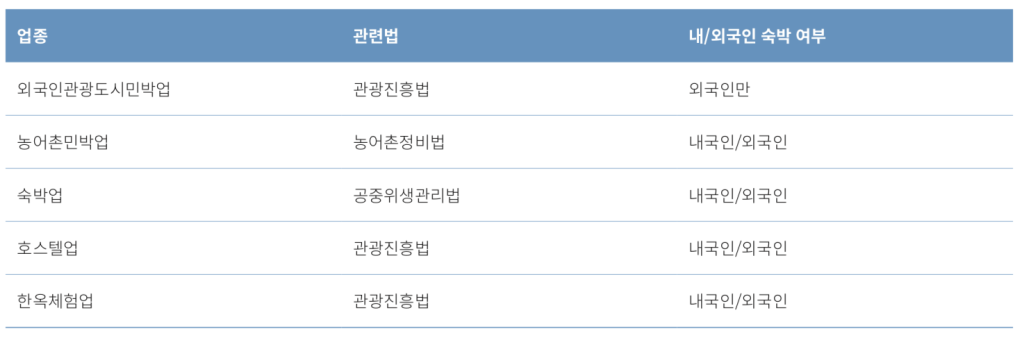
As the table shows, various lodging business types can use the "guesthouse" name, but Foreign Tourist Urban Homestay Business is the only one strictly limited to foreign guests. Most of us live in cities, and the appeal of running a personal business from an ordinary residential property draws many people to this Foreign Tourist Urban Homestay Business.
Over the next 10 installments in Magazine ON, I'll unpack everything about Foreign Tourist Urban Homestay Business. Because of its origin story — allowing lodging in residential areas where lodging businesses normally can't operate — Foreign Tourist Urban Homestay Business comes with many restrictions. I'll cover those regulations, exceptions (places where Korean guests can legally stay despite the foreign-only rule, areas that only qualify for rural homestay licenses despite being urban), and more.
I also won't skip Shared Homestay Business, which was covered in the government's announcement on January 9, 2019. Shared Homestay Business allows Korean guests to stay up to 180 days per year, but only after the Tourism Promotion Act is revised (meaning it must pass the National Assembly). Through this, you'll gain insights into which areas and properties work for starting a business, and how to leverage real estate you already own.
I often introduce myself as "a timid type B personality." Yes, quite timid. How many people actually dig through the original text of the Tourism Promotion Act, its enforcement decree, and implementation rules? How many bookmark the Ministry of Government Legislation and National Tax Service websites, searching and searching, then visiting the responsible civil servants when something seems unclear? Thanks to that timidity, I've built knowledge and experience I can now share — which makes me happy. Next time, I'll explain the types of housing where Foreign Tourist Urban Homestay Business is possible.
[Series Index]
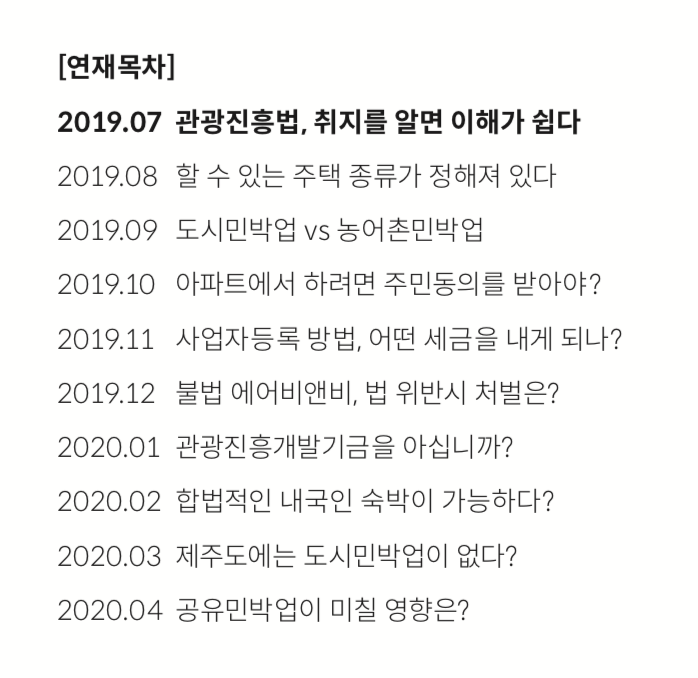
2019.07 Understanding the Tourism Promotion Act Makes Everything Easier 2019.08 Only Certain Property Types Qualify 2019.09 Urban Homestay vs. Rural Homestay 2019.10 Need Resident Approval for Apartments? 2019.11 Business Registration Methods and Tax Obligations 2019.12 Illegal Airbnb: Penalties for Breaking the Law 2020.01 Know About the Tourism Promotion Development Fund? 2020.02 Legal Ways to Host Korean Guests 2020.03 Why Jeju Has No Urban Homestay Business 2020.04 How Shared Homestay Business Will Change Things