What comes to mind when you hear the word 'motel'?...
⚠️ All rights reserved. Cite this piece as 'ONDA (온다)' when quoting.
In This Week's Edition
🏨 What comes to mind when you hear the word "motel"?
💡 In the 1950s–70s, yeogwan (Korean inns) served one purpose: a place to sleep.
⌨️ Motels' first major transformation arrived with the 1988 Seoul Olympics.
⌨️ #Hospitality #Hotels #Policy #Platforms #Reservations
🏠 Industry Deep Dive
Korean Motels at 70: Time for the Fifth Evolution
What comes to mind when you hear "motel"? Neon signs. Rotating beds. Hourly stays for couples. That's probably what most property owners picture too. But the data tells a completely different story. Motels make up 51.5% of Korea's lodging market. Out of roughly 60,000 registered properties nationwide, over half are motels. Even during Chuseok holidays, booking share is almost even: hotels (38.6%) vs. motels (36%)—with pensions (24.5%) trailing far behind. This is too big to ignore. And this massive sector didn't emerge overnight.
From Yeogwan to Parktel: The 1988 Olympics' First Great Shift
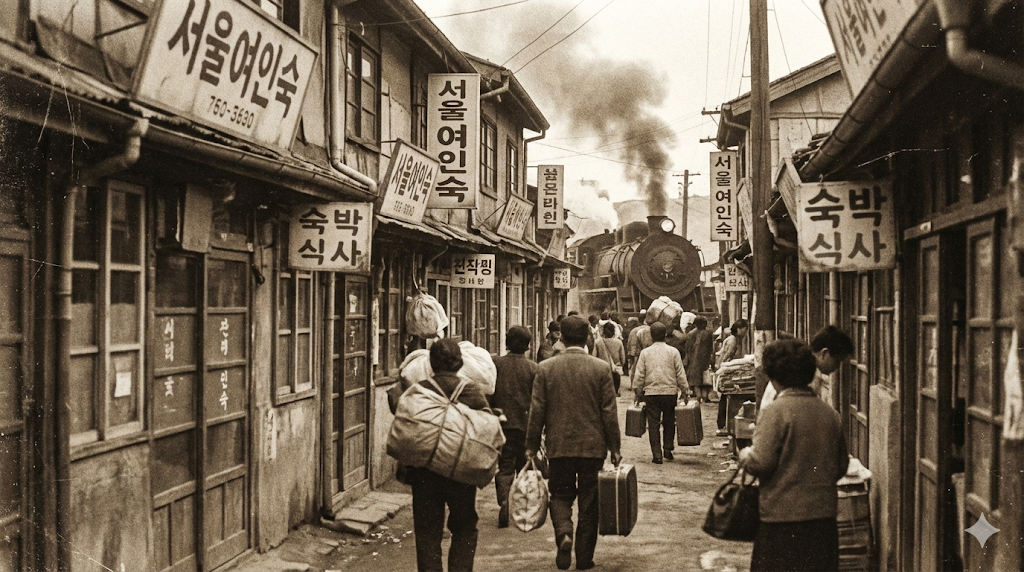
The 1950s–70s yeogwan had one function: a place to sleep. Post-war Korea was industrializing. Young people left villages for cities in search of work. Inns sprouted near train stations and bus terminals. Rooms were 2–3 pyeong (7–10 sqm), with shared bathrooms and ondol floors covered by a single quilt. That was it. When the government enacted the Lodging Business Act in December 1961, the word "motel" didn't appear anywhere.
Motels' first major transformation arrived with the 1988 Seoul Olympics. Anticipating an influx of international visitors, the government rolled out low-interest facility loans. Property owners rushed to upgrade. Rooms expanded to 3–5 pyeong. Shared bathrooms gave way to private ones. Air conditioning and TVs became standard. This new type of lodging got a new name: "parktel." The key takeaway: this shift was policy-driven and tied to a massive international event. External forces reshaped the industry's DNA.
From Love Hotels to Boutique Hotels: Platforms Rewrite the Rules
But the 16-day Olympic bump didn't last. Foreign tourists left. Vacancies piled up. Property owners discovered a new market: couples. Short-stay "daesil" (3–4 hour rentals) became standard. Some properties turned rooms over two, even three times a day. Occupancy rates exceeded 100%. Margins were strong. Rotating beds, mirrored ceilings, flashy lights—motels became "that kind of place." Functionality evolved. Perception regressed.
In the 2010s, platforms like Yanolja and Yeogi Eottae triggered another seismic shift. Smartphone bookings became the norm. The battle for guests moved from physical banners out front to top placements on OTA homepages. Guests no longer walked in—they booked sight unseen based on photos and reviews. To survive, you had to invest in interiors, photography, and platform ads. Franchise brands like "Hotel Yaja" and "Hotel Yam" emerged, branding themselves as "boutique hotels" instead of motels. The customer base widened: not just couples, but business travelers, families, solo guests. Motels reinvented themselves again.
The 20M Inbound Era: Why Is 51.5% of the Market Still Left Behind?
But new evolution brought new pain. Demand plateaued. Platform dependency skyrocketed. 80% of revenue came from Yanolja and Yeogi Eottae. Price wars intensified. Room rates stayed flat while ad spend and commissions climbed. Interest rates soared. Minimum wage rose. Inflation hit. But occupancy? Down. Properties that invested tens of millions now struggle to cover interest.
And now, another turning point. In 2025, Korea welcomed 18.93 million foreign visitors—an all-time high. 2026 is expected to break 20 million for the first time. K-pop, K-dramas, K-beauty have made Korea a must-visit destination. Just as the 1988 Olympics birthed parktels, this massive inbound wave demands motels' fifth evolution.
Yeogwan became parktels. Love hotels became boutique hotels. Motels have always adapted to the times. But right now, the sector that holds 51.5% of Korea's lodging market is being left out of this massive shift. Why? And how should property owners prepare for this moment of change?
💡 Hospitality Trends
When you think of government-run lodging facilities, what image comes to mind? Low occupancy, operating losses—that's been the default perception. But Hotel Uldolsori in Haenam County, South Jeolla Province, is shattering that stereotype. This 32-room boutique hotel hit 77% occupancy within four months of opening and turned a profit—remarkable for a small property in a regional market. Converted from a former youth hostel through a Ministry of Culture, Sports and Tourism grant, the hotel succeeded with two strategies: professional management outsourcing and deep integration with local tourism assets.
Key Data
Hotel Uldolsori's monthly occupancy trajectory is striking. It opened in October 2024 at 55.9%, climbed to 57.8% in November, 66.4% in December, and hit 77% in January 2025—well above the industry breakeven threshold of 70%. What's more impressive: it achieved this with just 32 rooms. Conventional wisdom says you need at least 50 rooms for stable profitability. The property spans one basement level and three above-ground floors, with room types ranging from compact 30.4㎡ units to 72.5㎡ family suites. Revenue is diversified through a restaurant, café, private synthetic turf soccer pitch, three event halls, and a business center. The hotel is also designated as a Jeollanam-do Blue Workation site, attracting young freelancers and solo entrepreneurs.
Market Impact
Hotel Uldolsori offers critical lessons for small-to-midsize lodging operators. First, you don't need scale to be profitable—you need diversified revenue streams. The hotel's four-month path to profitability wasn't just about room sales. It was about targeted amenities: a soccer pitch for sports training camps, event halls for local gatherings, a business center for workation guests. Second, professional management partnerships work. The operator, Daeil International Hospitality, runs a nationwide hotel chain and leveraged its proprietary reservation network and sales infrastructure to ensure steady guest flow. That avoided the common pitfall of public lodging projects: great facilities, zero operational know-how. Third, tight integration with local tourism is essential. Proximity to the Myeongnyang Battle historic site, the Uldolmok sea cable car, and the annual Myeongnyang Festival created sustained demand.
What You Can Do
These strategies scale down to your property. First, diversify beyond room revenue. Even small properties can monetize meeting rooms, workation packages, or partnerships with local events. Participating in local government workation programs can secure medium-term occupancy. Second, build a network with regional tourism assets. Package deals with nearby attractions, activity providers, and festival organizers can stabilize off-season occupancy. Third, strengthen partnerships with professional operators or booking platforms. To reduce OTA dependency while maintaining stable bookings, you need direct booking infrastructure and diversified distribution channels. Hotel Uldolsori proves that even small properties can compete—if you operate strategically and leverage local strengths.
Source: Sukbak Magazine

⌨️ Top Stories
1️⃣ Lunar New Year Highway Toll Waiver + 190,000 Chinese Tourists Expected 👉[Full story]
TL;DR: The government is implementing Lunar New Year stimulus measures (Feb 15–18), including highway toll waivers. With the overlap of Chinese New Year, up to 190,000 Chinese visitors are expected.
The story: Highway tolls are free during the Lunar New Year holiday, and KTX/SRT trains offer 30–50% discounts. Public parking is free Feb 14–18, and parking time limits near traditional markets are extended to two hours. Critically, this Lunar New Year coincides with Chinese Spring Festival. Chinese visitor arrivals are projected to jump 44% above the daily average, peaking at 190,000. The government is setting up Alipay "Welcome Zones" in Myeongdong and hospitality booths at Jeju Airport. With individual travel outpacing group tours, now is the time to review Chinese mobile payment systems and digital marketing targeting FIT travelers.
2️⃣ Seoul City Launches Year-Round Small Business Support: ₩31.5B Budget 👉[Full story]
TL;DR: Seoul is launching a ₩31.5 billion support program for 24,000 small business owners—covering everything from startup to post-closure re-entry—with year-round rolling applications.
The story: Previously, support was limited to specific enrollment windows. Now applications are accepted year-round through 25 Seoul Credit Guarantee Foundation centers and online portals. Startups get 4,000 slots for AI marketing training and consulting. Growing businesses (1,000 participants) receive digital capability development and online sales channel support. 3,000 struggling businesses will be identified through financial big data for preemptive intervention. 4,000 post-closure owners receive rent/restoration cost reimbursements and re-employment counseling. Lodging operators facing revenue decline or debt stress can apply anytime through the Foundation's comprehensive support centers.
3️⃣ 2,300-Person Corporate Incentive Trip from Taiwan Confirmed for Busan 👉[Full story]
TL;DR: Busan Tourism Organization secured two Taiwanese corporate incentive trips totaling 2,300 participants, signaling MICE tourism recovery.
The story: Winstron (1,800 participants) and Tenli (500) will visit Busan this year. This followed Busan's participation in the Taipei International Travel Fair and site inspection tours—proof that phased B2B marketing delivers results. In 2024, Busan supported roughly 15,500 corporate meeting and incentive travelers, recovering to pre-pandemic levels. Corporate incentive tourism drives spending across lodging, F&B, tours, and transport, creating broad economic impact. Trade show participation and buyer FAM trips remain highly effective for landing large group bookings.
4️⃣ Hawaii Tourism Authority Launches KakaoTalk AI Guide 'Lei' 👉[Full story]
TL;DR: Hawaii Tourism Authority launched 'Lei,' a KakaoTalk-based AI travel assistant powered by 600+ pieces of content and 3,000+ FAQs, offering real-time personalized trip planning.
The story: Users simply add the 'Hawaii Tourism Authority Lei' channel on KakaoTalk. The bot provides instant answers on attractions, travel basics, and services in Korean, English, and Japanese. Tourism boards running their own AI assistants represent a new marketing frontier that enhances traveler experience. Lodging operators can apply the same approach: deploy AI chatbots or KakaoTalk channels to automate booking inquiries, property info, and local tourism recommendations—boosting efficiency and guest satisfaction.
5️⃣ Uzbekistan Ramps Up Efforts to Attract Korean Tourists 👉[Full story]
TL;DR: The Korea Association of Travel Agents and the Embassy of Uzbekistan in Korea discussed strategies to attract more Korean tourists. 46,000 Koreans visited Uzbekistan in 2025, up from prior years.
The story: The Uzbekistan Embassy highlighted visa-free travel expansion and lodging infrastructure improvements, positioning Korea as a key source market. Major Korean travel agencies have designated Uzbekistan as a 2026 priority region. Both sides are exploring Korean-language guide training, FAM tours, and roadshows. As Uzbekistan emerges as a Central Asian tourism hotspot, demand for related travel packages is expected to rise—regional lodging operators should consider strategies to capture group tour business.