The Motel Rediscovery Part 2 – The 51.5% Paradox...
⚠️ All rights reserved. Cite this piece as 'ONDA (온다)' when quoting.
In This Week's Edition
🏨 The Motel Rediscovery Part 2 – The 51.5% Paradox
💡 2026 Inbound Tourism Surges 13.3%: China and Japan Recovery Creates New Opportunities
⌨️ #Hospitality #Hotels #Platforms #Bookings #OTA
🏠 Industry Insight
The Motel Rediscovery Part 2 – The 51.5% Paradox
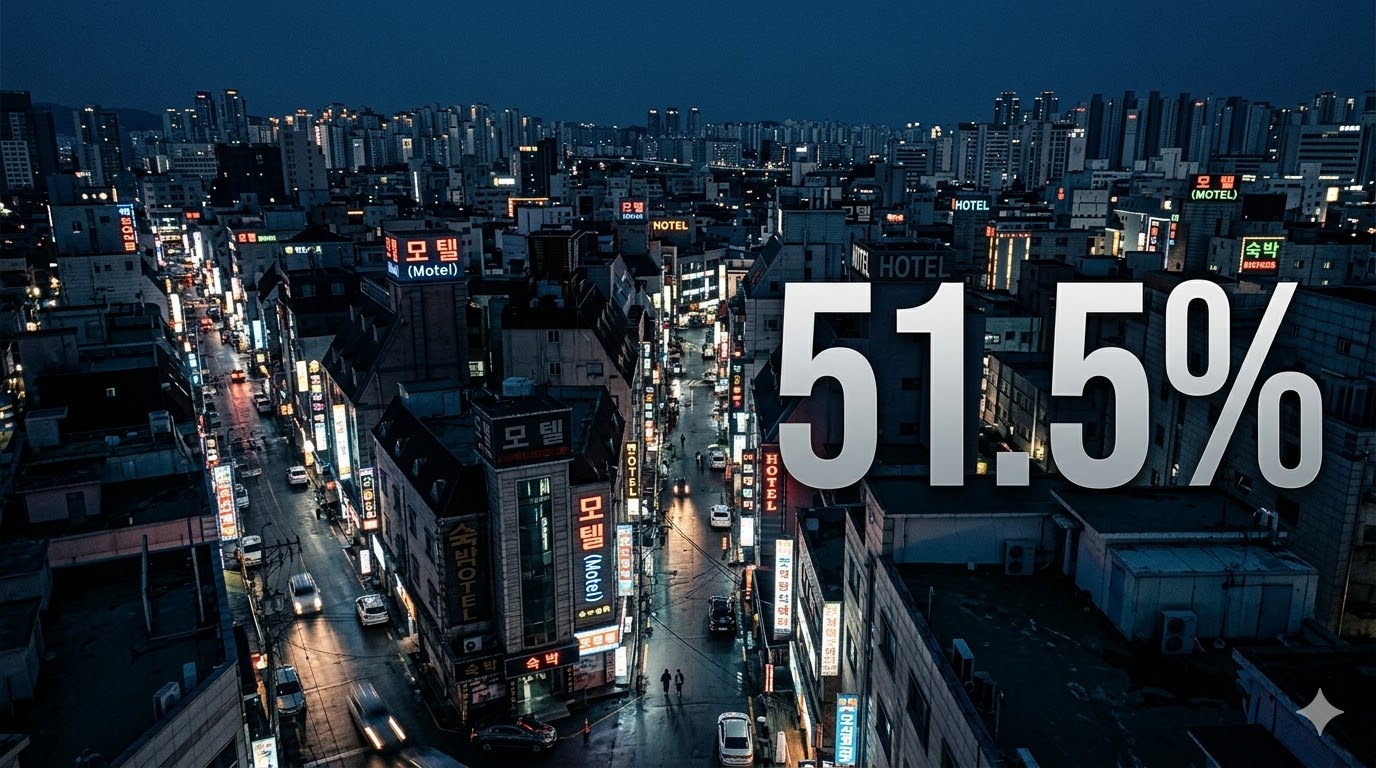
As of 2024, motels make up 51.5% of Korea's roughly 60,000 accommodation properties. That's over half the market. Yet the reality behind that number tells the opposite story. "It never used to be this hard." After 18 years in the hospitality industry and thousands of direct conversations with property owners, I've watched motel operators' faces grow noticeably darker over the past few years. Pouring tens of millions into renovations only to barely cover interest payments is no longer shocking news. The size of the number and the depth of the struggle are moving in opposite directions. That's the 51.5% paradox.
Without Platforms You're Dead, With Them You're Broke
Yanolja. Yeogi Eottae. Any motel owner feels conflicted about these names. Grateful, yet resentful. Without these platforms, there's no business. Over 80% of small to mid-sized motel revenue comes from here. Direct walk-ins are vanishing.
According to a 2024 Korea Federation of SMEs survey of 1,103 small businesses on online platforms, accommodation apps charge an average 11.5% commission (ranging 8-17%). Add monthly advertising costs averaging ₩1.08 million. Combined, about 20% of revenue goes to platforms. Sell a ₩50,000 room, at least ₩10,000 goes to the platform. Plus over ₩1 million in monthly ad spend.
Don't advertise? No one finds you. Competitors advertise, so ad costs spiral endlessly. This is a structural outcome predicted by platform economics. Korea is a closed market of 50 million. Domestic demand has growth limits. Once supply saturates, competition restarts inside the platform. The race for top placement becomes rent-seeking. Costs rise competing for a fixed pie; the pie itself doesn't grow.
What happened? The money spent on neon signs and flyers in the offline era simply shifted to burning ad budgets online. The battlefield changed. The war didn't end. Even the Fair Trade Commission recognizes the structural problem. In August 2025, they fined Yanolja and Yeogi Eottae ₩1.54 billion. Yeogi Eottae set coupon expiry at just one day, auto-expiring unused coupons. The value of expired coupons? ₩35.9 billion.
Cracks Appear in the Old Dayuse Formula
The core of motel profitability was dayuse. Or at least it used to be. Morning dayuse, afternoon dayuse, then overnight. Turning the room 2-3 times a day—that turnover rate was the essence of motel business. With occupancy needing to exceed 100% just to break even, dayuse wasn't optional—it was survival.
Ten years ago, motel owners said clearly: "Just capture couples." Back then, it was true. Now almost no one says it. The numbers tell the story. Korea's marriages hit an all-time low of 192,000 in 2022, less than half the 435,000 in 1996. Single-person households reached 8.045 million in 2024—36.1% of all households, up sharply from 27.2% a decade ago.
Dating itself has dropped. A 2024 PMI survey found 75.8% of single men and women in their 20s and 30s aren't currently dating. 25.5% have never dated. And they don't go out. OTT usage jumped from 41% in 2019 to 89.2% in 2024. Monthly delivery app users exceed 27 million. They stay home, watch Netflix, order delivery.
Motel dayuse was premised on "couples going out." That premise is crumbling. Motels aren't competing with the motel next door anymore. They're competing with "not leaving the house." To capture shrinking demand, you fight with facilities. Problem is, it doesn't last. Within 1-2 years you're "outdated," and staying relevant requires multi-million won reinvestments every 2-3 years.
Half the Market Is Missing a 20 Million Person Opportunity
This is what many motel owners already know. Platform fees are high. Dayuse isn't what it used to be. Everyone nods. But there's an opposite problem emerging on the other side.
According to the Korea Tourism Organization, foreign tourists visiting Korea hit 18.94 million in 2025. A record high. 2026 is set to break 20 million annually. K-pop, K-drama, K-beauty fandom is converting into actual tourism demand. Meanwhile supply is shrinking. In October 2025, Airbnb implemented mandatory registration, targeting 30,000-34,000 of the roughly 72,000 listed properties nationwide as unlicensed for delisting.
New supply is blocked. Seoul tourist hotel rooms grew 23.8% from 2016-2019, but only 3.7% from 2019-2025. With real estate PF crises and construction cost spikes freezing new permits and construction, hotel supply shortages are projected through 2029.
Demand at all-time highs. Airbnb supply down tens of thousands of rooms. Hotel construction stalled. Supply shortage is returning. Yet motels—half the market—stand unable to capture this massive opportunity. Foreigners can't book motels on Yanolja or Yeogi Eottae. Foreigners use global OTAs: Booking.com, Agoda, Airbnb, Expedia, Trip.com. Global OTA commissions from inbound tourism alone are estimated at ₩1 trillion annually.
But most motels aren't listed on these global OTAs. Half the market. Invisible to 20 million foreigners. That's the real 51.5% paradox. So what exactly must motels trapped in the domestic market prepare to capture this enormous inbound opportunity?
💡 Hospitality Trends
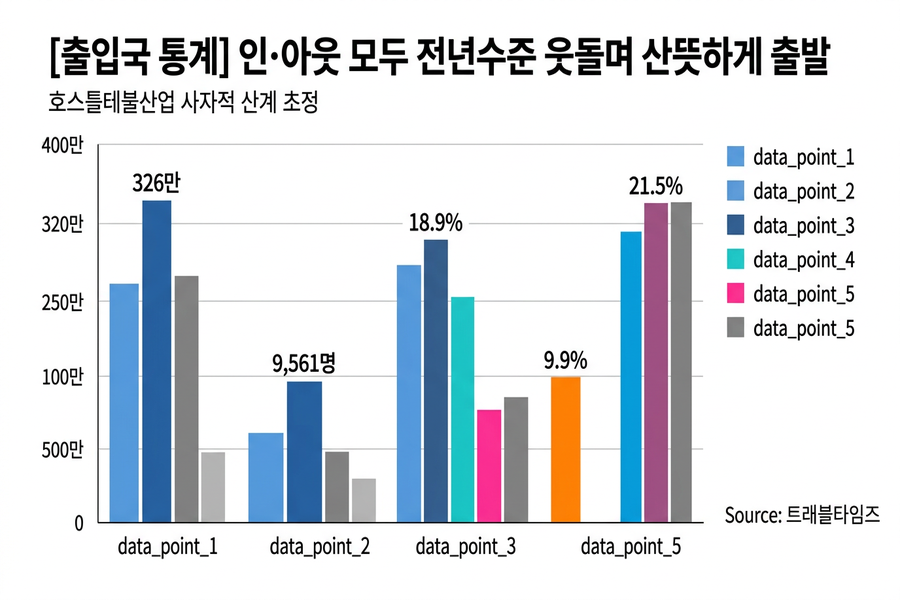
January 2026 opened with a fresh start for Korea's tourism market. According to Ministry of Justice immigration statistics, foreign arrivals exceeded 1.32 million—up 13.3% year-over-year—while Korean departures hit 3.27 million, up 9.9%. Notably, China and Japan showed clear recovery momentum. Chinese tourists increased 20.5%, Japanese tourists 29.4%, surpassing pre-pandemic levels. This isn't seasonal fluctuation—it signals structural recovery in Northeast Asia's tourism ecosystem. Operators should prepare for growing foreign guest demand and revisit service strategies tailored by nationality.
Key Data
Of January's 1,322,129 foreign arrivals, China led with 392,498—roughly 30%. Add Japan (267,091), Taiwan (170,243), Hong Kong (66,442), and the Greater China + Japan bloc comprises 63% of total arrivals. Japan's 29.4% growth reflects yen depreciation and K-content popularity synergizing.
For Korean outbound, Japan dominates at #1. 1,137,392 Koreans visited Japan—up 21.5% YoY—over double second-place Vietnam (485,331). China visits reached 303,498, surging 48.1%, driven by eased group tour restrictions and visa policy improvements. This two-way traffic growth signals the Korea-China-Japan tourism triangle is fully operational.
Market Impact
13.3% inbound growth translates directly into accommodation demand. Properties in Seoul, Busan, Jeju—foreign favorites—should feel occupancy rate lifts from Q1. Chinese tourists at 30% is strategic gold. They average 4.2-day stays versus Japan's 3.1, prefer shopping and dining, and drive strong regional economic multiplier effects.
Japanese tourist growth of 29.4% reflects FIT (Free Independent Traveler) trends. They prefer OTA bookings, value local experiences, and seek Instagram-worthy moments. This favors guesthouses, hanok stays, boutique hotels—personality-driven small properties.
Conversely, 9.9% Korean outbound growth intensifies domestic competition. A 21.5% jump in Japan travel means more consumers chose overseas over domestic. Korean accommodations must compete not just on price, but on delivering differentiated experiences.
Action Plan
First, strengthen multilingual support. Prepare Chinese and Japanese signage, check-in manuals. Adopt AI translation apps or chatbots to lower language barriers. Even basic Naver Papago or Google Translate integration significantly lifts satisfaction.
Second, audit your Chinese OTA presence. Verify listings on Trip.com, Fliggy. Add Alipay and WeChat Pay. Research shows 78% of Chinese tourists prefer mobile payments.
Third, design experiential content for Japanese travelers. K-beauty experiences, hanbok rentals, traditional market tours—Instagrammable elements in your area info attract Japanese FIT guests.
Fourth, build off-season strategies. January's strong start doesn't guarantee year-round performance. Prepare February-March packages, long-stay discounts ahead to smooth occupancy volatility.
Source: Travel Times
⌨️ Keyword News
1️⃣ Travel Industry Activates Emergency Response Amid Middle East Tensions 👉[Full Story]
TL;DR: Korea Travel Association and Seoul Tourism Association launched emergency response teams to ensure traveler safety and minimize industry damage as Middle East military tensions escalate.
The story: Korea Travel Association has operated emergency response teams since March 3, focusing on ▲tallying industry damage ▲ensuring safety and repatriation of travelers in the Middle East ▲requesting institutional support through government cooperation. The association requested emergency financial and tax support for the travel industry and pointed out that current travel insurance exempts war and disasters, failing to provide real protection—demanding coverage expansion. Seoul Tourism Association also formed dedicated units preparing for prolonged crisis and strengthened real-time info sharing with members. Accommodation operators running Middle East tour packages should review cancellation and refund policies.
2️⃣ Korea MICE Association Hosts 'MICE Business Plaza 2026' in Gwangju 👉[Full Story]
TL;DR: Korea MICE Association will hold a pre-matched, business-focused partnership event April 22-23 at Kim Dae-jung Convention Center in Gwangju.
The story: This event goes beyond networking—using the PSA platform for one-on-one business meetings. About 40 companies across MICE sectors participate as sellers, with pre-matched partners meeting onsite to boost actual contracting likelihood. Roughly 250 MICE industry professionals are expected. Separate promotional spaces accommodate member companies unable to attend. Day two features unique venue tours including the Asia Culture Center, showcasing regional MICE business models. Accommodation operators can explore partnership opportunities with MICE industry partners.
3️⃣ Discover Seoul Pass Hits 1.2M累積 Uses in 10th Anniversary 👉[Full Story]
TL;DR: Foreign-visitor-only tourism pass 'Discover Seoul Pass' reached 1.2 million累積 uses in 10 years, returning over ₩10 billion in settlements to partner attractions.
The story: Operated by Seoul Tourism Organization, Discover Seoul Pass bundles Seoul's major attractions with transport and telecom services, sold via global OTAs. When foreign visitors use the pass at partner facilities, settlements are paid proportional to usage. For accommodations, it's a channel to attract foreign guests without separate overseas marketing costs. Seoul Tourism Organization is recruiting new partner facilities through April 30, 2026—operators seeking foreign guest acquisition should consider joining.
4️⃣ Kota Kinabalu Route Records 86.5% Load Factor in December 👉[Full Story]
TL;DR: Incheon-Kota Kinabalu route's December load factor hit 86.5%, up 1.9%p MoM, with passenger count up roughly 7,000.
The story: Per Korea Transport Institute's December 2024 aviation stats, Kota Kinabalu carried the most Q4 passengers. Available seats grew 21.8%, passengers 27.8%. Korean LCCs excelled: t'way Air (93.1%), Jin Air (90.5%), Jeju Air (88.9%) near full. With Southeast Asian resort demand steady even in winter peak, Incheon-area accommodations should strengthen transit guest strategies.
5️⃣ Middle East Crisis Travelers Repatriated, Agencies Absorb Accommodation Costs 👉[Full Story]
TL;DR: Most of 1,700 stranded agency clients returned safely from Middle East tensions, but agencies absorbed local accommodation costs.
The story: Early March Middle East tensions closed airspace, stranding 1,700 clients from major agencies. Except ~200, all repatriated via Dubai-Incheon direct flight resumption. Hanatour, Modetour, Yellownballoon secured emergency connecting and direct flights. Problem: UAE government promised foreign tourist accommodation support but didn't deliver onsite—domestic agencies paid all extended stay costs. Industry calls for policy support for agencies that absorbed costs prioritizing customer safety. Operators running overseas tour packages need cost contingency plans for force majeure.